



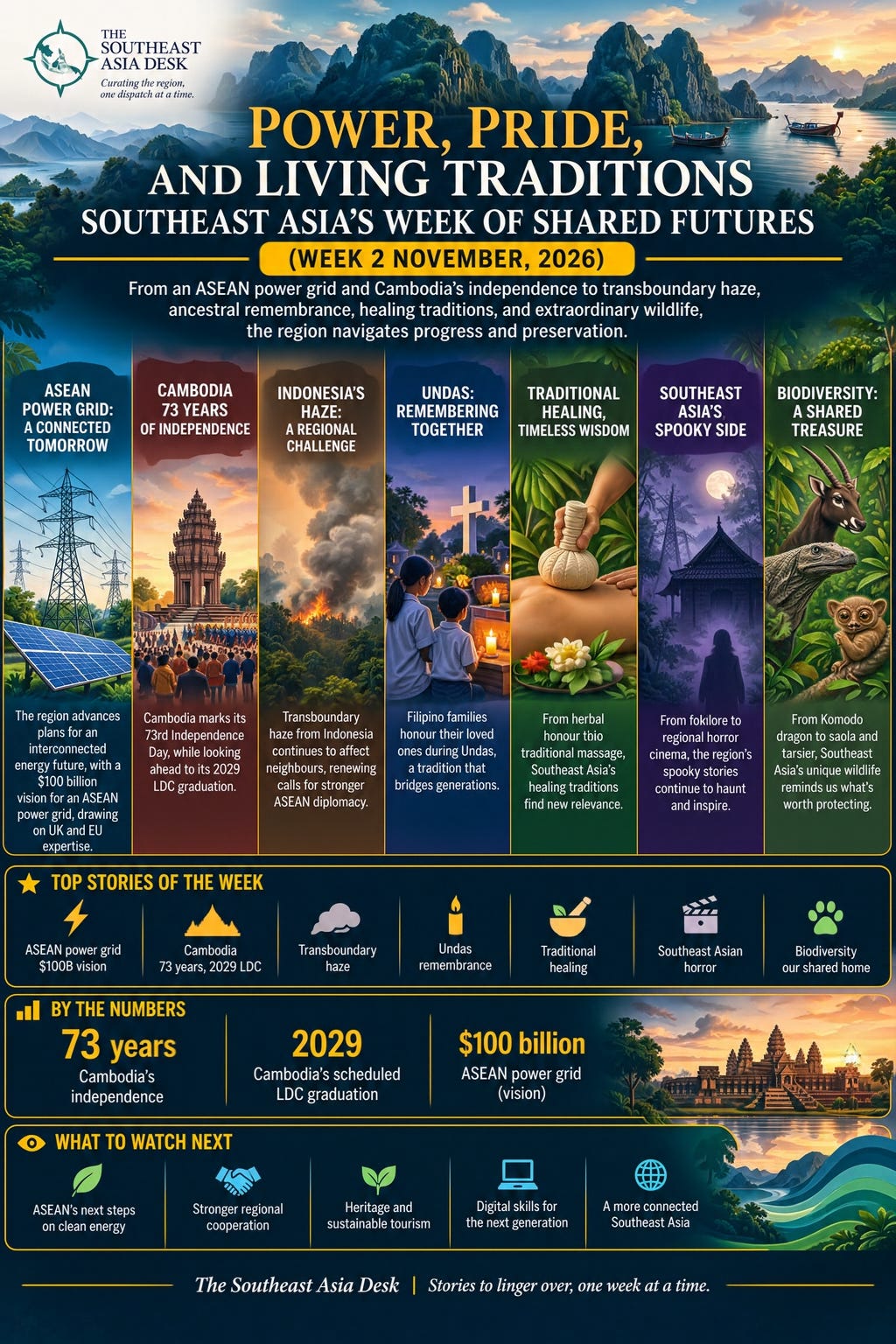
Your curated wrap-up from The Southeast Asia Desk.
✍️ Editorial Note
Hello and welcome back,
If this edition helps you see Southeast Asia a little differently, share it with someone who should be following the region more closely, and invite them to join us at The Southeast Asia Desk.
Southeast Asia spends a great deal of time thinking about the future: how to secure enough electricity, move economies up the development ladder, strengthen regional cooperation, and respond to environmental crises that cross national borders.
But the future here rarely arrives disconnected from the past.
Families still gather to honour their ancestors. Traditional healing practices remain part of everyday life. Local myths continue to inspire cinema. And some of the world’s most extraordinary animals survive in landscapes that have shaped communities for generations.
This week, we move between those two worlds — the systems Southeast Asia is trying to build and the traditions it continues to carry forward.
Thank you for joining us.
⚡ Building the ASEAN Power Grid Means More Than Building Cables
ASEAN’s electricity demand could more than double by 2050, making cross-border energy connectivity increasingly important to the region’s energy security and renewable transition.
ASEAN representatives recently visited the United Kingdom and the European Union to study how interconnected electricity markets work in practice. The lessons went beyond physical infrastructure: a functioning ASEAN Power Grid will also require compatible regulations, skilled engineers and system operators, financing, and trusted institutions that can coordinate across borders.
With existing international partners supporting regional connectivity financing and ambitions for far greater investment ahead, the challenge now is turning ASEAN’s long-discussed grid vision into an operational regional system.
Read more:
https://www.thesoutheastasiadesk.com/p/asean-power-grid-uk-eu-study-visit-2050-energy
🌫️ Haze Keeps Testing the Limits of ASEAN Cooperation
Indonesia’s recurring forest and land fires have once again spilled over its borders, affecting air quality and daily life in Malaysia and Singapore.
ASEAN already has a regional agreement on transboundary haze, but the crisis exposes a familiar institutional tension. Member states are expected to cooperate while respecting sovereignty, consensus, and non-interference—principles that can limit how forcefully neighboring countries respond when the source of a problem lies inside another state.
Recent responses are becoming more concrete, from Malaysia’s push for stronger regional discussion to Singapore’s actions involving companies suspected of links to fires. Yet the recurring haze shows why environmental diplomacy remains one of ASEAN’s most persistent tests.
Read more:
https://www.thesoutheastasiadesk.com/p/indonesia-transboundary-haze-asean-diplomacy-crisis
🇵🇭🇺🇸 Is the Philippines Moving Too Close to the United States?
Under President Ferdinand Marcos Jr., the Philippines has moved markedly closer to the United States, particularly in defense and security cooperation. In this week’s Regional Line, Ronaldo Palad argues that this shift goes beyond strategic alignment and risks eroding the Philippines’ long-standing pursuit of strategic autonomy.
The commentary examines expanded U.S. military access under the Enhanced Defense Cooperation Agreement, deeper security coordination, critical-mineral and supply-chain initiatives, and Manila's changing political environment. Palad contends that these developments are increasingly embedding the Philippines within Washington’s wider competition with China — raising a larger question about how much room Manila retains to pursue an independent foreign policy amid intensifying Indo-Pacific rivalry.
Read more:
https://www.thesoutheastasiadesk.com/p/philippines-us-alignment-marcos-foreign-policy-analysis
🇰🇭 Cambodia Marks Independence With Another Transition Ahead
Cambodia celebrated its 73rd Independence Day on 9 November, commemorating the transfer of full sovereignty from France in 1953.
This year’s anniversary also comes as the country prepares for another milestone: its scheduled graduation from the United Nations’ Least Developed Country category in 2029. Cambodia qualified after meeting income, human-assets, and economic-vulnerability criteria across successive UN reviews.
Graduation reflects decades of development, but it also brings new challenges. Cambodia will have to prepare for changes in some preferential financing and development arrangements while navigating slower growth, energy pressures, tourism vulnerabilities, and the need to diversify beyond traditional manufacturing strengths.
Independence, in that sense, remains an evolving story — increasingly tied to economic resilience and the ability to compete on different terms.
Read more:
https://www.thesoutheastasiadesk.com/p/cambodia-73rd-independence-day-2029-ldc-graduation
☕ Weekend Brew
🕯️ Undas: When Remembrance Becomes a Family Reunion
Every 1 and 2 November, millions of Filipinos observe Undas, gathering to remember family members who have passed away.
Families travel home, clean and decorate graves, light candles, pray, bring food, and spend time together in cemeteries. The observance combines Catholic traditions surrounding All Saints’ and All Souls’ Days with older Filipino understandings of ancestors and the continuing relationship between the living and the dead.
That blending of beliefs is what makes Undas especially revealing. It is not simply a religious holiday, but a tradition shaped by indigenous practices, Spanish colonialism, trans-Pacific cultural exchange, and the enduring importance of family.
Read more:
https://www.thesoutheastasiadesk.com/p/undas-ancestral-traditions-southeast-asia-guide
💆 Coins, Banana Leaves, and Herbal Compresses
Long before wellness became an industry, Southeast Asian communities had their own ways of dealing with sore muscles, fatigue, and everyday discomfort.
There is kerokan and its regional relatives, where the skin is scraped with a coin or similar object; the Filipino tradition of hilot, combining massage, oils, medicinal plants, and other practices; and Thailand’s luk pra kob, in which heated herbal compresses are pressed onto the body.
These practices reveal how local environments, beliefs, and inherited knowledge continue to influence ideas about wellbeing. They are best understood as traditions of comfort and wellness, not substitutes for appropriate medical care.
Read more:
https://www.thesoutheastasiadesk.com/p/traditional-remedies-science-kerokan-hilot-luk-pra-kob
👻 Southeast Asia Already Has Plenty of Reasons to Be Scared
Halloween may be imported, but Southeast Asian horror certainly is not.
Recent releases from Cambodia, Indonesia, Malaysia, and the Philippines show how filmmakers continue to draw on local supernatural traditions, histories, and anxieties. Indonesia’s Pirunduk, for example, draws on Banjar mystical beliefs in South Kalimantan, while Malaysia’s Giring draws on a belief associated with the Bandau community in Sabah.
Others demonstrate that horror does not always require ghosts. Family trauma, violence, and painful secrets can be just as unsettling.
The result is cinema that entertains while preserving — and sometimes reinventing — stories rooted deeply in particular communities.
Read more:
https://www.thesoutheastasiadesk.com/p/spooky-october-southeast-asias-horror
🎧 The Dispatch Podcast: Dragons, Unicorns, and Tiny Primates
Southeast Asia sometimes sounds like the setting of a fantasy story, except the creatures are real.
This week’s Weekly Dispatch Podcast introduces some of the region’s most extraordinary wildlife, from Indonesia’s Komodo dragon and the elusive saola of Vietnam and Laos to the Philippine eagle and Borneo’s surprisingly accomplished swimming proboscis monkey.
Their unusual characteristics are fascinating, but the episode carries a more serious message too. Habitat loss, hunting, climate change, and slow reproduction threaten several of these species, turning the region’s remarkable biodiversity into an urgent conservation story.
Listen here:
https://www.thesoutheastasiadesk.com/p/extraordinary-animals-southeast-asia
✍️ Closing Note
This week offers two very different ways of thinking about resilience.
One is institutional: building electricity grids that connect countries, preparing Cambodia for a new development category, and finding better regional responses when haze crosses borders.
The other is quieter.
It exists in families returning to cemeteries every November, remedies passed down from one generation to another, stories transformed into films, and communities living alongside species found almost nowhere else on Earth.
Southeast Asia changes quickly. But it also carries remarkable continuity.
Perhaps understanding the region requires watching both at once: what it is becoming and what it refuses to forget.
Thank you for reading, sharing, and continuing to explore Southeast Asia with us.
Until next week, take care, stay curious, and keep looking beyond the headlines.
✨ Stories to linger over, one week at a time.
(QOB)