



🎯 The Main Takeaway
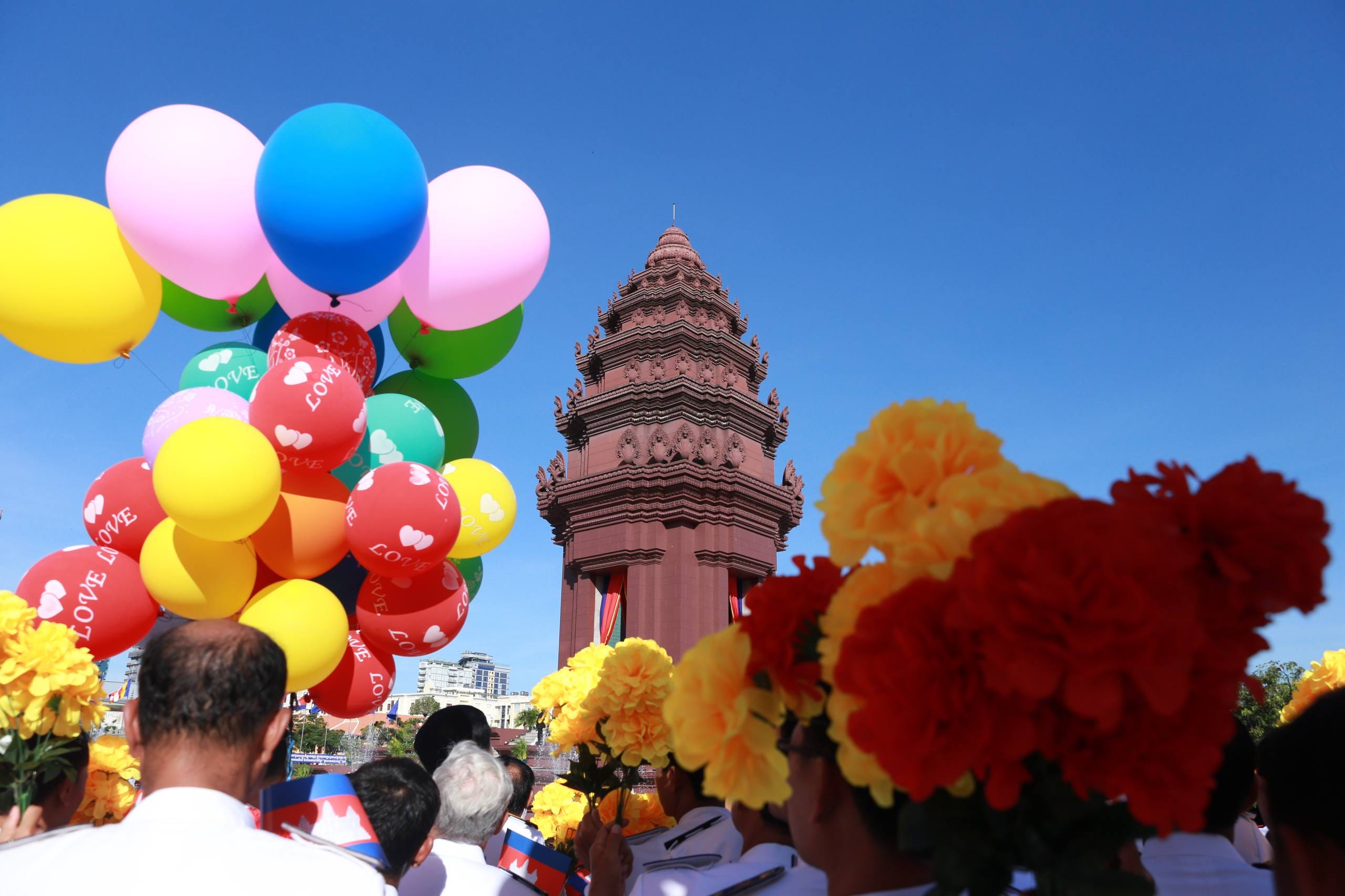
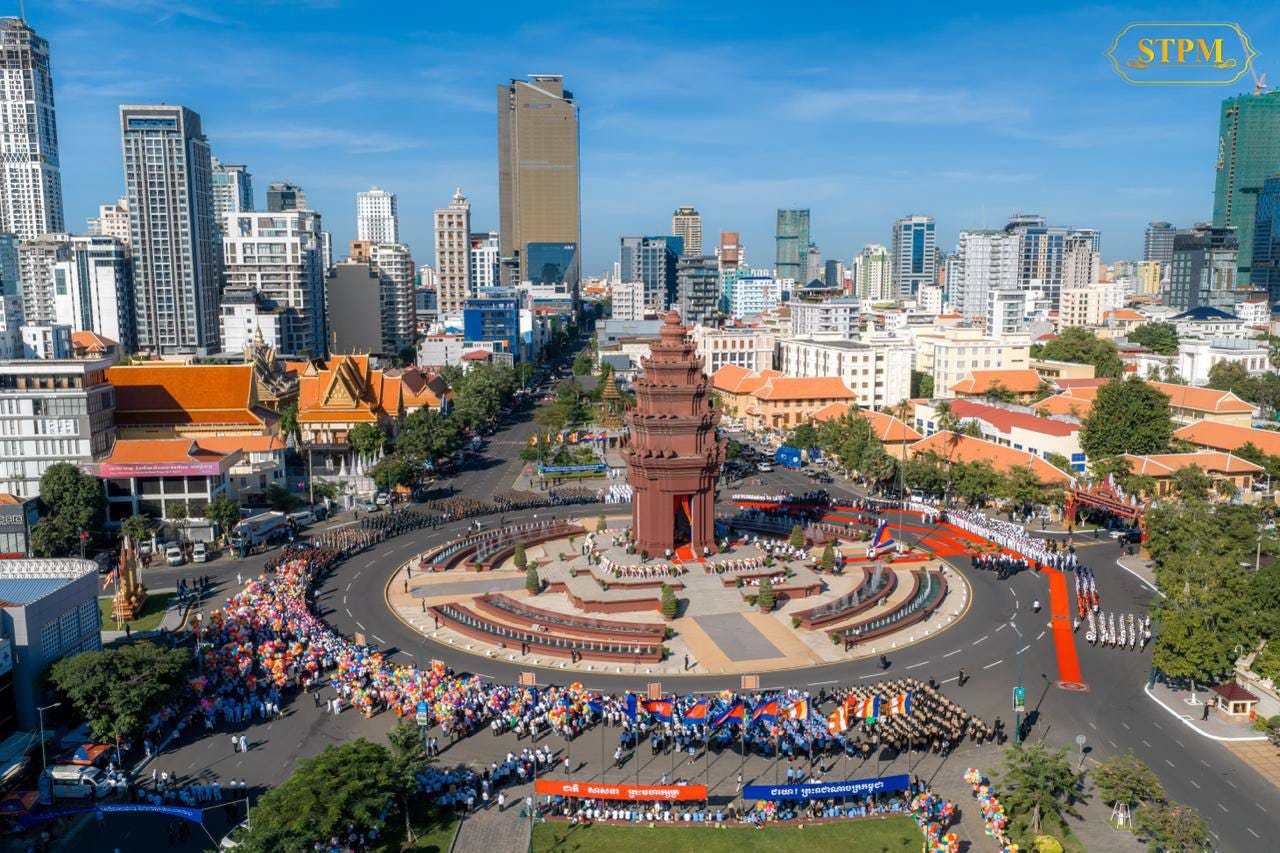
On 9 November 2026, Cambodia marked its 73rd National Independence Day, commemorating its independence. Cambodia held an official ceremony at the Independence Monument in Phnom Penh, with thousands in attendance.
Celebrations are concentrated in Phnom Penh, with government buildings and schools across the country holding flag-raising ceremonies as a palpable sense of national pride fills the air.
Beyond Cambodia, celebrations are also taking place in Cambodian diaspora communities worldwide. In Long Beach, Paris, and Melbourne, Khmer associations would host flag-raising ceremonies at city halls, keeping the nation’s pride alive for the generations of Cambodian’s living abroad
Additionally, many world leaders sent congratulatory messages to Cambodia. This includes leaders from across Asia, Europe, the Middle East, the Americas, and Oceania, reflecting Cambodia’s diplomatic relationships, which are also a major factor in its independence.
Moreover, Cambodia marks its anniversary with developmental growth that shows its readiness for greater self-sufficiency, which will be officially marked through the United Nations in 2029.
⌛ The Making of a Nation: From Colony to Independence
Unlike many independence movements marked by armed conflict. Cambodia gained sovereignty largely through diplomacy, spearheaded by a young king.
In 1863, Cambodia became a French protectorate and remained one for 90 years. Colonial rule suppressed Cambodia’s autonomy and extracted economic resources for French benefit. This left many sectors, such as education, the judicial system, and health, barely improved in Cambodia.
The turning point came in 1941 with the rise of King Norodom Sihanouk, who, in 1953, dissolved the National Assembly, which had suffered from factionalism and an inability to influence French policy. This move would centralise the nation’s power in the king, who would govern through decrees
Sihanouk then embarked on what he called the “Royal Crusade for Independence”, travelling to France and many other countries to pursue a non-violent campaign to gain mass support overseas for Cambodia’s independence, while also putting pressure on France.
This move was successful: on 9 November 1953, France formally transferred full sovereignty to Cambodia, and the nation gained independence.
📈 The Economic Story: Economic Classification and Development
Category Graduation:
In 2024, the United Nations General Assembly adopted a resolution confirming that Cambodia would graduate from the Least Developed Country (LDC) category in 2029, a status it has held since 1991.
Cambodia achieved this by meeting the specific economic and social development criteria at two consecutive triennial reviews conducted by the UN Committee for Development Policy (CDP). These include:
Gross National Income per capita.
Human Assets Index.
Economic Vulnerability Index.
Since the announcement, Cambodia has taken steps to intensify its reforms and strategies to boost its appeal to both domestic and international financiers with the aim of increasing foreign direct investment (FDI) and promoting Cambodian-made products.
Economic Growth:
With a Gross Domestic Product (GDP) growth of 3.0% in 2026, according to the International Monetary Fund (IMF). Cambodia is showing economic growth in preparation for its graduation.
The manufacturing industry remains the main driver of this growth.
According to the April 2026 Asian Development Outlook (ADO), Cambodia’s manufacturing industry will remain the primary growth engine in 2026, with industrial output expected to grow by 7.3%. This is largely due to garment manufacturing, where Cambodia exported 15.5 billion USD worth of products in 2025, a 15.7% year-on-year increase.
However, the electronics manufacturing sector is also growing: in 2025, Cambodia exported electronic equipment and parts valued at 924 million USD, a 35.7% increase from 2024.
🏃 The Challenges Ahead: In the Short Term and Long Term
Short-term: border dispute & energy crisis
The service industry, such as tourism in Cambodia, is taking a hit from the border conflict between Cambodia and Thailand. As projected by ADO, the industry is expected to slow from 3.4% growth in 2025 to 2.3% in 2026.
Additionally, according to the IMF, higher energy costs from the conflict in the Middle East are disrupting Cambodia's energy and trade, and the IMF forecasts economic growth to slow to 3.0%, with inflation expected to remain elevated at 5.6% in 2026. Moreover, potential disruptions from El Niño conditions could also impact Cambodia’s economy.
Long-term: the impact of graduating from LDC
Despite Cambodia’s potential graduation from LDC status in 2029, it is official proof that the country has developed to the point of reaching self-sufficiency. Graduating from the category also comes with its challenges.
Beyond the requirement to stay on track within the criteria to graduate, there are also challenges for Cambodia after graduation that the country needs to prepare in advance for:
Borrowing funds: Many countries, such as Japan, Korea, Germany, and France, have their own terms for lending funds based on LDC status. Some countries give more favourable terms to countries under LDC status, which could impact graduating countries.
Multilateral funding: Most international institutions do not consider LDC status when deciding how much to lend or grant. A few, including UNDP, the Global Environment Facility and the Asian Development Bank, treat it as a secondary factor that gives LDCs somewhat more favourable allocations or terms, which could impact Cambodia’s access to those benefits once it graduates.
Specific LDC programmes: Certain programmes are limited to countries with LDC status, most importantly the Least Developed Countries Fund (LDCF), which pays for climate adaptation projects. Once it graduates, Cambodia would no longer be able to access this fund. However, projects approved before graduation still continue to be funded until finished.
Contribution to the International Community: Graduating would make Cambodia’s participation in international bodies more expensive and less subsidised. The UN’s economic affairs department estimates that Cambodia would pay about $131,000 more a year in mandatory contributions, mostly to the International Telecommunication Union and to peacekeeping. Additionally, Cambodia would lose some LDC-specific help for sending delegates to international meetings.

🏠 Why This Hits Home
For ordinary citizens of Cambodia, it’s not just a day off; Cambodia’s Independence Day reminds them how important sovereignty is, reflects how far the country has come, and shows its continued strides toward further progress.
For many rural Cambodian’s who rarely travel, the live broadcast of the ceremony is their clearest view of the royal family, the government, and the armed forces of their nation.
For families who do decide to travel, the day is treated as a mini holiday, as families would raise the occupancy rate of hotels near the celebration, and street vendors would be blessed by the increased earnings from travellers
🏁 The Bottom Line
With many challenges still remaining before and even after Cambodia graduates from its status as an LDC, Independence Day becomes a moment of reflection for the country’s government and citizens on the long struggle it took to gain the nation’s sovereignty.
Both the movement to gain independence and the climb to graduate from LDC status reflect Cambodia’s persistence in improving itself toward self-reliance.
🔍 Need More Angles?
ADB Cambodia’s Economy to Grow by 4.5% in 2026 Under an Early Middle East Stabilization Scenario
Cambodia Government Cambodia Celebrates 73 Years of Independence Day from France | អង្គភាពព័ត៌មាន និងប្រតិកម្មរហ័ស
Cambodia Kingdom Cambodia Independence Day — ទិវាឯករាជ្យជាតិ
CambodiaNess Cambodia Marks 73 Years of Independence as World Leaders Send Congratulations
Eventguide Cambodia Independence Day: Why It Matters & How to Observe
IEA Southeast Asia’s energy challenges and emerging opportunities
IETSTOCK Cambodia eyes new growth path as 2029 LDC graduation nears
IMF 2026 ARTICLE IV CONSULTATION—PRESS RELEASE AND STAFF REPORT
The Star Cambodia strengthens efforts to attract FDI amid Least Developed Country status-graduation plans
UN Committee for Development Policy The 2024 triennial review of the list of least developed countries
UN Department of Economic and Social Affairs Potential impacts of LDC graduation on development cooperation in Cambodia, Comoros, Djibouti, Senegal, and Zambia: Preliminary assessment, by Marcia Tavares (CDP Background Paper No. 53)
Worldometer Cambodia GDP (2026)
(FRD/QOB)