



🔥 Forest fires, once again…
Indonesia's forest fires have once again sent haze across national borders, affecting Malaysia and Singapore, and prompting renewed calls for regional cooperation.
The fires are concentrated in Borneo and Sumatra, but the consequences are traveling across borders and affecting public health, schools, transport, and daily life.
The regional impact extends beyond Indonesia’s efforts to extinguish the fires.
As the haze crosses national borders, it is placing greater pressure on neighboring countries and ASEAN to respond while respecting Indonesia’s sovereignty.
The region pays more attention to this issue because ASEAN already has the 2002 ASEAN Agreement on Transboundary Haze Pollution, which entered into force in 2003 and provides a framework for monitoring, prevention, emergency response and cross-border assistance.
Yet the agreement operates within ASEAN’s familiar principles of consensus, sovereignty and non-interference, limiting how directly one member state can intervene in another’s territory.
Read our initial dispatch on this issue:
The Southeast Asia Desk Indonesia’s wildfire crisis: Haze spreads across Southeast Asia as health risks mount
🚪 The Regional Impacts
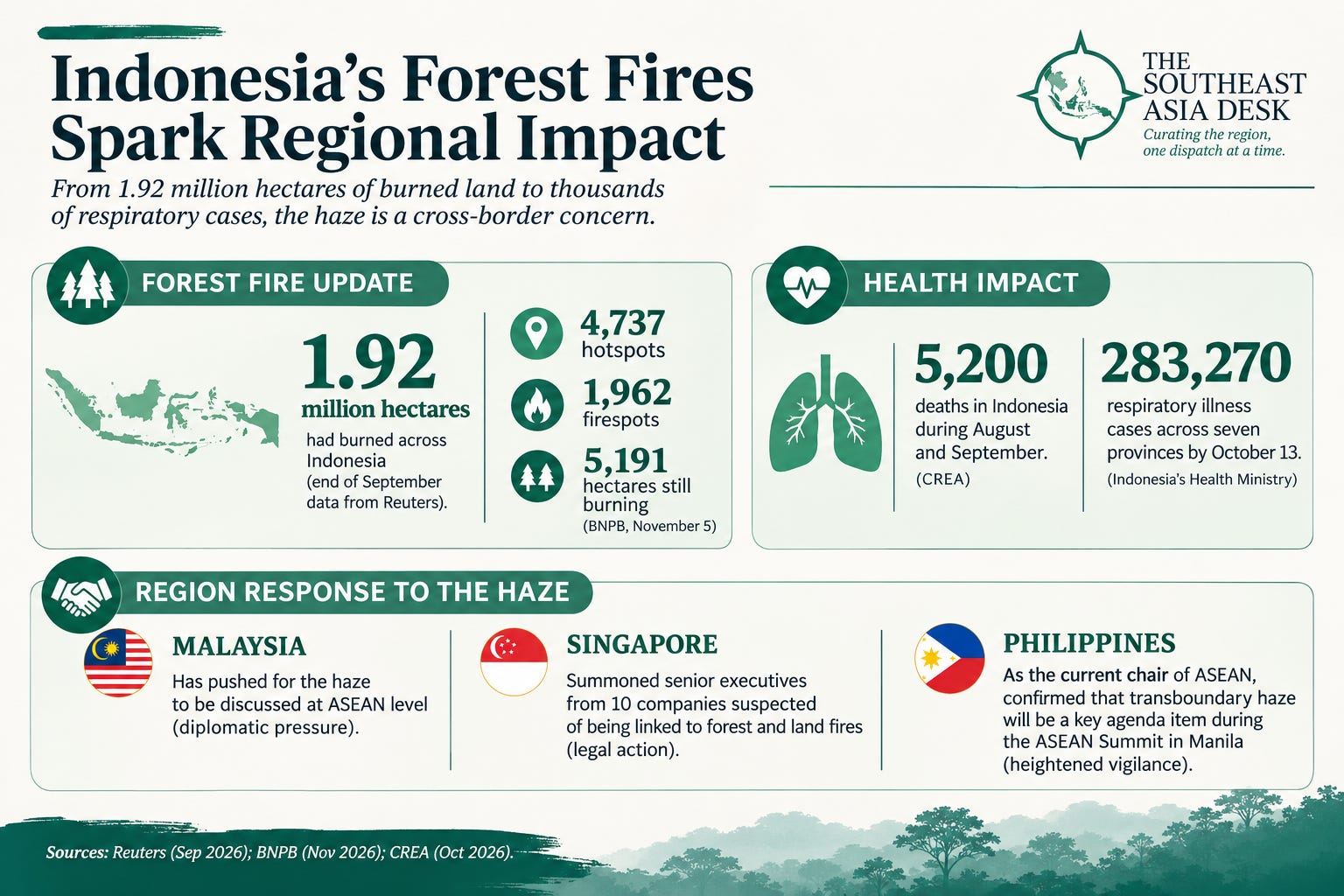
The scale of Indonesia's forest fires has made the haze a regional concern.
By the end of September, approximately 1.92 million hectares had burned across Indonesia, according to Nusantara Atlas satellite data cited by Reuters.
The health impact is also significant. Indonesia’s Health Ministry recorded 283,270 respiratory illness cases across seven provinces by October 13, while haze from fires in Sumatra and Borneo affected air quality in Malaysia and Singapore, disrupting schools, flights and daily activities.
The regional response is also becoming more concrete.
Malaysia has pushed to discuss the haze at the ASEAN level, while exploring a bilateral agreement with Indonesia covering hotspot data sharing, high-risk areas, and early fire prevention.
Singapore has summoned senior executives from 10 companies suspected of links to forest and land fires as part of its efforts to address transboundary haze under its Transboundary Haze Pollution Act.
The Philippines, as the 2026 ASEAN chair, has also confirmed that transboundary haze will be included in the agenda of ASEAN foreign ministers’ preparatory meetings in November, ahead of the 49th ASEAN Summit in Manila.
🇮🇩 Indonesia and the Politics of Foreign Aid
Foreign assistance has become one of the clearest examples of the political sensitivity surrounding the haze.
Malaysia offered Indonesia three helicopters, an aircraft and 52 personnel to help fight the fires. Singapore also offered assistance.
On 16 October, Indonesian Foreign Minister Arrmanatha Nasir said President Prabowo Subianto had approved accepting assistance from neighboring countries, with Indonesia’s disaster agency discussing how the support could be deployed.
The central government has also taken a measured position on foreign assistance. Officials have also stressed that the country remains capable of managing the fires with its own resources and that accepting foreign assistance involves technical and operational considerations.
That distinction matters.
For Jakarta, accepting help can be interpreted not simply as a practical firefighting decision, but as a question of sovereignty, national capacity and diplomatic perception.
🇲🇾🇸🇬 Malaysia and Singapore’s Positions
Malaysia and Singapore have taken broadly cooperative approaches, but their responses show different priorities.
🇲🇾 Malaysia: Cooperation, but stronger regional mechanisms
Malaysia has repeatedly offered assistance to Indonesia for stronger ASEAN coordination.
Prime Minister Anwar Ibrahim said Malaysia remained ready to assist Indonesia and proposed an ASEAN-level cooperation mechanism to strengthen coordination, preparedness and collective action on transboundary haze.
Foreign Minister Mohamad Hasan has also said Malaysia will raise the issue at an ASEAN meeting, arguing that haze requires special attention because it is not covered by existing ASEAN natural disaster mechanisms.
Malaysia’s position therefore combines solidarity with pressure for stronger regional action.
🇸🇬 Singapore: Assistance alongside accountability
Singapore offered Indonesia assistance, but it is taking a more explicit approach towards corporate accountability.
Singapore’s National Environment Agency announced that it would issue preventive measure notices to ten companies in Indonesia linked to fires contributing to the current haze. The notices require companies to take steps to extinguish or prevent fires and submit action plans.
Singapore has also indicated that further measures under its Transboundary Haze Pollution Act remain possible, including fines or charges if the legal requirements are met.
Malaysia is emphasising stronger regional cooperation, while Singapore is combining cooperation with domestic legal tools aimed at companies linked to the pollution.
Both approaches face the same underlying problem: enforcement depends on Indonesia's cooperation.
📱 The Role of Public Pressure

Public pressure has become another factor shaping the regional response to the haze, with demonstrations emerging in Indonesia and Malaysia as communities demand stronger action and greater accountability.
In Jakarta, Greenpeace Indonesia activists climbed the Welcome Monument at Bundaran HI on October 20, unfurling banners criticizing the government’s response to the climate crisis and worsening disasters.
Six activists were detained after displaying the banners, AFP and CNA reported.
The action came alongside student demonstrations in Jakarta and several other Indonesian cities calling for stronger government action on the fires and for the disaster to be declared a national emergency.
In Malaysia, civil society groups have also taken their concerns directly to Indonesian and Malaysian authorities.
On September 4, Greenpeace Malaysia and Himpunan Advokasi Rakyat Malaysia (HARAM) held a protest outside the Indonesian Embassy in Kuala Lumpur, calling for the disclosure of fire locations, concession ownership and investigation findings related to companies potentially linked to the fires.
The pressure continued in October, when Greenpeace Malaysia, HARAM and other civil society groups marched from Tugu Negara to Parliament on October 7, calling for stronger Malaysian legal powers to investigate companies linked to environmental damage across borders. The groups also urged the Malaysian government to develop a dedicated legal framework addressing transboundary haze.
The public conversation can therefore reinforce diplomatic pressure.
When citizens in one country are breathing pollution generated across a border, government statements about sovereignty can become harder to sustain politically without visible regional action.
🏁 What’s next?
The haze is not simply a recurring environmental problem. It is a stress test for Southeast Asia’s model of regional cooperation.
ASEAN has had a transboundary haze agreement for more than two decades, but the current crisis is again exposing the gap between regional commitments and the ability to enforce them across national borders.
Indonesia needs a real and more effective solution to manage fires within its territory, while Malaysia and Singapore need to protect their populations from pollution that does not stop at the border.
The immediate solution may be more firefighting, information sharing and assistance.
ASEAN faces pressure to strengthen mechanisms to prevent and respond to transboundary environmental crises while maintaining the bloc’s principles of sovereignty and consensus.
🔎 Need More Angles
BBC Who’s to blame for the toxic haze choking South East Asia?
CNA Singapore to send haze prevention notices to 7 companies in Indonesia responsible for fires
Kompas Malaysia and Singapore Offer to Assist with Fire Management, Menko Polkam: Welcome
Mongabay ‘Perpetuating stupidity’: Indonesia comes under fire for response to burning and haze
Reuters Indonesia’s burned land doubles in September as fires rage, data shows
(NML)