



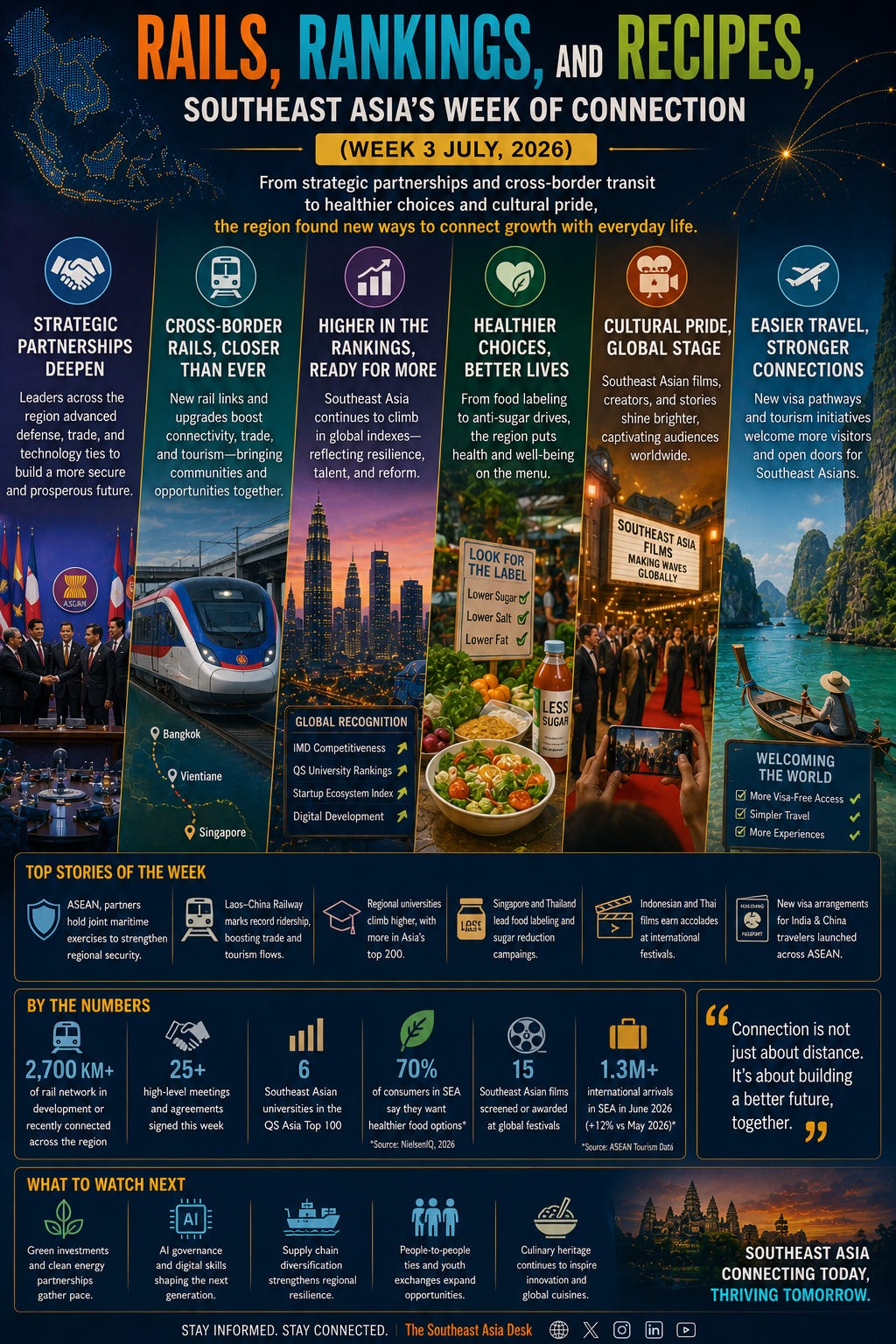
Your curated wrap-up from The Southeast Asia Desk.
✍️ Editorial Note
Hello and welcome back,
This week’s stories show how connection can take many forms.
It can emerge through a new rail line that brings neighboring communities closer together, a strategic partnership linking two major Indo-Pacific countries, or a familiar recipe that connects younger generations with their cultural heritage.
Across Southeast Asia, progress is rarely only about building faster systems or achieving higher rankings. It is also about making growth more useful, inclusive, and meaningful for the people who experience it.
Thank you for spending part of your week with us. We hope this edition offers a thoughtful and enjoyable look at the changes unfolding across our region.
🇮🇩🇮🇳 India and Indonesia elevate their strategic partnership
India and Indonesia are moving their relationship beyond diplomatic symbolism. During Indian Prime Minister Narendra Modi’s July 2026 state visit, the two countries signed 20 agreements covering defense manufacturing, critical minerals, digital payments, economic cooperation, and cultural conservation.
The deeper partnership connects Indonesia’s maritime ambitions with India’s growing role in the Indo-Pacific, while reflecting both countries’ desire for greater strategic and economic autonomy.
🚆 The Singapore–Johor RTS link nears completion
The long-awaited Rapid Transit System Link between Johor Bahru and Singapore has reached approximately 90 percent completion. Once operational, the four-kilometer route is expected to reduce a journey that can take several hours by road to a five-minute rail crossing.
Beyond easing the daily experience of cross-border workers, the project could strengthen the Johor–Singapore Special Economic Zone and demonstrate how infrastructure can bring two closely connected economies even closer.
Read more:
https://www.thesoutheastasiadesk.com/p/singapore-johor-rts-link-construction-progress-impact
📊 Singapore sets Southeast Asia’s competitiveness benchmark
Singapore once again leads Southeast Asia in the 2026 IMD World Competitiveness Ranking, supported by strong business efficiency, infrastructure, workforce productivity, and investor confidence.
The wider regional results reveal a more uneven picture. Southeast Asian economies must strengthen institutions, public trust, human capital, and economic resilience to remain competitive amid geopolitical disruption and shifting investment patterns.
Read more:
https://www.thesoutheastasiadesk.com/p/imd-world-competitiveness-ranking-2026-southeast-asia
🥗 Food labels make health choices easier
Indonesia introduced its Nutri-Level front-of-package labeling system in April 2026, joining Singapore, Malaysia, and Thailand in making nutritional information easier for consumers to understand.
The initiative begins with ready-to-drink beverages and uses a graded system to show their levels of sugar, salt, and fat. While implementation is still developing, clearer labels could help consumers make quicker decisions and encourage companies to produce healthier options.
Read more:
https://www.thesoutheastasiadesk.com/p/food-labels-for-health-why-southeast
🍽️ Heritage 2.0: Traditional food becomes an economic force
Traditional Southeast Asian cuisine is enjoying a revival driven by younger consumers, social media, specialty ingredients, and renewed pride in local identity.
From Indonesian kue basah and Filipino heritage ingredients to Vietnamese culinary certification, ancestral food is increasingly being treated not only as cultural memory but also as intellectual property and economic opportunity. The challenge is ensuring that recognition and revenue also reach the farmers, artisans, and communities who preserve these traditions.
Read more:
https://www.thesoutheastasiadesk.com/p/heritage-2-0-economic-rise-southeast-asian-cuisine
☕ Weekend Brew
🧗 Meet Desak Made, Indonesia’s speed-climbing star
Balinese climber Desak Made Rita Kusuma Dewi continues to establish herself among the world’s best. Her recent World Cup victories and place among the top-ranked women in speed climbing add to a journey that began with a childhood introduction to the sport in Singaraja.
Beyond the medals, her story offers something equally valuable: an example for young athletes—especially girls—who may not yet see themselves represented on the world’s biggest sporting stages.
Read more:
https://www.thesoutheastasiadesk.com/p/meet-desak-made-indonesias-speed
☕ From local beans to global café icons
Southeast Asia has long been one of the world’s great coffee-producing regions. It is now building an equally confident café culture of its own.
Across Jakarta, Bangkok, Ho Chi Minh City, Kuala Lumpur, and Singapore, cafés have become workplaces, social spaces, cultural landmarks, and travel destinations. Local beans are no longer simply exported—they are increasingly roasted, served, and celebrated at home.
Read more:
https://www.thesoutheastasiadesk.com/p/from-local-beans-to-global-fame-how
🎧 The Dispatch Podcast: Floating traditions
In this week’s episode, we visit five Southeast Asian communities where rivers, lakes, and seas remain part of everyday life.
From Indonesia’s Bajo Mola and Brunei’s Kampong Ayer to floating and stilt-house communities in Cambodia and Thailand, these villages preserve knowledge of living with water rather than simply controlling it. Their survival also depends on how the region responds to climate change, tourism, and urban development.
Listen here:
https://www.thesoutheastasiadesk.com/p/s26e23-5-floating-villages-keeping
✍️ Closing Note
This week reminded us that Southeast Asia’s future is being built through both major agreements and small everyday choices.
It can be seen in the trains crossing borders, the partnerships connecting countries, the labels helping families understand their food, and the recipes, cafés, athletes, and waterborne communities carrying regional identity forward.
We know that no single newsletter can capture everything happening across such a diverse region. Still, we hope these stories help make its changes feel a little clearer, closer, and more human.
Thank you for reading, sharing, and continuing this journey with us.
Until next week, take care and stay curious.
✨ Stories to linger over, one week at a time.
(QOB/ELS)