



🎯 The Main Takeaway
The International Institute for Management Development (IMD) published its latest World Competitiveness Ranking 2026 on June 18.
The annual report ranks 70 countries across multiple regions and serves as a key reference for governments, policymakers, business leaders, and investors to make informed decisions and strengthen future competitiveness.
It evaluates each country’s resources, policies, and overall competitiveness to support long-term value creation and drive sustainable economic prosperity.
📡 Why It’s on Our Radar?
Several global challenges continue to shape the international landscape, including:
Regional Conflicts: Ongoing tensions and armed conflicts involving Israel and Iran, Russia and Ukraine, China and Taiwan, the United States and Venezuela, the Korean Peninsula, the South China Sea, and several countries in Africa.
Power Rivalry: Political, economic, and technological competition among major powers, especially the United States, China, and Russia, is increasing global fragmentation.
Legal Decline: Many countries are increasingly ignoring international norms and legal commitments, weakening public trust in governments and legislative institutions.
📉 As the Result…
Several global impacts have emerged as a result of these developments, including:
Global Uncertainty: Ongoing conflicts have disrupted supply chains, especially in the energy sector, increasing inflation and commodity prices.
Alliance Shift: Many countries are strengthening ties with major powers, reshaping geopolitical alliances and the global balance of power.
Trade Restructuring: Geopolitical tensions are changing global trade patterns, encouraging currency diversification, and slowing international cooperation.
Financial Disruption: Unpredictable policies, weaker legal protection, and poor coordination have increased financial risks and threatened business continuity.
Investment Decline: Weakening rule of law and political uncertainty have reduced investor confidence and discouraged foreign direct investment (FDI).
Welfare Crisis: Conflicts have caused humanitarian crises, displaced millions of people, and reduced public welfare in affected countries.
Economies do not get competitive by legislating more. They get competitive when economic actors trust that contracts will be upheld, public decisions will be reviewable, corruption will be constrained, and administrative discretion will operate within visible limits. - Arturo Bris, Director IMD World Competitiveness Center.
🏡 Why This Hits Home?
Six Southeast Asian countries were included in the ranking. Despite their differences, they share several common challenges:
Energy Dependence: Around 60% of the region’s crude oil imports come from the Gulf, making Southeast Asia highly vulnerable to supply disruptions in West Asia and the Arabian Peninsula.
Foreign Alignment: Southeast Asian countries have different foreign policy approaches. Some are closer to China, others to the United States, while some seek to maintain balanced relations with both.
Domestic Challenges: Many countries continue to face issues such as declining public trust in government, territorial disputes, and outflows of FDI.
💡 How does the ranking process work?
The IMD evaluates each of the 70 countries based on four main factors:
Economic Performance: Measures the strength of the domestic economy, including macroeconomic conditions, employment, international trade, investment, and prices.
Government Efficiency: Assesses how government policies, public finances, regulations, and institutions support national competitiveness.
Business Efficiency: Evaluates how well the business environment enables companies to operate efficiently, innovate, and remain profitable.
Infrastructure: Examines whether a country’s physical, technological, scientific, and human resources can support business and economic growth.
Each factor is divided into five sub-factors, with every sub-factor assessed using 264 criteria. These consist of 92 indicators from the IMD Executive Opinion Survey and 172 statistical indicators from international, regional, and national sources.
Economies can remain competitive not by choosing between realism or values, nor by choosing between openness or security, but by embedding all four in institutions that are credible, enforceable, and trusted. - Arturo Bris, Director IMD World Competitiveness Center .
🇸🇬 Singapore: The Regional Benchmark
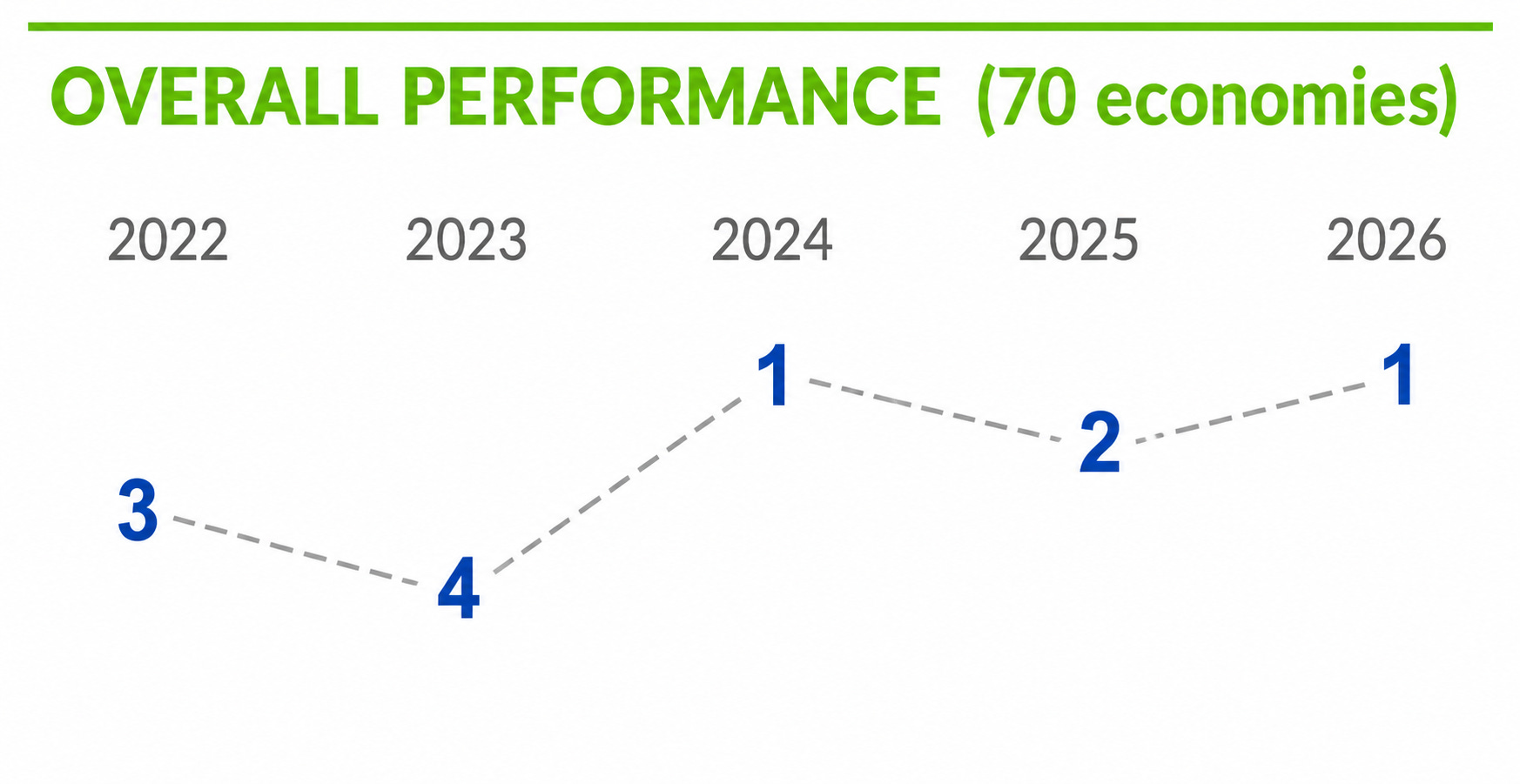
Singapore ranked first in the IMD World Competitiveness Ranking 2026, rising from second place in 2025. The country has remained in the top five since 2022, showing strong resilience despite global uncertainty.
The republic improved its performance across all four competitiveness factors. Its biggest gain was in Business Efficiency, which jumped from 8th to 1st, driven by improvements in:
Productivity & Efficiency (Rank 2): GDP per capita (PPP) is projected to rise from USD 164,300 in 2025 to USD 173,700 in 2026.
Attitudes & Values (Rank 3rd): A skilled and adaptable workforce, supported by strong public trust and political stability, continues to strengthen the business environment.
Labor Market (Rank 4th): The labor force increased from 4.0 million in 2025 to 4.13 million in early 2026, and is expected to reach 4.2 million by the end of the year.
Finance (Rank 4th): IPO fundraising rebounded from zero in the first quarter of 2025 to around SGD 1.2 billion in the first quarter of 2026.
Key challenges: Rising geopolitical tensions, rapid AI development, the transition to a low-carbon economy, and an aging population with slower workforce growth.
🇲🇾 Malaysia: The Leading Contender
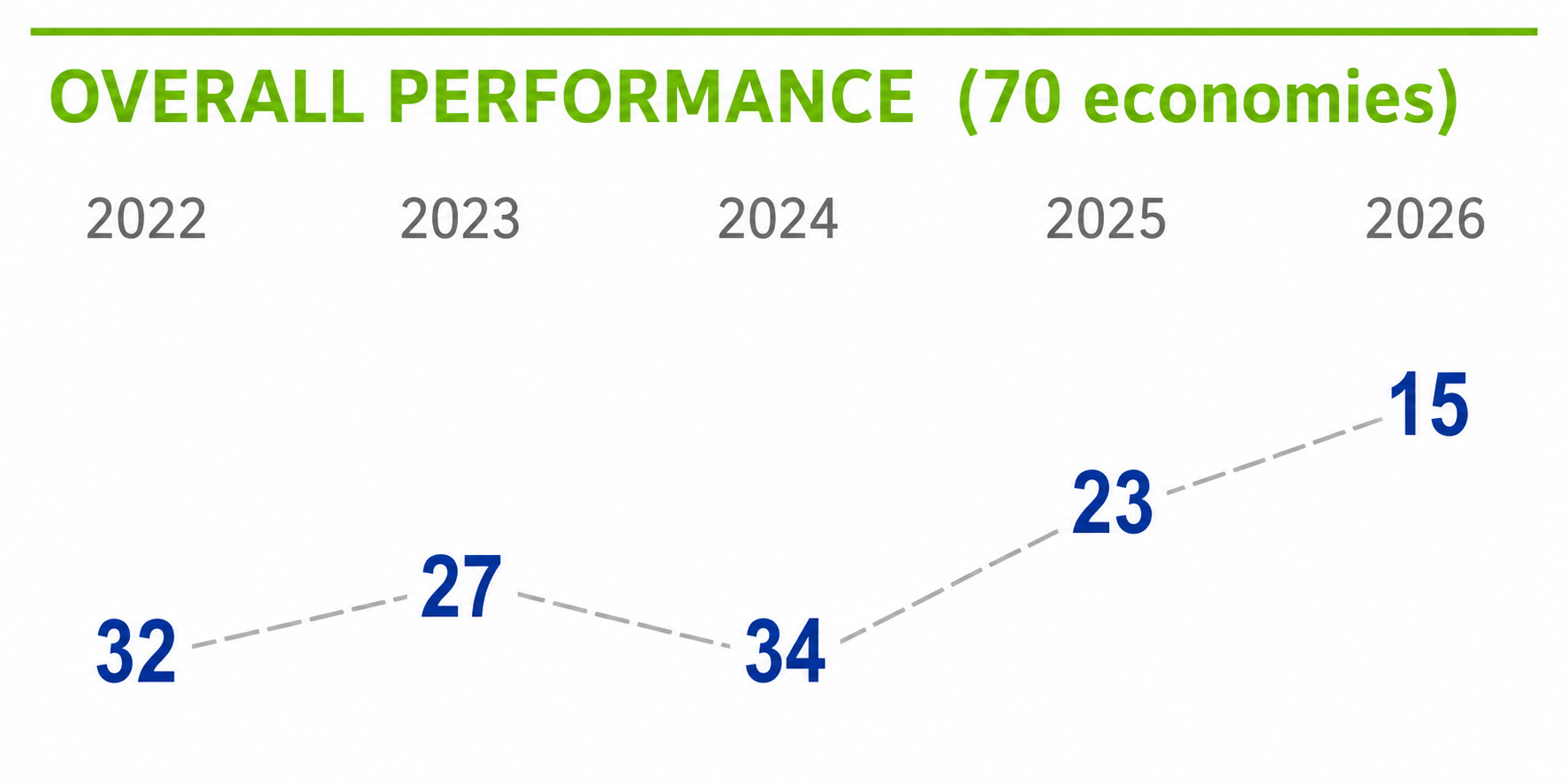
Malaysia ranked 15th in the competitiveness ranking, jumping eight places from 23rd in 2025.
The country’s strongest performance came from Economic Performance, where it maintained 4th place, supported by:
Prices (Rank 2nd): Keeping inflation below 2% from 2024 through May 2026.
International Trade (Rank 5th): Extending its trade surplus streak to 28 consecutive years. The country recorded a MYR 151.8 billion trade surplus in 2025 and MYR 63.22 billion in the first quarter of 2026.
Key challenges: Improving the regulatory environment, accelerating digital transformation and AI adoption, developing a future-ready workforce through upskilling and reskilling, and strengthening supply chain resilience.
🇹🇭 Thailand: The Established Competitor
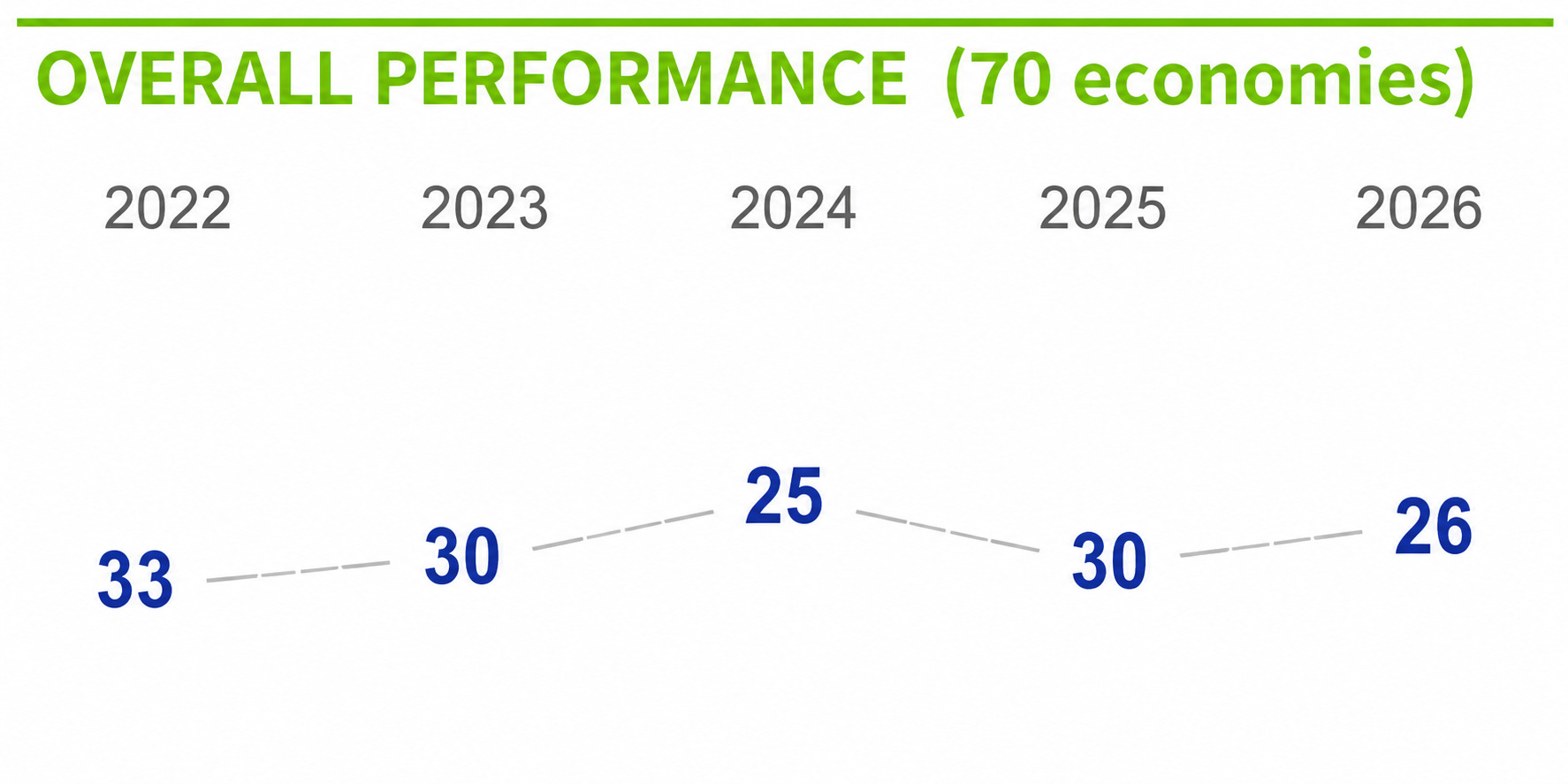
Thailand ranked 26th in the competitiveness list, climbing four places from 30th in 2025.
The kingdom ranked 10th in Economic Performance. The result was largely driven by:
Employment (Rank 4th): With its labor force increasing from 40.1 million in 2025 to 41.9 million in the first quarter of 2026. However, the unemployment rate also edged up from 0.7% to 0.9%.
International Trade (Rank 9th): Exports grew 12.9% to USD 339.64 billion in 2025, and increased another 17% to USD 162.09 billion during the first five months of 2026. However, the country continued to record a trade deficit as imports outpaced exports.
Key challenges: Reducing the impact of global energy and supply chain disruptions, attracting more foreign investment, strengthening regional cooperation, expanding AI and digital adoption, and modernizing the economy.
🇻🇳 Vietnam: The Fast-Rising Challenger
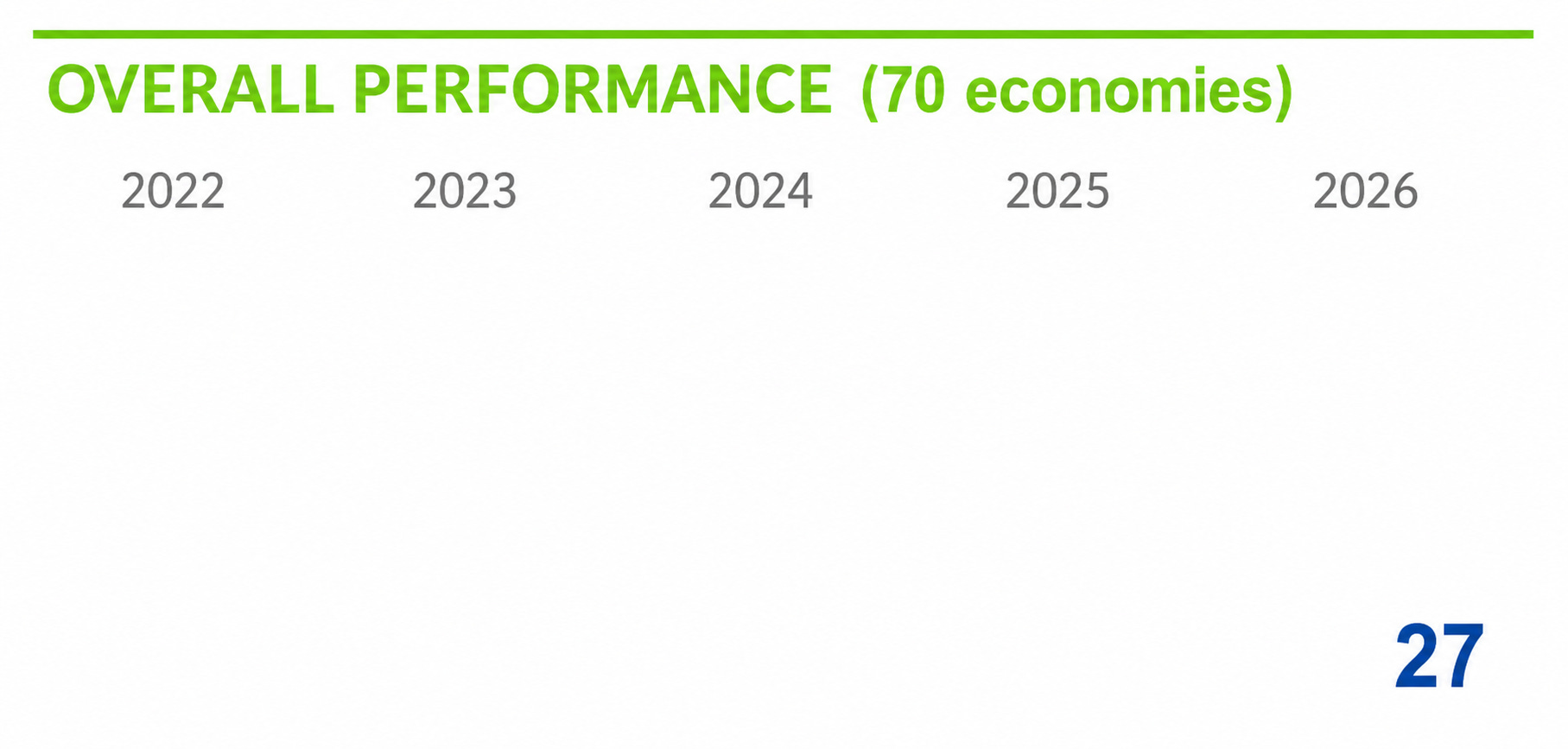
Vietnam joined the IMD World Competitiveness Ranking for the first time in 2026, debuting at 27th.
Economic Performance and Business Efficiency were Vietnam's strongest factors, both ranking 19th. The performance was mainly supported by:
International Trade (Rank 6th): Exports rose 17% to USD 475.04 billion in 2025 and increased another 19.5% to USD 215.66 billion during the first five months of 2026. Vietnam recorded a USD 20.03 billion trade surplus in 2025. However, it posted a USD 13.81 billion trade deficit in the first five months of 2026 as imports grew faster than exports.
Labor Market (Rank 7th): Vietnam’s labor force reached 53.8 million in 2025, with 52.7 million employed. Employment rose to around 53 million in the first quarter of 2026, while the unemployment rate improved slightly from 2.22% in 2025 to 2.21%.
Key challenges: Reducing reliance on exports, improving productivity and innovation, expanding energy infrastructure, addressing climate risks, and developing a more skilled workforce.
🇵🇭 The Philippines: The Emerging Aspirant
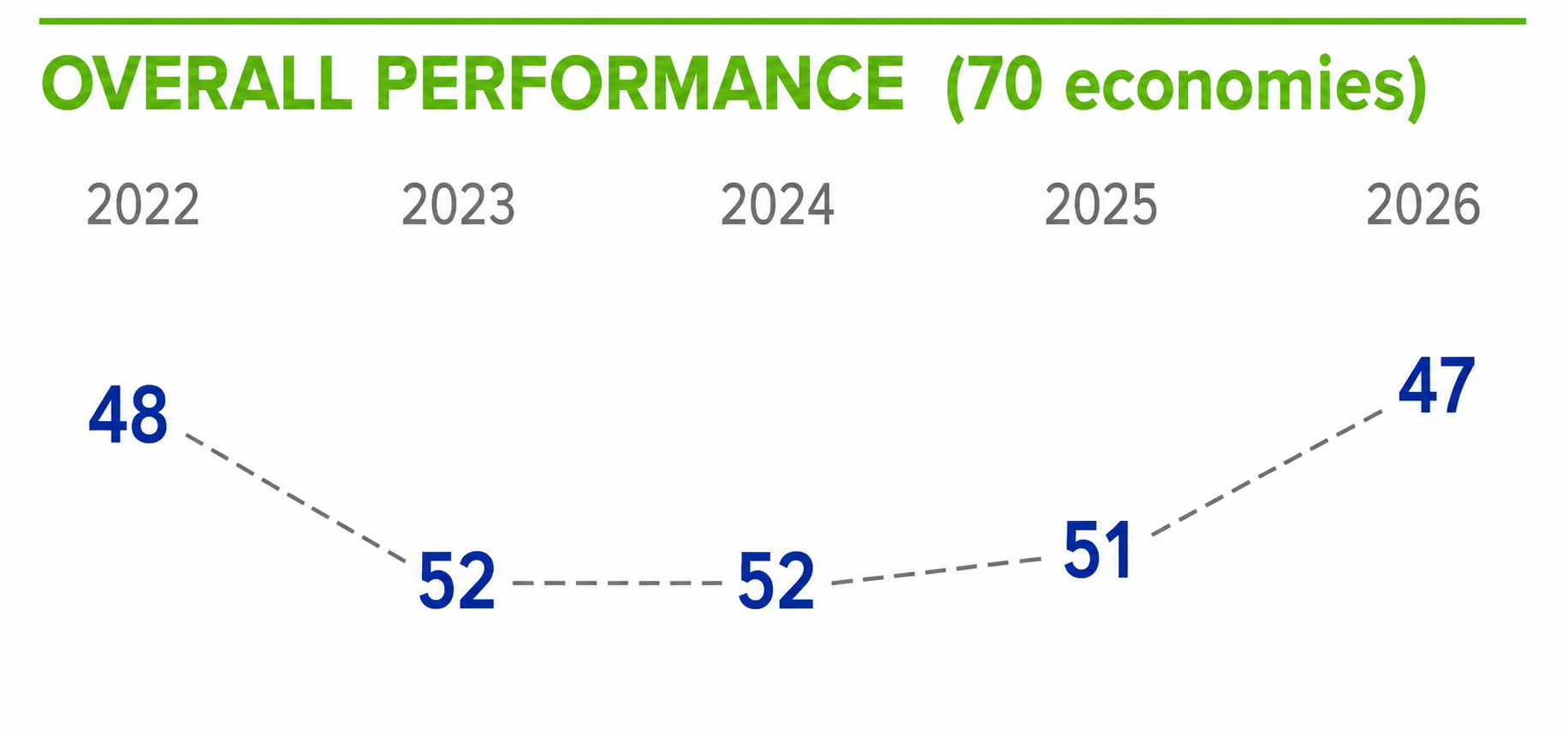
The Philippines ranked 47th in the list, climbing four places from 51st in 2025.
Business Efficiency was the country's strongest factor, ranking 30th. Although none of its sub-factors made the top 10, the improvement was mainly driven by:
Labor Market (Rank 16th): The Philippines’ labor force participation rate fell from 64.4% in 2024 to 63.2% in 2025, before improving slightly to 63.8% by May 2026. The employment rate also declined from 96.2% in 2024 to 95.8% in 2025 and 94.9% by May 2026. Meanwhile, the unemployment rate rose from 3.8% in 2024 to 4.2% in 2025 and 5.1% by May 2026.
Key challenges: Boosting economic growth, improving government efficiency and mitigate corruption risks, responding to energy and food supply risks, strengthening education, and accelerating renewable energy development.
🇮🇩 Indonesia: The Struggling Giant
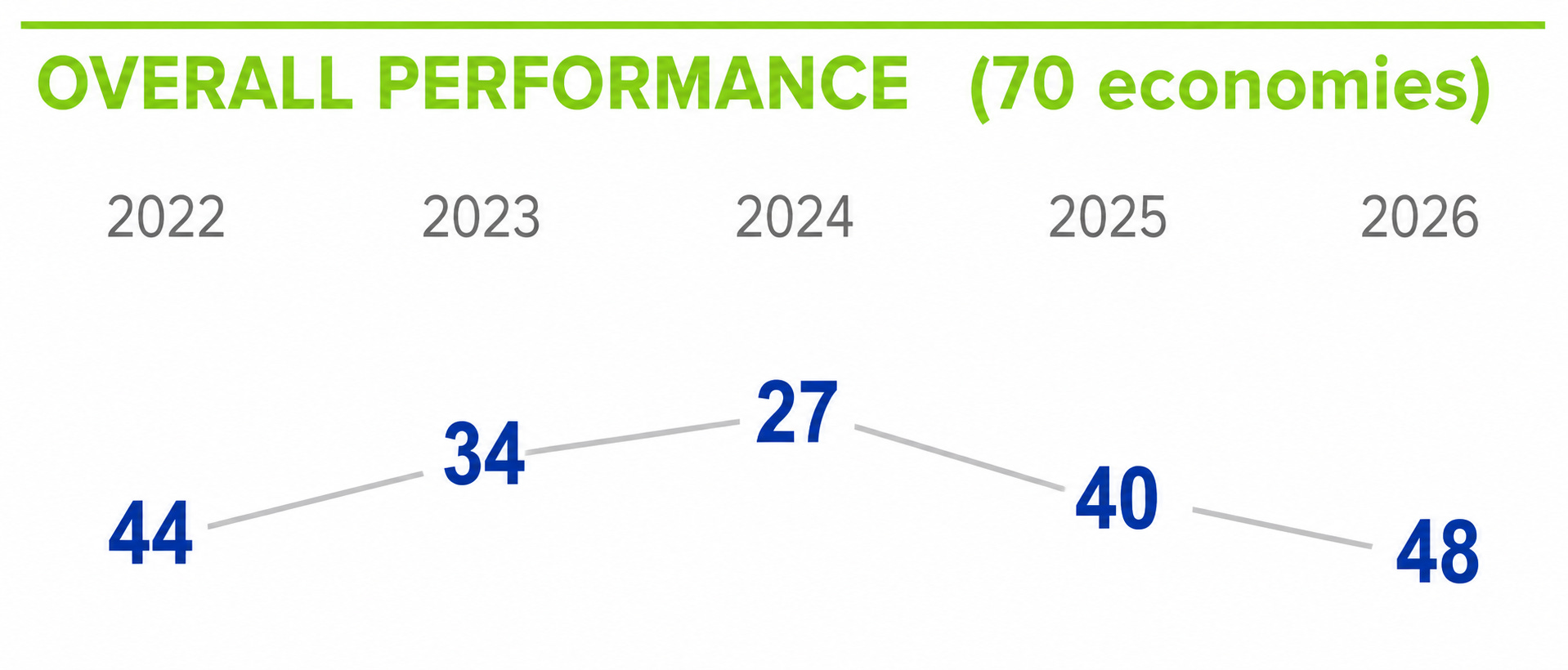
Indonesia ranked 48th on the list, dropping 8 places from 40th in 2025, and was the only Southeast Asian country to experience a decline in rank.
The country’s strongest performance came from Economic Performance, where it ranked 28th. The improvement was mainly driven by:
Prices (Rank 10th): Indonesia kept inflation below 3.5% throughout 2024 and 2025, remaining within the central bank’s target range of 2.5% ± 1%. Inflation briefly rose to 3.55% in January and 4.76% in February 2026, before easing back below 3.5% from March through June.
Domestic Economy (Rank 24th): Indonesia’s GDP growth remained stable at around 5% from 2022 through the first quarter of 2026. Household consumption contributed around 53% of the country’s economic growth.
Key challenges: Strengthening energy security, boosting economic growth, improving infrastructure and workforce skills, optimizing government spending, and expanding access to financing.
🔗 The Similarities
Despite their different rankings, all six Southeast Asian countries share one common weakness: Infrastructure.
Singapore remains the regional leader, ranking 5th in Infrastructure, followed by Malaysia (33rd), Thailand (45th), Vietnam (46th), Indonesia (58th), and the Philippines (60th).
The weakest areas across the region are health & environment, education, and scientific infrastructure. Strengthening these sectors will be critical for improving long-term competitiveness, productivity, and innovation.
📌 The Bottom Line
The competitiveness ranking is not just a scoreboard—it is a stress test. It measures not only how strong an economy is today, but also how prepared it is to face tomorrow’s challenges.
As geopolitical tensions, trade fragmentation, AI disruption, and climate risks continue to reshape the global economy, competitiveness is becoming less about size and more about resilience, adaptability, and long-term strategy.
The 2026 ranking shows that Southeast Asia is moving forward, but not at the same pace. While Singapore, Malaysia, Thailand, Vietnam, and the Philippines improved their positions, Indonesia was the only country to fall in the rankings.
The message is clear: economic growth alone is no longer enough. Countries that invest in productivity, innovation, institutions, human capital, and energy security will be better positioned to compete in an increasingly uncertain world.
🔍 Need More Angles?
Bank Indonesia Data Inflasi
Department of Statistics Malaysia Consumer Price Index, May 2026
International Institute for Management Development Rankings out of 70 economies
International Monetary Fund GDP per Capita, Current Prices
Malaysia External Trade Development Corporation Trade, Exports and Imports in the First Quarter (Q1) of 2026 Remained on An Upward Trajectory, Registering Highest Value Ever for Q1 Despite Ongoing Global Uncertainties
Ministry of Manpower Labour Force in Singapore 2025
National Statistical Office, Ministry of Digital Economy and Society Thailand The Labor Force Survey, Whole Kingdom Quarter 1: January - March 2026
Philippine Statistics Authority 2025 Annual Provincial Labor Market Statistics (Preliminary Results)
Trade Policy and Strategy Office Thai International Trade in May 2026
The Investor Vafie Magazine Vietnam set to add 300,000 jobs in Q1 as manufacturing rebounds
(NGO/QOB)