



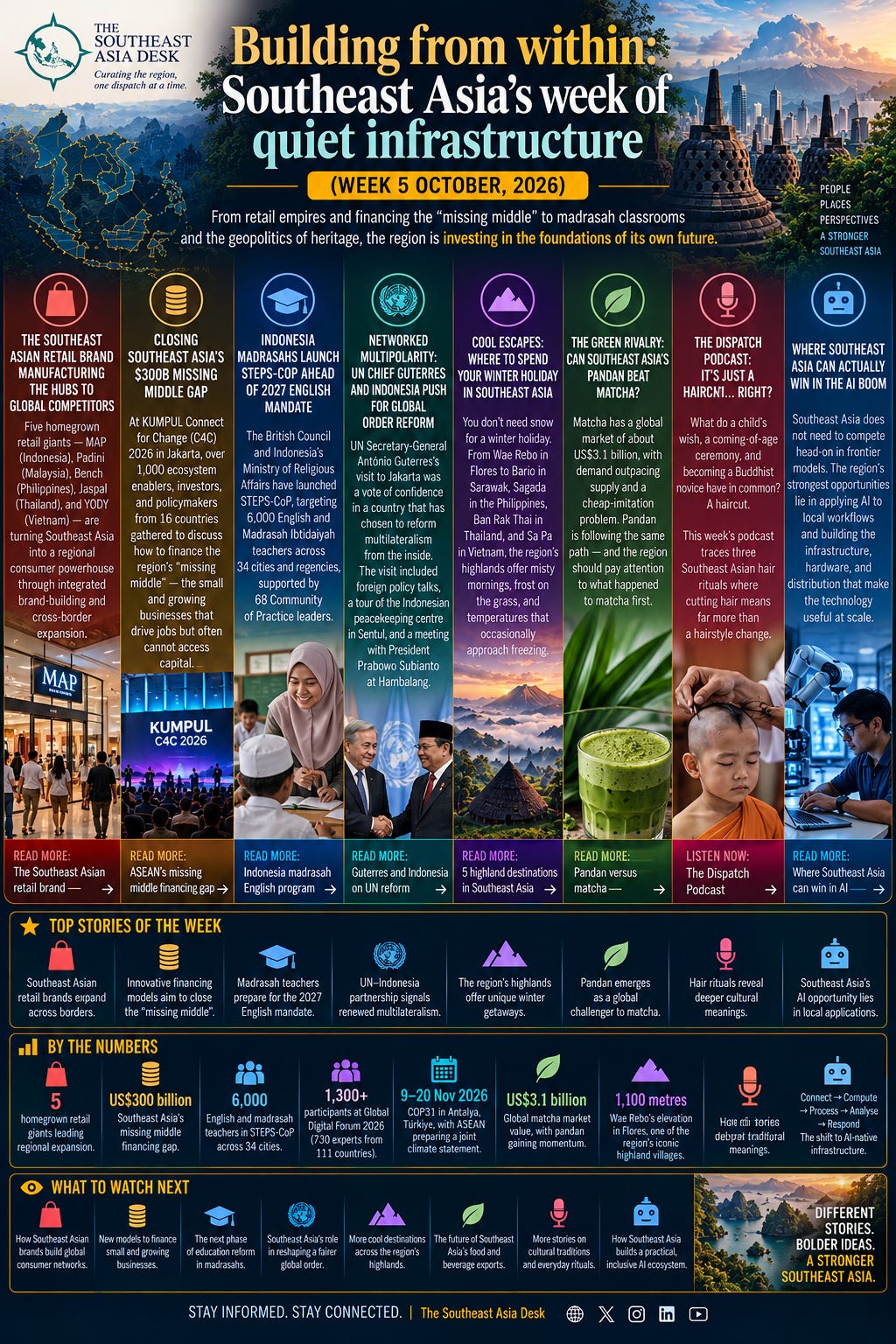
Your curated wrap-up from The Southeast Asia Desk.
Welcome back.
We took a week off last week to recharge, regroup, and grow — and we returned to a region that spent that same week doing much the same.
This edition is about the unglamorous, essential work of building: retail networks that compete across borders, capital that reaches the businesses nobody else funds, teachers preparing for a mandate not yet in force, and a diplomacy that insists on reform rather than retreat.
Here is your news in focus.
🛍️ The Southeast Asian retail brand manufacturing the hubs to global competitors
Southeast Asia's retail industry has moved beyond its role as a manufacturing base. Five homegrown players now dominate cross-border commercial spaces through integrated brand-building: MAP in Indonesia, Padini in Malaysia, Bench in the Philippines, Jaspal in Thailand, and YODY in Vietnam.
Read more:
https://www.thesoutheastasiadesk.com/p/the-southeast-asian-retail-brand
💰 Closing Southeast Asia’s $300B missing middle gap: Key takeaways from KUMPUL C4C 2026
At Jakarta’s KUMPUL Connect for Change (C4C) on 20–21 October, over 1,000 ecosystem enablers, investors, and policymakers from 16 countries gathered under the mandate “Reimagine Impact”.
Read more:
https://www.thesoutheastasiadesk.com/p/asean-missing-middle-financing-gap-kumpul-c4c-2026
🎓 Indonesia madrasahs launch STEPS-CoP ahead of 2027 English mandate
The British Council and Indonesia’s Ministry of Religious Affairs have launched STEPS-CoP (Strengthening the Teaching of English in Primary School through Communities of Practice), targeting 6,000 English and Madrasah Ibtidaiyah teachers across 34 cities and regencies, supported by 68 Community of Practice leaders.
Read more:
https://www.thesoutheastasiadesk.com/p/indonesia-madrasah-english-steps-cop-program
🇺🇳 Networked multipolarity: UN Chief Guterres and Indonesia push for global order reform
António Guterres’s state visit to Jakarta from 17–19 October was a vote of confidence in a country that has chosen to reform multilateralism from the inside rather than abandon it. The visit included foreign policy talks at the Ministry of Foreign Affairs, a tour of the Indonesian National Armed Forces Peacekeeping Mission Centre in Sentul, and a meeting with President Prabowo Subianto at his Hambalang residence.
Read more:
https://www.thesoutheastasiadesk.com/p/guterres-indonesia-visit-multilateralism-un-reform
❄️⛄ Cool escapes: Where to spend your winter holiday in Southeast Asia
You don’t need snow for a winter holiday. The region’s highlands offer misty mornings, frost on the grass, and temperatures that occasionally approach freezing.
Read more:
https://www.thesoutheastasiadesk.com/p/cool-escapes-where-to-spend-your
🍵 The green rivalry: Can Southeast Asia’s pandan beat matcha?
Matcha has a global market of about US$3.1 billion, demand outpacing supply, and a cheap-imitation problem. Pandan is following the same path — and the region should pay attention to what happened to matcha first.
Read more:
https://www.thesoutheastasiadesk.com/p/matcha-versus-pandan-drink
🎙️ The Dispatch Podcast: It’s Just a Haircut… Right?
What do a child’s wish, a coming-of-age ceremony, and becoming a Buddhist novice have in common? A haircut.
This week’s podcast traces three Southeast Asian hair rituals where cutting hair means far more than a hairstyle change.
Listen here:
https://www.thesoutheastasiadesk.com/p/southeast-asian-hair-rituals-cultural-meanings
🤖 Where Southeast Asia can actually win in the AI boom
Global capital is concentrating around AI. Southeast Asia does not need to compete head-on in frontier models — and trying to would be a strategic mistake.
Vito Samudra, Investment Associate at New Energy Nexus, argues that the region’s strongest opportunities lie in applying AI to local workflows and building the infrastructure, hardware, and distribution that make the technology useful at scale.
✍️ Closing Note
This week’s stories share a single thread: building foundations.
Retailers are building the commercial architecture of their own consumer economies.
Financing initiatives are building the capital pathways that reach the businesses nobody else funds.
Madrasah teachers are building peer communities before the mandate arrives. A UN Secretary-General is building reform from inside the institution that needs it.
Highlanders are building winter escapes out of mist and frost. And founders are building AI businesses around local workflows rather than frontier models.
None of this is dramatic. All of it is durable.
Thank you for reading.
✨ Stories to linger over, one week at a time.
(ELS/QOB)