




🎙️ Opening
🤔 What do a child’s wish, a coming-of-age ceremony, and becoming a Buddhist novice have in common?
✂️ The answer might be... a haircut.
💇🏻♂️ Across Southeast Asia, cutting hair can mean much more than changing your hairstyle.
🇮🇩 In Indonesia, some children traditionally have their hair cut only after a special request has been fulfilled.
🇰🇭 In Cambodia, a traditional haircut can mark the transition from childhood to adulthood.
🇲🇲🇹🇭 And among Shan communities in Myanmar and Thailand, shaving a boy’s head is part of his journey into novice monkhood.
🎭 Three traditions. Three very different stories.
🌏 And one surprisingly important thing in common:
✂️ Hair.
🎙️ Hello and welcome to The Southeast Asia Desk Weekly Dispatch Podcast. I’m Dilla Sunarya.
🧭 This is where we slow down the headlines and make sense of the stories shaping Southeast Asia.
🎧 So, let’s take a closer look at three Southeast Asian hair rituals that are much more than a haircut.
🇮🇩 The Hair That Has to Wait for a Wish
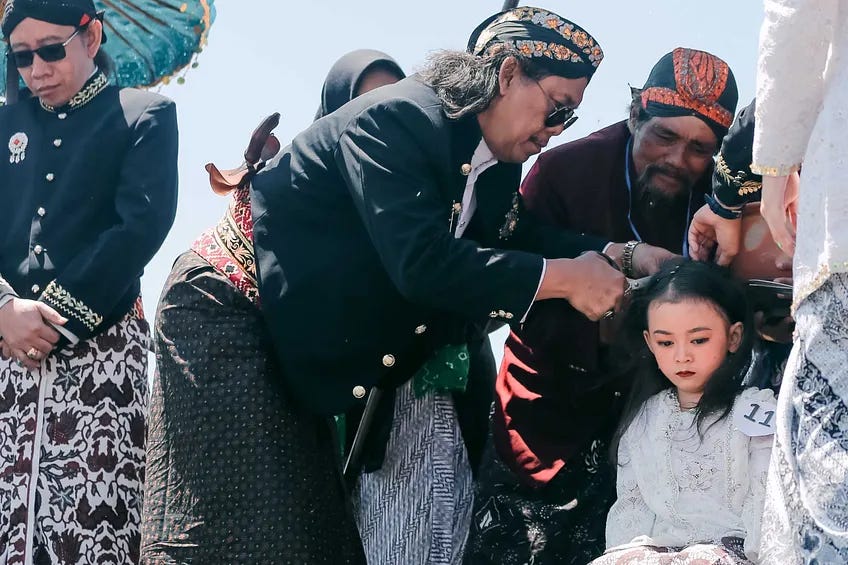
⛰️ Let’s start in the Dieng highlands of Central Java, Indonesia.
👦 Some children in the area naturally grow hair that becomes matted into dreadlock-like strands.
🇮🇩 These children are locally known as bocah gembel or bocah bajang.
🤔 And for the Dieng community, this hair is not treated like ordinary hair.
🙏 It is considered something that needs to be cleansed through a special ritual called ruwatan.
✂️ But here is where things get interesting.
⏳ The hair cannot simply be cut whenever someone feels like it.
🎁 Before the ritual, the child makes a request called a bebana.
🍬 It could be something simple, like sweets.
🧸 It could be a toy.
👕 It could even be a particular piece of clothing.
💭 And traditionally, the child’s request needs to be fulfilled before the hair is cut.
🎭 The haircut itself is also part of a much bigger ritual.
🙏 There are prayers.
🪔 There are offerings.
🚶 And there can be a procession before the hair is finally cut.
🌊 The hair is then released as part of the ritual, marking the end of the child’s ruwatan.
🤔 So, in Dieng, the haircut is not really the main event.
🌱 It is a marker of transition.
👦 The child is moving from one stage of life to another.
👨👩👧👦 And the community comes together to take part in that transition.
📌 Ruwatan Rambut Gimbal was also officially recognised as part of Indonesia’s Intangible Cultural Heritage in 2016.
🎉 Today, the ritual is one of the cultural highlights of the annual Dieng Culture Festival.
✂️ So in Dieng, getting a haircut can actually start with a child’s wish.
🇰🇭 When a Haircut Means Growing Up
🌏 Now, let’s move to Cambodia.
🇰🇭 Here, there is a traditional ceremony known as Kor Chuk.
💇🏻♂️ And unlike a normal haircut, this one is about growing up.
👦 Kor Chuk is a traditional Khmer hair-cutting ceremony associated with the transition from childhood into adulthood.
✂️ But once again, the haircut is only one part of the ceremony.
🕯️ Traditionally, the ceremony can last for two days and one night.
🙏 There are prayers and blessings.
🎁 There are offerings.
👨👩👦 And family members and community members take part in the different stages of the ceremony.
📅 And this tradition is not only something from the past.
🇰🇭 In March 2026, a traditional Kor Chuk ceremony was held in Siem Reap for five boys.
👀 The ceremony was documented by Cambodia’s APSARA National Authority.
🤔 But there is another interesting part.
⏳ Kor Chuk is becoming increasingly rare.
🏠 As lifestyles change, traditional ceremonies like this can become harder for families to maintain.
🎭 That makes the ceremony more than just a coming-of-age celebration.
🌱 It also becomes a way of keeping a cultural tradition alive.
✂️ Because once the hair is cut, the meaning goes beyond appearance.
👦 The child is no longer just a child.
🌱 The haircut becomes a visible sign that they are entering a new stage of life.
🤔 So while we might normally ask, “How short do you want it?”
🇰🇭 Kor Chuk asks a very different question:
✂️ “What stage of life are you entering?”
🇲🇲🇹🇭 From Prince to Novice
👑 Now, let’s move to one of the most dramatic transformations.
🤔 Imagine a group of young boys dressed like princes.
👑 They wear elaborate clothes and jewellery.
🚶 They are carried or accompanied through their community.
🎉 There are celebrations around them.
✂️ And then...
💇🏻♂️ Their hair is shaved.
🇲🇲🇹🇭 This is Poy Sang Long, a Shan tradition found in Myanmar and also in northern Thailand.
👦 The ceremony is generally held for boys who are preparing to enter novice monkhood.
👑 Before becoming novices, the boys are dressed as princes.
📖 This is connected to the story of Prince Siddhartha, who later became the Buddha.
🎭 The boys are dressed in elaborate costumes to represent the prince before he left his royal life behind.
🙏 And then comes the transformation.
✂️ Their hair is shaved.
🧘 They put on monk’s robes.
🛕 And they begin their life as novice monks.
🤔 So once again, the haircut is not really about appearance.
🎭 It represents a change in identity.
👦 A child is moving from one role into another.
👨👩👦 And just like the traditions in Dieng and Cambodia, the transition is not experienced alone.
🙏 Family members take part.
👵 Elders take part.
🛕 Religious figures take part.
👥 And the wider community becomes part of the ceremony.
✂️ The haircut becomes a physical sign that something in the child’s life is changing.
🌏 And that idea brings us back to all three traditions.
🌏 Three Haircuts, Three Very Different Stories
🤔 So, what do these three traditions actually have in common?
🇮🇩 In Dieng, the ritual is connected to children with naturally matted hair, purification, and ancestral traditions.
🇰🇭 In Cambodia, Kor Chuk marks the transition from childhood to adulthood.
🇲🇲🇹🇭 And in Poy Sang Long, boys move toward novice monkhood as part of a Buddhist tradition among the Shan people.
🌏 The rituals come from different communities.
📜 They have different histories.
🙏 And they have different religious and cultural meanings.
✂️ But there is one thing they share:
Hair becomes a physical marker of change.
👦 A child grows up.
🙏 Someone takes on a new religious role.
🌱 Or a community carries an old tradition into another generation.
👨👩👧👦 And perhaps the most interesting part is that these are not private moments.
🎭 They bring together families.
🙏 Elders.
🛕 Religious figures.
👥 And entire communities.
🤝 That means a physical change becomes a shared cultural experience.
🤔 And maybe that is why these rituals continue to matter.
🏛️ Preserving culture is not always about keeping an old object inside a museum.
🎭 Sometimes, it means continuing to do something together.
✂️ Something as simple as cutting hair.
🎭 More Than Just a Haircut
🤔 We usually think of hair as something personal.
💇🏻♀️ We cut it.
🎨 We colour it.
💈 We style it.
📸 And sometimes, we change our hairstyle just because we want a different look.
🌏 But these traditions show another side of hair.
🧒 It can tell us something about childhood.
👨 It can tell us about adulthood.
🙏 It can tell us about spirituality.
👨👩👧👦 And it can tell us about family and community.
✂️ Sometimes, a haircut is not about how you look.
🌱 It is about who you are becoming.
🎭 And perhaps that is what makes these traditions so fascinating.
🌏 They may look very different from one another.
🇮🇩🇰🇭🇲🇲🇹🇭 But they all use something very ordinary to mark something extraordinary.
✂️ A few strands of hair can become a symbol of change.
🎙️ Closing
😂 So, the next time you get a haircut, maybe think about this.
✂️ For some people, it is just a haircut.
🌏 But somewhere in Southeast Asia, it might mark the end of childhood.
🙏 It might be part of a spiritual journey.
🎁 Or it might even begin with a child asking for something they really want.
🤔 Three countries.
✂️ Three traditions.
👦 Three very different ways of growing up.
🌏 And one reminder that even the most ordinary things can carry a much bigger story.
🎙️ I’m Dilla Sunarya, and this has been The Southeast Asia Desk Weekly Dispatch Podcast, where we slow down the noise and follow the region’s compass.
📬 If you enjoyed this episode, subscribe to our newsletter at thesoutheastasiadesk.com and join us again next weekend for stories to linger over, one weekend at a time.
This episode is also available on Spotify:


