



Your curated wrap-up from The Southeast Asia Desk.
✍️ Editorial Note
Hello and welcome back,
Some of Southeast Asia’s biggest challenges have one thing in common: they do not respect borders.
Smoke from forest fires crosses the Malacca Strait. Maritime tensions test legal rules drawn across shared seas. Energy transitions reshape regional industries and supply chains. Extreme weather can disrupt a marathon hundreds of kilometers from where the environmental problem began.
But borders are not the only things being crossed.
Knowledge travels too. Indonesia is sharing trade experiences with African partners. Electric mobility is moving beyond passenger cars. And online, Southeast Asians are increasingly finding common ground around problems they recognize in one another’s lives.
This week is about those connections — and what happens when regional problems require regional ways of thinking.
Thank you for joining us.
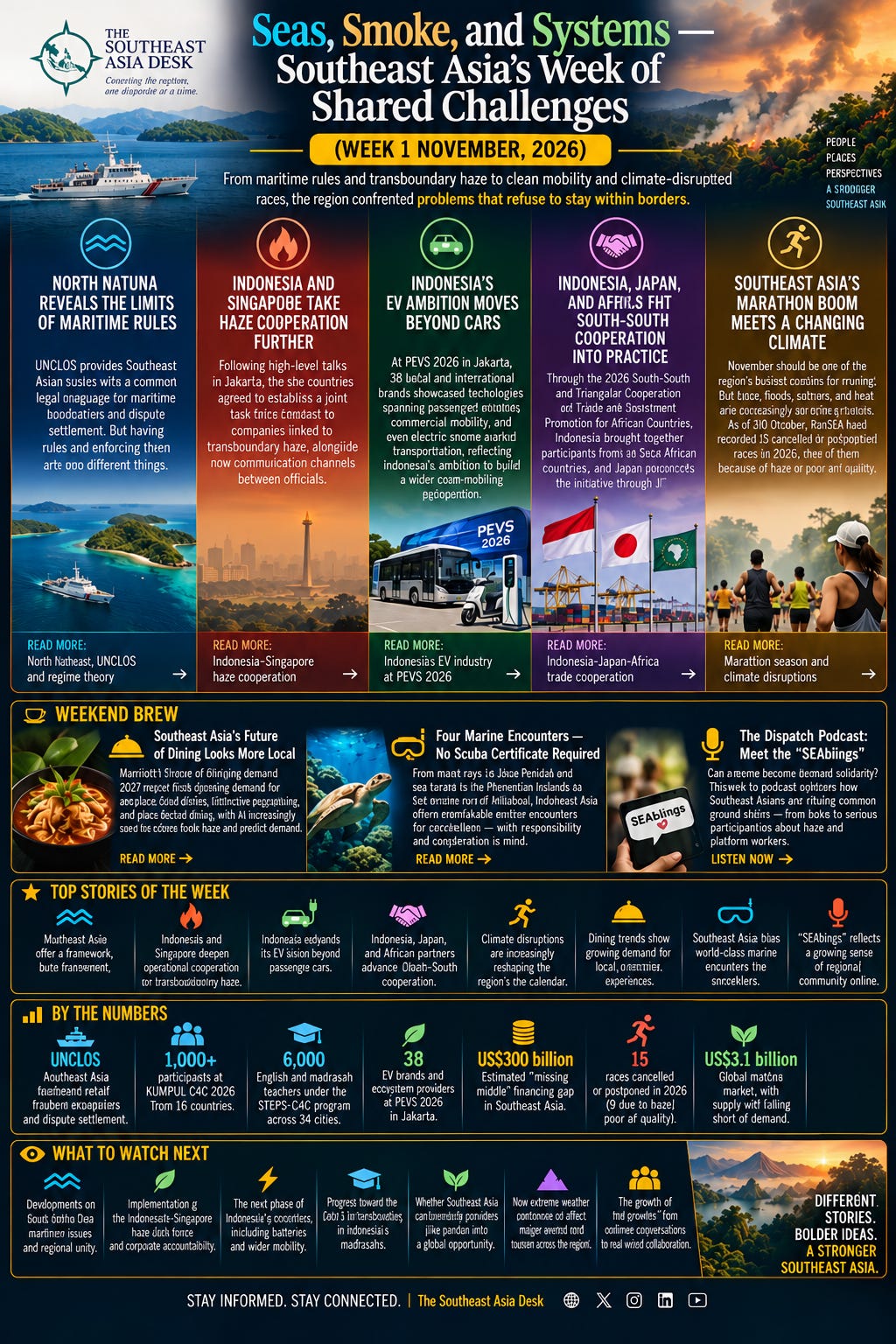
🌊 North Natuna Reveals the Limits of Maritime Rules
UNCLOS provides Southeast Asian states with a common legal language for maritime boundaries and dispute settlement. But having rules and enforcing them are different.
In last week’s Regional Line, Farhan Muhammad Aditomo uses the North Natuna waters and international regime theory to examine that gap. The analysis looks at the limits of legal enforcement, ASEAN’s difficulty in developing a unified response to the South China Sea disputes, and how economic relationships can complicate otherwise firm legal positions.
The bigger question goes beyond one patch of sea: what happens to an international regime when states agree on the rules, but political power determines how far those rules can actually reach?
Read more:
https://www.thesoutheastasiadesk.com/p/north-natuna-unclos-south-china-sea-regime-theory
🇮🇩🇸🇬 Indonesia and Singapore Take Haze Cooperation Further
Transboundary haze has tested Southeast Asian cooperation for decades. Indonesia and Singapore are now trying to make that cooperation more operational.
After high-level talks in Jakarta, the two countries agreed to establish a joint task force focused on companies linked to transboundary haze, along with new communication channels between officials.
The discussions also covered energy supplies and the broader management of a relationship in which environmental, economic, and public-health concerns are deeply intertwined.
The shift matters because the haze problem cannot be solved through firefighting alone. Accountability may increasingly require regulators, financial authorities, companies, and governments to work across jurisdictions.
Read more:
https://www.thesoutheastasiadesk.com/p/indonesia-singapore-joint-task-force-transboundary-haze
🚘 Indonesia’s EV Ambition Moves Beyond Cars
Indonesia’s electric-vehicle story is expanding beyond the passenger cars most consumers associate with the transition.
At PEVS 2026 in Jakarta, 38 local and international brands and ecosystem providers showcased technologies spanning passenger vehicles, commercial mobility, and even electric marine and air transportation. The exhibition reflects Indonesia’s ambition to build an EV industry extending from batteries and manufacturing to a much wider clean-mobility ecosystem.
The stakes are also economic. Indonesia is trying to reduce exposure to imported fossil fuels while using its industrial and mineral base to capture more value from the global energy transition.
Read more:
https://www.thesoutheastasiadesk.com/p/indonesia-ev-industry-pevs-2026-asean-growth
🌍 Indonesia, Japan, and Africa Put South–South Cooperation Into Practice
Indonesia is also exporting something less tangible: its experience with trade promotion, SME development, regional integration, and economic diplomacy.
Through the 2026 South-South and Triangular Cooperation on Trade and Investment Promotion for African Countries, Indonesia brought together participants from six East African countries, with Japan supporting the initiative through JICA. The programme combines training on trade negotiations, digitalisation, investment, and export promotion with Indonesia’s own experience of economic integration within ASEAN.
It represents a form of diplomacy built less around aid flowing in one direction and more around exchanging practical knowledge among developing economies — with Indonesia positioning itself as a bridge between Asia and Africa.
Read more:
https://www.thesoutheastasiadesk.com/p/indonesia-japan-sstc-africa-trade-cooperation-2026
🏃 Southeast Asia’s Marathon Boom Meets a Changing Climate
November should be one of Southeast Asia’s busiest months for running. RunSEA recorded 70 scheduled half and full marathons, including 26 events offering a full marathon distance.
But haze, floods, storms, heat, and other environmental disruptions are increasingly becoming part of race planning. As of 30 October, RunSEA had recorded 15 cancelled or postponed races in 2026, nine of them because of haze or poor air quality. Singapore’s Great Eastern Women’s Run was among the major events affected.
The takeaway extends beyond sport. Road races depend on tourism, transportation, local government, public health, and predictable weather. Their disruption offers a clear example of how climate variability is shaping everyday economic and social planning.
Read more:
https://www.thesoutheastasiadesk.com/p/southeast-asia-marathon-season-haze-climate-disruptions
☕ Weekend Brew
🍽️ Southeast Asia’s Future of Dining Looks More Local
The next big dining trend may actually be about looking closer to home.
Marriott International’s Future of Food Asia Pacific 2027 report finds growing demand for authentic local dishes, distinctive ingredients, smaller dining spaces, and experiences rooted more strongly in place and identity. Among surveyed properties, 95% identified authentic local signature dishes as a leading trend in their market.
Technology is entering the kitchen too. AI is increasingly being used behind the scenes for tasks ranging from reducing food waste to predicting staffing and understanding guest behaviour.
For Southeast Asia, that creates an interesting combination: increasingly sophisticated restaurant technology paired with stronger demand for food that still feels unmistakably local.
Read more:
https://www.thesoutheastasiadesk.com/p/southeast-asia-future-of-food-dining-trends-2027
🤿 Four Marine Encounters — No Scuba Certificate Required
You do not always need tanks and a diving licence to encounter Southeast Asia’s extraordinary marine life.
From manta rays around Nusa Penida and sea turtles in Malaysia’s Perhentian Islands to the sardine run off Moalboal, shallow-water ecosystems across the region offer remarkable wildlife encounters that snorkellers can access.
But accessibility comes with responsibility. These are wild animals in fragile habitats, so local conditions, conservation rules, responsible operators, and respectful distance matter as much as the encounter itself.
Read more:
https://www.thesoutheastasiadesk.com/p/4-epic-marine-encounters-destination
🎧 The Dispatch Podcast: Meet the “SEAblings”
Can a meme become regional solidarity?
This week’s Weekly Dispatch Podcast explores the idea of “SEAblings” — Southeast Asians discovering shared experiences and identities through digital spaces.
From jokes and cultural similarities to serious conversations about haze and platform workers, social media can turn a national conversation into something recognizable across borders. People may live under different governments and political systems, but they can still identify with one another’s struggles.
The episode asks an intriguing question: as Southeast Asians increasingly meet one another online, could digital familiarity eventually strengthen a sense of regional community offline?
Listen here:
https://www.thesoutheastasiadesk.com/p/seablings-digital-solidarity-southeast-asia
✍️ Closing Note
This week reminds us that Southeast Asia is interconnected long before anyone calls it “regional integration.”
The air we breathe, the seas we share, the energy we consume, the supply chains we build, and even the weather determining whether a Sunday morning race goes ahead are already regional realities.
Institutions often arrive afterward, trying to keep up.
But another kind of integration is happening from below: runners crossing borders for races, diners rediscovering local ingredients, travellers encountering shared marine ecosystems, and people online recognizing strangers elsewhere in Southeast Asia as their “SEAblings.”
Perhaps that is the more interesting story.
Regionalism is not only something negotiated by governments. Sometimes, it simply emerges because our lives are already connected.
Thank you for reading, sharing, and continuing to explore the region with us.
Until next week, take care, stay curious, and keep looking beyond the headlines.
✨ Stories to linger over, one week at a time.
(QOB)