



Editor’s note: This is the first edition of a monthly collaboration between The Southeast Asia Desk and RunSEA, using its verified Southeast Asian road-race calendar to look beyond individual finish lines and examine the regional patterns surrounding running.
🎯 The Main Takeaway
Southeast Asia is entering one of the busiest stretches of its road-running calendar, but the same regional weather patterns shaping when people race are increasingly determining whether some races can happen at all.
RunSEA recorded 149 half and full marathon events across the region in October and November, making the two months the busiest since it began tracking races in August 2026.
November alone includes 26 events offering a full marathon, the highest monthly total in RunSEA’s tracking so far.
Malaysia leads November’s calendar with 17 races, followed by the Philippines with 15, Thailand with 13, Vietnam with 12 and Indonesia with nine.
But not every scheduled race will reach the starting line.
Singapore’s Great Eastern Women’s Run, originally scheduled for 1 November, was cancelled because of worsening air quality. The organiser said prolonged outdoor activity under uncertain haze conditions posed health concerns for participants, staff and volunteers; more than 12,000 people had registered.
It was not an isolated disruption.
RunSEA’s cancellation tracker recorded 15 races cancelled or postponed in 2026 as of 30 October, with nine attributed to haze or poor air quality. Most affected events were in Malaysia and Singapore.
The emerging picture is more interesting than a crowded race calendar alone:
Southeast Asia’s running season follows the climate and increasingly has to negotiate with it.
🔎 Why It’s on Our Radar
Road races offer an unusual window into how Southeast Asia operates as a region.
They bring together domestic runners, travelling participants, city authorities, sponsors, tourism operators and local communities. They also depend heavily on conditions organisers cannot completely control: heat, rainfall, flooding and air quality.
RunSEA’s data show that the regional calendar is not evenly distributed throughout the year.
October and November have so far been the busiest months in its dataset, with 79 and 70 races respectively, compared with 60 in August, 50 in September and 48 scheduled for December. But the pattern differs by country: the Philippines peaked in October, Malaysia in November, and Thailand is expected to peak in December, with Thailand’s cooler-season calendar remaining active into February.
That distinction matters.
There is no single “Southeast Asian running season.”
Instead, the calendar shifts across the region according to local weather patterns, race traditions and national schedules.
For runners willing to cross borders, that produces an unusually dense regional circuit.
For organisers, it also makes environmental conditions increasingly difficult to treat as background variables.
🌫️ Haze Is Becoming Part of Race Planning
The clearest warning this season has come from the southern part of the region.
Since September, nine half and full marathons in Malaysia and Singapore have been called off because of haze, according to RunSEA.
Others have survived only by changing format.
At the Garmin Run Singapore on 25 October, organisers dropped the competitive format and shortened the planned 21-kilometre category to a non-competitive 10-kilometre route because of haze conditions.
The Great Eastern Women’s Run was cancelled altogether.
This disruption also fits the wider regional climate picture.
The ASEAN Specialised Meteorological Centre warned in its October–December outlook that El Niño conditions, below-normal rainfall over much of the Maritime Continent and above-normal temperatures could sustain elevated hotspot and smoke-haze risks across southern ASEAN.
Conditions have since begun to improve. On 29 October, the centre downgraded its southern ASEAN haze alert to Level 2 after showers reduced hotspot activity, although it cautioned that elevated hotspots and transboundary haze could still occur in drier areas.
That distinction is important.
The issue is not that every November race is suddenly threatened by haze.
It is that organisers in a region accustomed to seasonal environmental variability increasingly need contingency plans that can change races quickly—and communicate those changes before runners travel.
🌧️ And It’s Not Only Haze
Mainland Southeast Asia offers the other side of the equation.
Thailand’s Chaiyaphum Marathon was originally scheduled for 11 October but has been pushed to 21 February 2027 after flooding damaged the organiser’s office and race materials.
That case reinforces a broader point.
The region’s most comfortable running months are attractive partly because they avoid the worst combinations of tropical heat and humidity.
But those same transitional periods can still bring haze, heavy rain, storms or flooding depending on location.
In other words:
Good running weather is increasingly something organisers have to manage rather than assume.
🗓️ The November Weekends to Watch
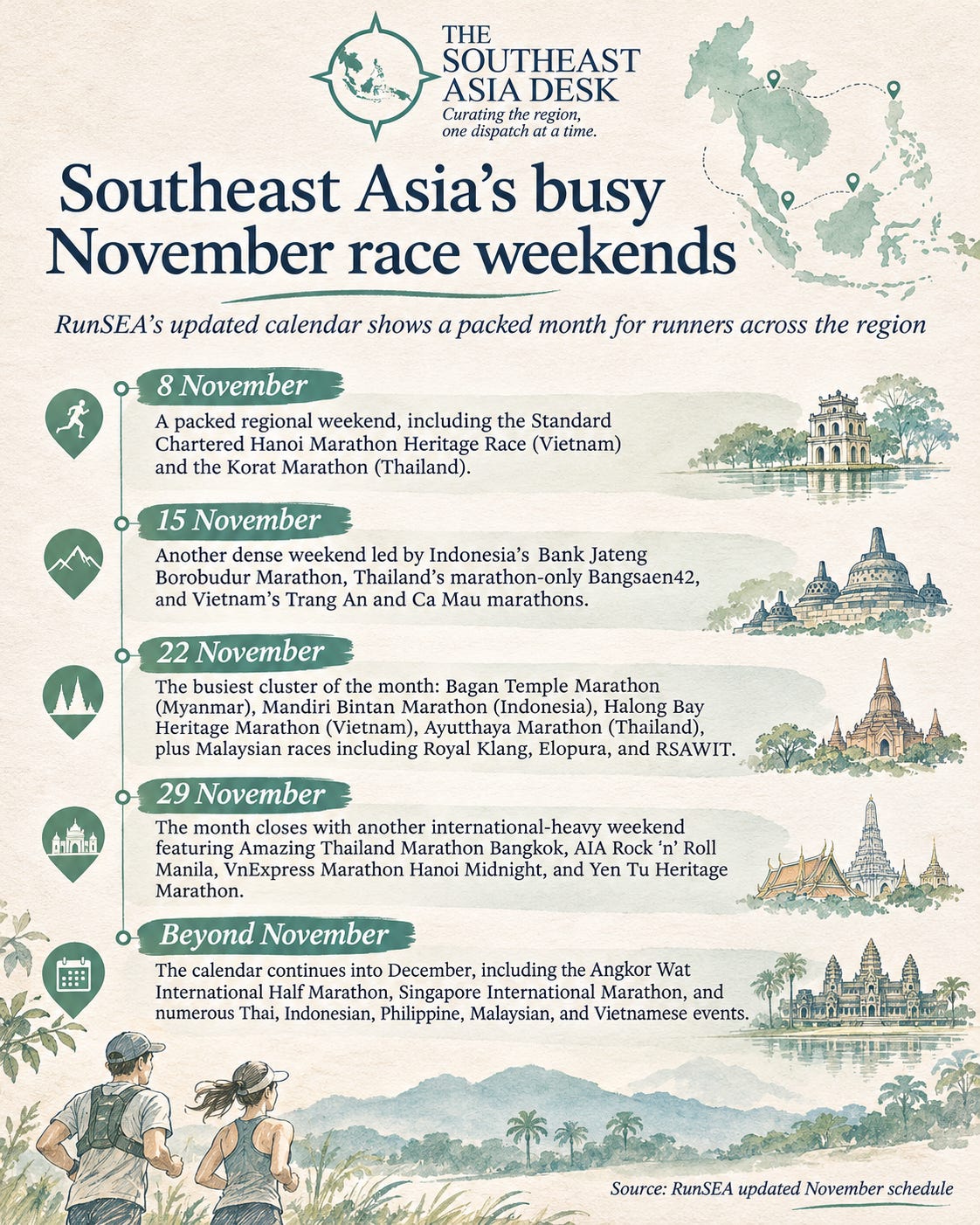
For runners, the calendar remains exceptionally busy. RunSEA’s updated November schedule highlights several major weekends across the region:
🇻🇳🇹🇭8 November: Standard Chartered Hanoi Marathon Heritage Race in Vietnam and Korat Marathon in Thailand sit among a packed regional programme.
🇮🇩🇹🇭🇻🇳15 November: Indonesia’s Bank Jateng Borobudur Marathon, Thailand’s marathon-only Bangsaen42, and Vietnam’s Trang An and Ca Mau marathons lead another dense weekend.
🇲🇲🇮🇩🇻🇳🇹🇭🇲🇾22 November: the busiest cluster includes the Bagan Temple Marathon in Myanmar, Mandiri Bintan Marathon in Indonesia, Halong Bay Heritage Marathon in Vietnam, Ayutthaya Marathon in Thailand, and multiple Malaysian races including Royal Klang, Elopura and RSAWIT.
🇹🇭🇵🇭🇻🇳29 November: the month closes with another international-heavy weekend featuring Amazing Thailand Marathon Bangkok, AIA Rock ’n’ Roll Manila, VnExpress Marathon Hanoi Midnight and Yen Tu Heritage Marathon.
Beyond November: the calendar continues into December, including the Angkor Wat International Half Marathon, Singapore International Marathon and numerous Thai, Indonesian, Philippine, Malaysian and Vietnamese events.
The practical lesson is simple: verify before travelling.
RunSEA recommends checking the organiser’s own channels in the week before a race, particularly after the recent sequence of weather-related cancellations and modifications.
📸 The Big Picture
Another regional story is buried in these numbers.
Southeast Asia’s road-running landscape does not revolve around one dominant city.
The November calendar stretches from major capitals such as Bangkok, Hanoi and Manila to Magelang, Bintan, Sandakan, Sibu, Ninh Binh, Ha Long, Ayutthaya, Biak and Bagan.
That geographical spread gives running a particularly local character.
A marathon can be simultaneously:
a sporting event,
a city-branding exercise,
a reason to visit somewhere, and
a way of moving through landscapes that travellers might otherwise experience from a vehicle or behind a window.
Borobudur offers one version of that experience.
Bagan offers another.
So do Bangsaen, Ha Long, Bintan and Ayutthaya.
The regional calendar therefore tells us something bigger than where runners can collect their next medal.
It maps how Southeast Asian cities and destinations increasingly present themselves through movement, public space and experience.
⚖️ What’s at Stake
The denser the race calendar becomes, the more important reliability becomes.
For runners, cancellation may mean more than losing an entry fee. Those travelling between provinces or countries may already have committed to transport, accommodation and training schedules.
For organisers, waiting too long to make a weather decision can create health risks and larger operational losses.
Cancelling too early can create another problem if conditions subsequently improve.
The Great Eastern Women’s Run illustrates that dilemma. Organisers said they made the decision more than two weeks in advance because an event involving more than 12,000 registered participants required extensive logistical planning and because the haze's duration remained uncertain.
That is likely to become a bigger part of race management across the region.
Weather contingency plans, air-quality thresholds, health guidance, refund rules and rapid communication may eventually matter almost as much as route maps and water stations.
❤️ Why This Hits Home
Running is one of the simplest sports to enter.
Shoes, a road and enough motivation can be sufficient.
But mass-participation running also depends heavily on the environment.
You cannot air-condition 42.195 kilometres of public road.
You cannot move an entire city course indoors when smoke arrives.
And when runners travel across Southeast Asia for races, conditions in one part of the region can become a shared regional problem.
That makes the running calendar surprisingly revealing.
Haze is usually discussed through diplomacy, forest fires, health warnings and environmental policy.
Flooding is usually discussed through infrastructure and disaster response.
For runners, those large regional problems become intensely personal:
Can I safely reach the starting line on Sunday morning?
🌐 The Regional Stakes
There is something distinctly Southeast Asian about the November calendar.
A runner could theoretically move from Indonesia to Thailand, Malaysia, Vietnam, the Philippines, or Myanmar across successive weekends and encounter completely different landscapes while staying within the same regional running ecosystem.
RunSEA currently tracks more than 200 upcoming races across ten Southeast Asian countries, regularly checking listings against official and other public sources.
That creates an opportunity to build stronger regional information infrastructure for recreational sport.
Not necessarily another formal institution.
Something more practical:
reliable calendars,
cross-border race information,
transparent cancellation records,
comparable results,
weather information, and
eventually better understanding of how runners move across the region.
Sometimes regional integration is visible in treaties and summit communiqués.
Sometimes it looks like thousands of people waking up before dawn in different Southeast Asian cities to run the same distance.
🔍 Beyond the Headlines
November’s 70 scheduled races make for an impressive number.
But the more important story may be what happens around them.
October already demonstrated how quickly haze can disrupt sporting events.
November will test how effectively organisers, runners, and cities respond as the race calendar nears its annual peak.
For Southeast Asia’s growing community of runners, the lesson is not to stop travelling or racing.
It is to treat environmental information as part of race preparation.
Check the official channel.
Watch the weather.
Understand the cancellation policy.
And perhaps increasingly, choose a race not only by medal, route or personal-best potential—but by how transparently its organisers prepare for conditions they cannot control.
In Southeast Asia, running season is never only about the race calendar.
It is also about the region runners are moving through.
This article is part of a monthly editorial collaboration between The Southeast Asia Desk and RunSEA, a free directory of verified half and full marathons across Southeast Asia.
RunSEA supplied race-calendar data and cancellation tracking; The Southeast Asia Desk added regional context and independent verification.
RunSEA’s calendar was last updated on 2 November 2026. Race schedules can change; runners should verify details with individual organisers before making travel arrangements.
(QOB/NGO)