



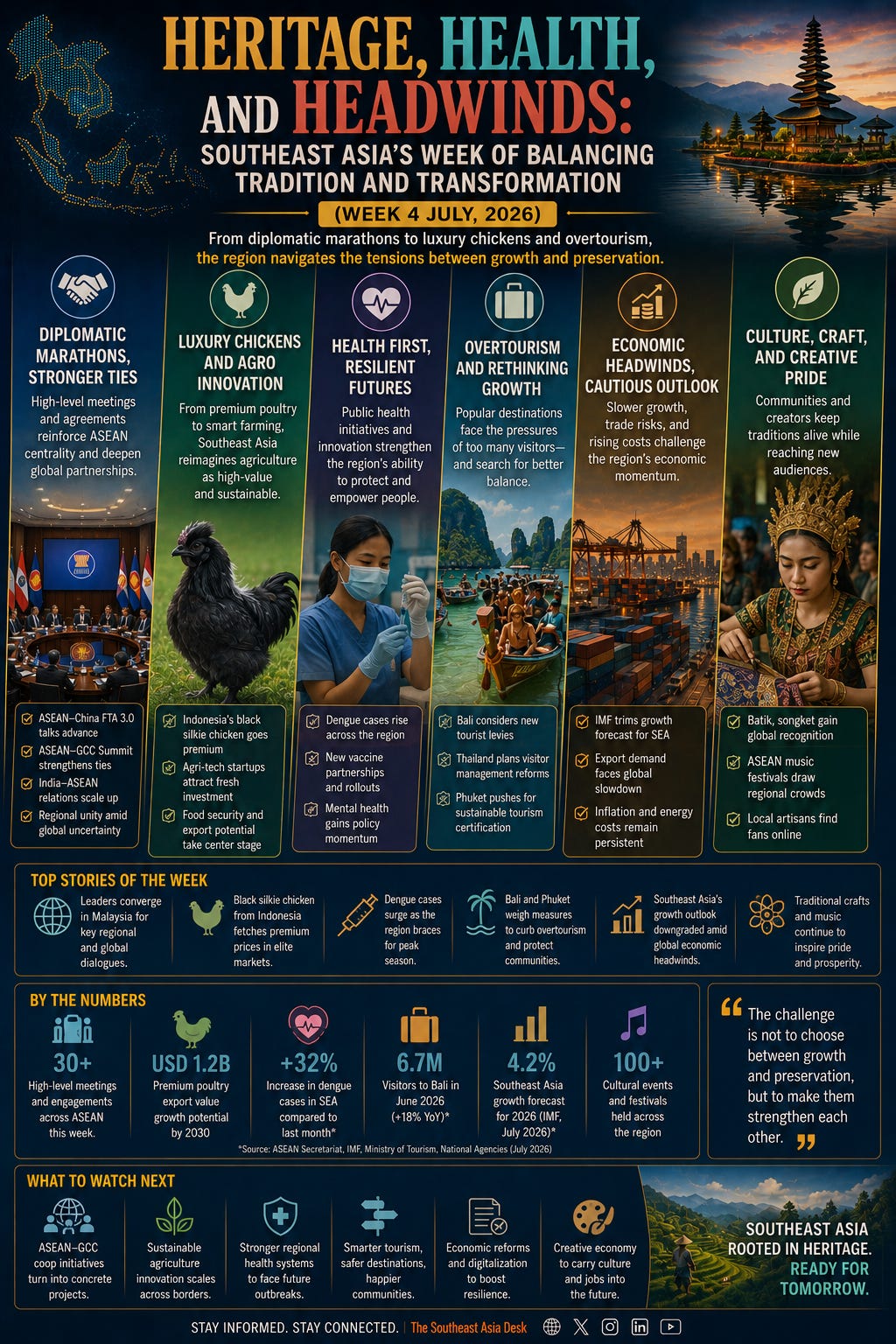
Your curated wrap-up from The Southeast Asia Desk.
This week, Southeast Asia’s stories reveal a region in transition—where ancient traditions become global commodities, where diplomatic meetings tackle overlapping crises, and where the benefits of growth must be weighed against its costs.
Here is your news in focus.
🌏 ASEAN Foreign Ministers meet in Manila to tackle regional security and unity
The 59th AMM addressed overlapping crises from the South China Sea to the Middle East. The Philippines hosted the meetings from 20–24 July, with key discussions covering Myanmar, tensions between Thailand and Cambodia, the Korean Peninsula, and the Gaza humanitarian crisis. ASEAN and China reaffirmed their commitment to finalize the Code of Conduct (COC) this year. Timor-Leste expressed readiness to serve as ASEAN Chair in 2029. Türkiye was admitted as the 12th Dialogue Partner, while Germany and Qatar became Sectoral Dialogue Partners.
Read more:
https://www.thesoutheastasiadesk.com/p/asean-59th-amm-2026-unity-security
🌏📈 Brazil’s strategic pivot to Southeast Asia takes center stage at FHI 2026
At FHI 2026 in Jakarta, 10 Brazilian food industry representatives showcased nuts, açaí, coffee, and wine. Indonesia’s exports to Brazil surpassed $2 billion in 2025, while Brazil’s exports to Indonesia more than doubled since 2020, peaking above $4.4 billion. Brazil acceded to the TAC in 2012—the first Latin American country to do so—and became an ASEAN Sectoral Dialogue Partner in 2022.
Read more:
https://www.thesoutheastasiadesk.com/p/brazil-indonesia-food-trade-fhi-2026
🌺 From dark magic to luxury perfume: Benzoin’s Southeast Asian renaissance
Indonesia’s benzoin resin or kemenyan, traded since the 8th–9th century, is prized internationally as a natural fixative in high-end perfumes and skincare. Indonesia’s exports reached 43,000 tons, valued at over US$52 million, in 2024. Yet locally, it’s often associated with dark magic. The government is pushing for downstreaming—processing domestically to capture more value—but faces challenges: many farmers are elderly, and production is declining.
Read more:
https://www.thesoutheastasiadesk.com/p/indonesia-benzoin-resin-kemenyan-commodity
🏎️ More than a race: How Formula 1 is expanding across Southeast Asia
The first official F1 Exhibition in Asia opened in Singapore (23 July–18 October), coinciding with the Singapore Grand Prix (9–11 October). Malaysia’s Sepang will host a Grand Prix on 2–4 October 2026, marking F1’s return since 2017. Thailand has approved a US$1.2 billion proposal for a Bangkok Street Race in 2028. In 2025, F1’s revenue reached US$3.9 billion.
🐔 Indonesia’s Ayam Cemani goes global
Ayam Cemani—the “thoroughly black chicken”—possesses a rare genetic trait causing all-black features. Since at least the 12th century, it has carried cultural significance in Java. First imported to Europe in 1998, it’s now marketed as the “world’s rarest chicken” or the “Lamborghini of poultry,” with breeding pairs selling for thousands of dollars. It represents an opportunity for cultural diplomacy and economic growth—but raises questions about genetic preservation and community benefit.
Read more:
https://www.thesoutheastasiadesk.com/p/indonesias-ayam-cemani-goes-global
🎙️ The Dispatch Podcast: One Label, Better Health
Southeast Asia is making it easier for consumers to understand what’s in their food. Non-communicable diseases account for 55% of deaths in Southeast Asia (9.5 million annually). Singapore uses an A-D Nutri-Grade system for beverages. Indonesia launched Nutri-Level in April 2026. Malaysia and Thailand use a Healthier Choice logo instead of grades. As nutrition information becomes easier to see, food companies face greater pressure to reduce sugar, salt, and saturated fat.
Listen here:
https://www.thesoutheastasiadesk.com/p/s26e25-one-label-better-health
👗 The Fashion Revival: Southeast Asia’s new era on the global stage
From Indonesia’s Batik (UNESCO-recognized) to Malaysia’s songket, designers are fusing heritage with contemporary aesthetics. Didiet Maulana’s IKAT debuted at New York Fashion Week. Bernard Chandran has modernized Malaysian fashion since 1991. WISHARAWISH (Thailand) featured at Rakuten Fashion Week Tokyo. Kilomet 109 (Vietnam) champions slow fashion and sustainability. As heritage-blended designs gain popularity, the fashion industry becomes a vehicle for cultural preservation.
Read more:
https://www.thesoutheastasiadesk.com/p/the-fashion-revival-southeast-asia
🌏🌴 Southeast Asia’s tourism boom brings a new challenge: Managing overtourism
Tourism contributed 12.1% of Southeast Asia’s GDP and supported 42 million jobs pre-pandemic. International arrivals increased by over 150% in 2023. Bali faces waste, traffic, and water pressure. Boracay was closed for six months in 2018 for rehabilitation. Maya Bay was closed for four years (2018–2022). The challenge ahead is not to attract more tourists, but to manage growth sustainably—ensuring destinations remain livable for residents and attractive to visitors.
Read more:
https://www.thesoutheastasiadesk.com/p/southeast-asia-overtourism-challenge
✍️ Closing Note
This week’s stories reveal a region learning to balance the old and the new, the local and the global. ASEAN ministers grapple with crises while expanding partnerships. Aromatic resins and all-black chickens move from heritage to global commodities. Formula 1 races toward new markets while overtourism tests beloved destinations.
Southeast Asia is learning—sometimes through trial, sometimes through foresight—how to hold both tradition and transformation.
Thank you for reading.
✨ Stories to linger over, one week at a time.
(ELS/QOB)