



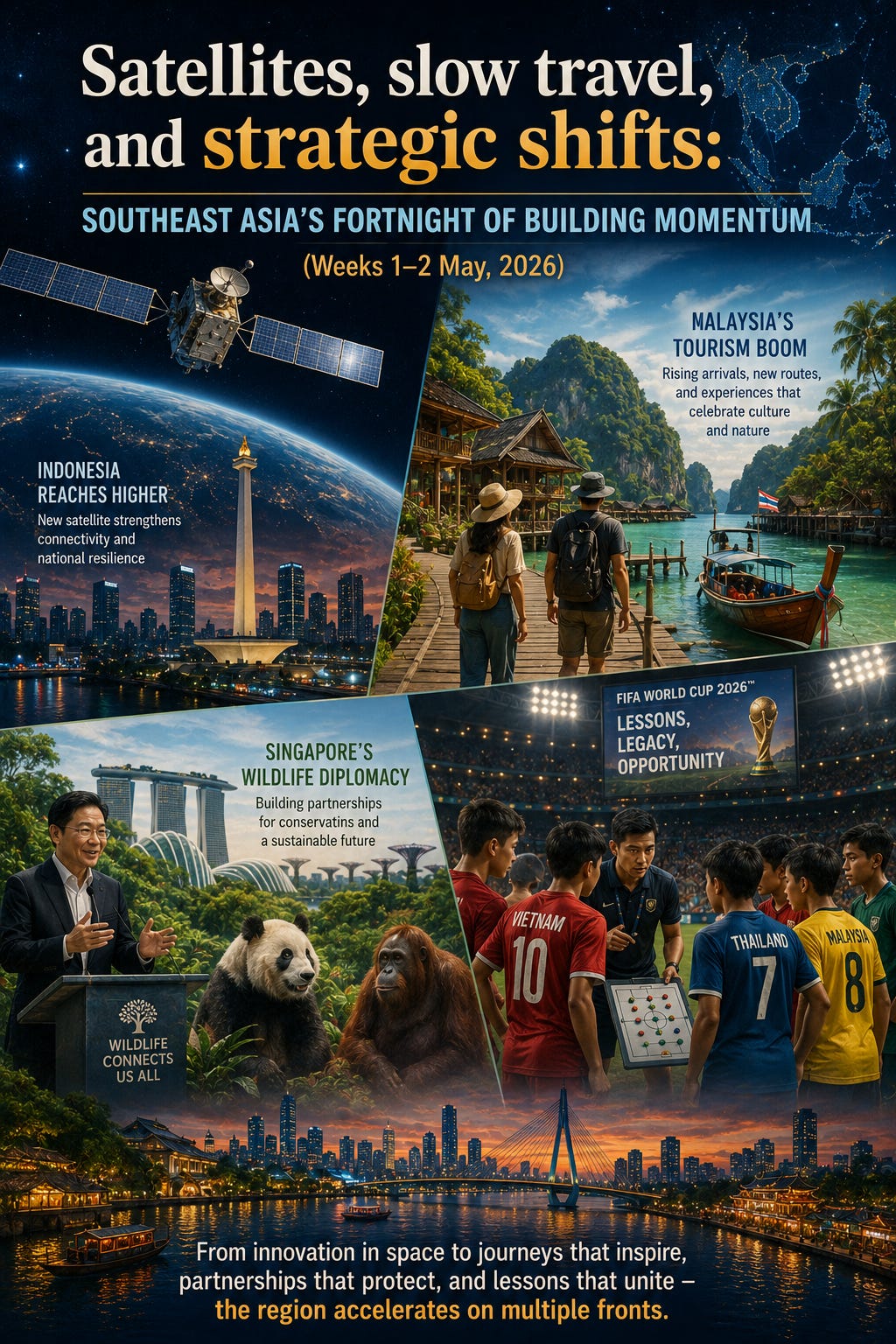
Your curated wrap-up from The Southeast Asia Desk.
Welcome back. The Desk Briefing paused last week for the Ascension Day national holiday in Indonesia, but the news never stopped. This fortnight’s edition captures two weeks of stories — from the launch of a major satellite to a record tourism quarter, from strategic diplomatic recalibration to the quiet art of slow travel.
Here is your news in focus.
🛰️ Indonesia’s Nusantara Lima begins operations, boosting digital connectivity
Indonesia’s newest satellite is now fully operational — and it’s the largest communications satellite in Southeast Asia. Nusantara Lima, built by Boeing and launched via SpaceX’s Falcon 9, delivers up to 160 Gbps of internet capacity using Very High Throughput Satellite (VHTS) technology. Positioned at 113° East longitude, it covers Indonesia, the Philippines, and Malaysia, with a 15+ year lifespan. For a nation of over 17,000 islands where 3,029 villages still lack internet access, this is a leap toward digital equality — and a statement of technological sovereignty. Indonesia now leads Southeast Asia with 20 satellites in orbit.
Read more:
https://www.thesoutheastasiadesk.com/p/indonesias-nusantara-lima-begins
🇲🇾📈 Malaysia tops 10.6 million arrivals as Southeast Asia’s tourism landscape shifts
Malaysia has cemented its position as the region’s most-visited country in Q1 2026. With 10.6 million international tourists (up 5% year-on-year), powered by Singapore (5.14 million), China (1.41 million, up 25%), and Indonesia (1.05 million), the “Visit Malaysia 2026” campaign is delivering. Meanwhile, Thailand is pivoting to “Quality Tourism” — prioritizing high-spending travellers over volume — as arrivals contracted 2.43% to 9.31 million. Vietnam posted record growth (6.76 million, up 12.4%), and Indonesia welcomed 3.44 million (up 8.62%). The takeaway? More competition means better value and richer experiences across the region.
Read more:
https://www.thesoutheastasiadesk.com/p/malaysia-tops-106-million-arrivals
🇮🇩🇸🇬 Rising 60: Indonesia and Singapore recalibrate their strategic partnership
Ahead of the 60th anniversary of diplomatic relations in 2027, Jakarta and Singapore are re-energizing their ties under the banner “RISING 60.” Foreign Ministers Sugiono and Vivian Balakrishnan met in Jakarta to deepen cooperation on energy security, the green economy, cross-border electricity trade, and ASEAN stability. Singapore remains Indonesia’s largest foreign investor (USD 17.4 billion in 2025), and bilateral trade reached USD 32.86 billion. The meeting also opened with condolences over three hikers killed in North Maluku — a reminder of the “closeness of the hearts” between the two nations.
Read more:
https://www.thesoutheastasiadesk.com/p/rising-60-indonesia-singapore-recalibrate
🐾 Otters, hornbills, and crocodiles: How Singapore learned to live alongside wildlife
Singapore has transformed itself from a concrete jungle into a thriving sanctuary for urban biodiversity. Through naturalized infrastructure (bio-engineered waterways), targeted species recovery (the Hornbill Project brought oriental pied hornbills back from local extinction), and the Wildlife Act (2020), the city-state has proven that dense urbanism can coexist with active ecosystems. For the rest of Southeast Asia, replicating this model is tougher: budget constraints, vast geographical scales, and ambiguous legal enforcement remain barriers. But the ASEAN Biodiversity Plan 2024-2030 offers a regional roadmap.
Read more:
https://www.thesoutheastasiadesk.com/p/otters-hornbills-and-crocodiles-how
✈️ Beyond the hype: What the World Cup teaches us about brand longevity
The 2026 World Cup offers a high-stakes lesson in brand strategy. As marketing leaders Antonius Pribadi and Andi Alaika argue, Japan’s “Samurai Blue” — propelled by decades of systemic investment — offers a model of structural endurance. Brazil’s post-2002 struggles, by contrast, show that even the richest talent is fragile without disciplined systems. For Indonesian brands trapped in a cycle of viral trends and “social commerce inflation,” the lesson is clear: shift from momentary digital relevance to structural endurance. Durable advantage comes not from playing the existing game harder, but from designing a game competitors struggle to play.
Read more:
https://www.thesoutheastasiadesk.com/p/beyond-the-hype-what-the-world-cup
🐢 Moving away from the trends: Slow travelling across Southeast Asia
Trade crowded hotspots for deep cultural immersion. Slow travel — born from Italy’s 1986 slow food movement — is finding its natural home in Southeast Asia. From Chiang Mai’s Mae Kampong Village (tea-leaf fermentation and shade-grown coffee) to Yogyakarta’s Borobudur Temple, from Luang Prabang’s morning alms ceremony to George Town’s Balik Pulau (durian farms and hiking trails), lingering in one place transforms the trip — and helps preserve the region’s rich heritage. The true magic? Living like a local, even just for a day.
Read more:
https://www.thesoutheastasiadesk.com/p/slow-travel-guide
🎙️ The Dispatch Podcast: Marathon running and digital nomads
Two podcast episodes this fortnight explore how movement defines modern Southeast Asia.
S26E15 – Marathon: Where running moves beyond the finish line. Southeast Asia’s destination marathons — from Singapore to Bali — are drawing runners from around the world, combining sport with cultural exploration.
S26E16 – Southeast Asia’s Digital Nomad Hubs: From Bali to Bangkok, Da Nang to Kuala Lumpur, the region is becoming the world’s most dynamic laboratory for remote work. Affordable cost of living, robust digital infrastructure, and tailored visa policies (Thailand’s DTV, Malaysia’s DE Rantau Nomad Pass) are luring talent from across the globe.
Listen:
https://www.thesoutheastasiadesk.com/p/s26e15-marathon-where-running-moves
https://www.thesoutheastasiadesk.com/p/s26e16-southeast-asias-digital-nomad
🧠 Also in the news this fortnight
The midnight obsession: Southeast Asia loves horror movie🎬 – In Southeast Asia, horror movies feels less like fiction and more like stories we secretly believe.
https://www.thesoutheastasiadesk.com/p/the-midnight-obsession-southeast
Southeast Asian MotoGP presence reaches new heights – Regional riders are making their mark on the world’s most prestigious motorcycle racing circuit.
https://www.thesoutheastasiadesk.com/p/southeast-asian-motogp-presence-reaches
Thailand-Indonesia explore Southeast Asia’s wellness future – Thailand is deepening healthcare and wellness cooperation with Indonesia as preventive care and healthy lifestyles emerge as major regional priorities.
https://www.thesoutheastasiadesk.com/p/thailand-indonesia-explore-southeast
ASEAN Unveils Sweeping Crisis Response Mechanism – A new regional framework for coordinated disaster and emergency response.
https://www.thesoutheastasiadesk.com/p/asean-unveils-sweeping-crisis-response
Crocodile Tears: When a psychological thriller sinks its teeth – A review of the region’s latest horror hit and what it says about Southeast Asian cinema.
https://www.thesoutheastasiadesk.com/p/crocodile-tears-when-a-psychological
☕ Weekend notes: Building momentum, not just managing crises
This fortnight’s stories reveal a region that is no longer just reacting — it is building.
Indonesia launched a satellite to close its digital divide. Malaysia posted record tourism numbers. Jakarta and Singapore deepened their strategic partnership ahead of a major anniversary. Singapore proved that dense urbanism can coexist with thriving wildlife. And across the region, travellers are discovering that slowing down might be the best way to move forward.
The news did not pause for a holiday. Neither does the region’s momentum.
✨ Stories to linger over, one week (or two) at a time.
(ELS/QOB)