



Your curated wrap-up from The Southeast Asia Desk.
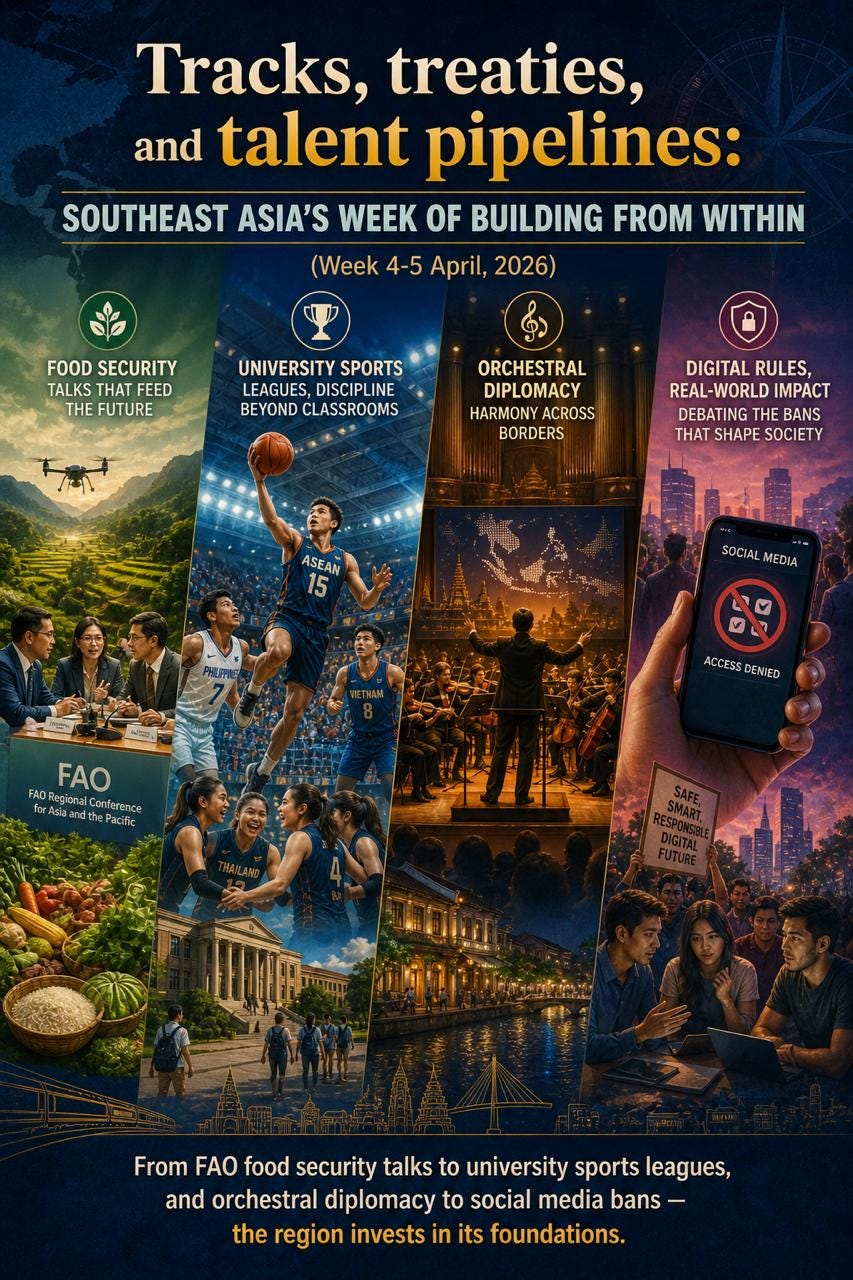
This week brought stories of a region looking inward to build outward. Food systems are being rethought from farm to fork. Talent partnerships are bridging Jakarta and Stockholm. University sports are getting their first professional league. Indonesia and the Philippines are aligning strategy ahead of ASEAN’s chairmanship. And even the rules of the MRT are revealing something deeper about who Southeast Asians are. The region is playing the long game, in policy, in culture, and in the daily rhythms of urban life.
Here is your week in focus:
🍴 Feeding the world, fixing the gap: Inside the latest FAO Regional Conference
Asia-Pacific produces more than half the world’s food — yet 42% of global hunger lives here. The 38th FAO Regional Conference (APRC38) in Brunei revealed a stark paradox: production alone does not equal security. The bottom line? Food security is not just a development goal — it is the basis of continuity for human civilization.
Read more:
https://www.thesoutheastasiadesk.com/p/feeding-the-world-fixing-the-gap
🎓 Sweden–Indonesia talent bridge gains momentum
Indonesian student mobility to Sweden rose 17% in 2024-2025, and the pipeline is widening. JOIN SWEDEN 2026, hosted by the Swedish Embassy in Jakarta, connected over 2,000 participants with leading universities (Lund, Uppsala, KTH) and global companies (Ericsson, IKEA, Volvo Cars).
Read more:
https://www.thesoutheastasiadesk.com/p/swedenindonesia-talent-bridge-gains
🎓 Campus League Season 1 launches: A new era for Indonesian university sports
Indonesia now has its first structured intercollegiate sports ecosystem, and it’s modeled on the NCAA. Campus League Season 1 (launched 20 April) expands from 2 to 6 cities, from 1 sport to 3 core sports (basketball, badminton, futsal), and introduces UniGames, a multi-sport finale featuring 13 additional sports. Drawing inspiration from the NCAA Philippines (established 1924, the oldest in Asia), the league is designed for the 99% of student-athletes who will not turn professional, developing soft skills that translate directly to workplace success.
Read more:
https://www.thesoutheastasiadesk.com/p/campus-league-season-1-launch-marks
🇮🇩🇵🇭 Forging ahead in crisis: Indonesia–Philippines align on ASEAN resilience
On the same day, two meetings, one policy, one public, delivered the same message: ASEAN must stay united. The 8th Joint Commission for Bilateral Cooperation (JCBC) in Jakarta saw Foreign Minister Sugiono and Secretary Ma. Theresa P. Lazaro deepen cooperation on local currency settlement, QR payment integration, maritime security, and diaspora documentation (~8,000 Indonesians in the Philippines, ~800 Filipinos in Indonesia).
Read more:
https://www.thesoutheastasiadesk.com/p/forging-ahead-in-crisis-indonesiaphilippines
🚇 Inside Southeast Asia’s unique MRT rules
From Singapore to Jakarta, mass transit reveals the soul of each city. With daily ridership reaching 3.4 million in Singapore, 500,000 in Bangkok, and 127,000 in Jakarta, standard rules apply everywhere: no eating, no loud noises. But local culture shapes unique etiquette. The MRT is more than transit, it’s a living ecosystem of social norms.
Read more:
https://www.thesoutheastasiadesk.com/p/inside-southeast-asias-unique-mrt
🎙️ The Dispatch Podcast: Why Southeast Asia’s cities are winning right now
Bangkok (#8), Singapore (#23), Hanoi (#25), and Ho Chi Minh City (#38) are beating global competition, and it’s not about luxury. According to the Time Out World’s Best Cities Index 2026, the region’s appeal is shifting from sightseeing to living like a local. The message: travel has changed, and Southeast Asia’s cities offer something the world is craving, identity you can feel.
Listen:
https://www.thesoutheastasiadesk.com/p/s26e13-why-southeast-asias-cities
🎵 Southeast Asia’s orchestral diplomacy tour
The baton has become a bridge. Indonesia’s Jakarta Concert Orchestra (JCO) just earned a standing ovation at the 40th Ankara International Music Festival and will become the first Indonesian collective to perform at Amsterdam’s legendary Het Concertgebouw. The Manila Symphony Orchestra is celebrating its centennial season. The Thailand Philharmonic, under Carl St.Clair, is tackling massive productions like Lord of the Rings with 250-person choruses. Southeast Asia is no longer just a stop on a world tour, it is the origin point for the next generation of global sound.
Read more:
https://www.thesoutheastasiadesk.com/p/southeast-asias-orchestral-diplomacy
📱 Indonesia’s social media ban: The kids will find a way. Will you?
On March 28, Indonesia banned social media accounts for children under 16, and marketers panicked. The lazy answer is to target mothers harder. The smarter pivot? From buying users to buying moments: co-viewing, family screens, gaming, and any context where the person who wants the product and the person who buys it are in the same room.
Read more:
https://www.thesoutheastasiadesk.com/p/indonesias-social-media-ban-the-kids
☕ Weekend notes: Building from within
This week’s stories share a single thread: Southeast Asia is investing in its own foundations, not as a retreat from the world, but as a strategy for engaging it on its own terms.
Food systems are being reorganized to close the gap between production and access. Talent pipelines are being built with Sweden, the EU, and beyond. University sports are getting a professional structure after decades of absence. Indonesia and the Philippines are coordinating ahead of ASEAN’s chairmanship. Orchestras are touring Europe, and cities are topping global rankings.
The region is no longer waiting for the world to notice. It is building the infrastructure, physical, institutional, and cultural — to shape its own future.
✨ Stories to linger over, one week at a time.
(ELS/QOB)