




Hello and welcome to The Southeast Asia Desk Weekly.
I’m Akasha Viandri.
This is where we slow down the headlines and make sense of the stories shaping our region.
In this episode, we’re gonna talk about a dream.
A dream of living long, comfortable lives, for us and Mother Earth.
🎣 The Hook
To make that dream real, in December 2015, almost every country signed the Paris Agreement, pledging to limit global warming by cutting greenhouse gas emissions by 43 percent by 2030.
Including Indonesia? Of course, along with the rest of ASEAN.
But how far do we need to go to keep that promise?
And how essential is it, really?
🌍 It is essential
To answer that, picture a day from the moment you wake up until you go back to sleep.
First, you hear your alarm ring. Then you take a hot shower in the morning.
You’re ready to go, don’t forget to fill up your car!
Now you’re at the office. You heat up your lunch in the microwave.
Let’s just skip the working part, okay?
You charge your phone and bla bla bla… and then you head home and go to sleep.
Every step of your daily routine runs on fossil fuels, oil, gas, and coal, which still power about 80 percent of global energy demand.
This energy built our modern world, but it’s finite.
In the next 60 to 100 years, it could be gone. And I tell you, that’s like the blink of an eye.
To add to the tension, it also has a high environmental cost.
And what is the cost? the carbon they leave behind.
Greenhouse gases, especially carbon dioxide, trap heat in our atmosphere and drive climate change.
So, if the world wants to keep the Paris promise, we have to cut fossil-fuel use, invest in renewable energy, and create an economy powered by green industry and cleaner air.
🌱 The potential
Can we do it? Of course. The potential is there, and it’s massive
The block has more than 7,000 gigawatts of renewable energy from solar, wind, hydro, and geothermal sources.
Indonesia could be the cornerstone of that future, holding roughly 3,600 gigawatts of renewable potential.
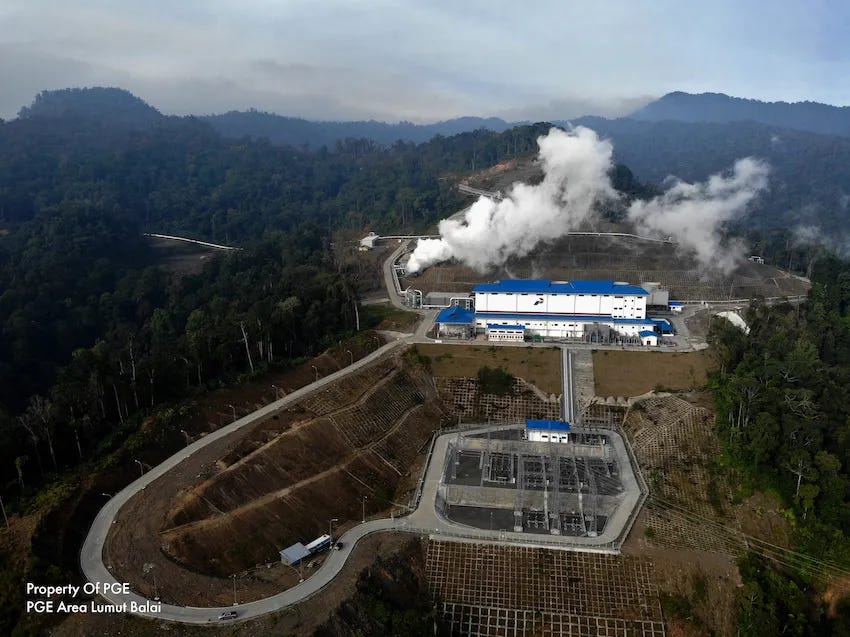
The country even ranks second in the world for geothermal capacity, behind the United States and just ahead of the Philippines.
✨Three, two, one… and go
So, ASEAN has set some goals.
First, according to the ASEAN Centre for Energy, the bloc is targeting a 23 percent share of renewable energy in total primary energy supply by 2025, and raising that to over 70 percent by 2050.
In the near future, ASEAN’s renewable capacity is expected to grow from around 125 gigawatts in 2025 to about 178 gigawatts by 2030
To align with that vision, Indonesia has pledged net-zero emissions by 2060.
In the coming years, the country is going all in on adding 69.5 gigawatts of power capacity, with about 61 percent, or 42.6 gigawatts, coming from renewable sources.
Second, ASEAN also needs to cut fossil-fuel imports and invest more aggressively in solar, wind, hydro, and geothermal.
Third, the paperwork. Governments must streamline regulations and licensing so renewable projects actually attract investors.
Because here’s the truth: all of this takes money.
The International Energy Agency estimates that the Asia-Pacific region must triple its investment in renewable energy.
Meanwhile, Indonesia’s Chamber of Commerce estimates 3.8 trillion US dollars in renewable-energy investment opportunities, about 4 percent of GDP from 2025 to 2050.
Do we need to worry? Nope.
What is the point of having siblings if they don’t help each other?
ASEAN needs to act like siblings, like family.
That means working more closely as a region and getting the private sector on board, so clean energy projects can grow.
📩 The Wrap
This will be a long journey
Not to mention that one of the original initiators of the Paris Agreement, the United States, has been a bit wishy-washy…
withdrawing, rejoining, and withdrawing again in 2025.
ASEAN, and the rest of the world, must stay the course.
So our next generation won’t have to daydream about a comfortable life.
They will simply live it.
I’m Akasha Viandri, and this has been The Southeast Asia Desk Weekly Dispatch, where we slow down the noise and follow the region’s compass.
If you enjoyed this episode, subscribe to our newsletter at thesoutheastasiadesk.com, and join us again next weekend for stories to linger over, one weekend at a time.
(AKS/QOB)


