




🎯The Main Takeaway
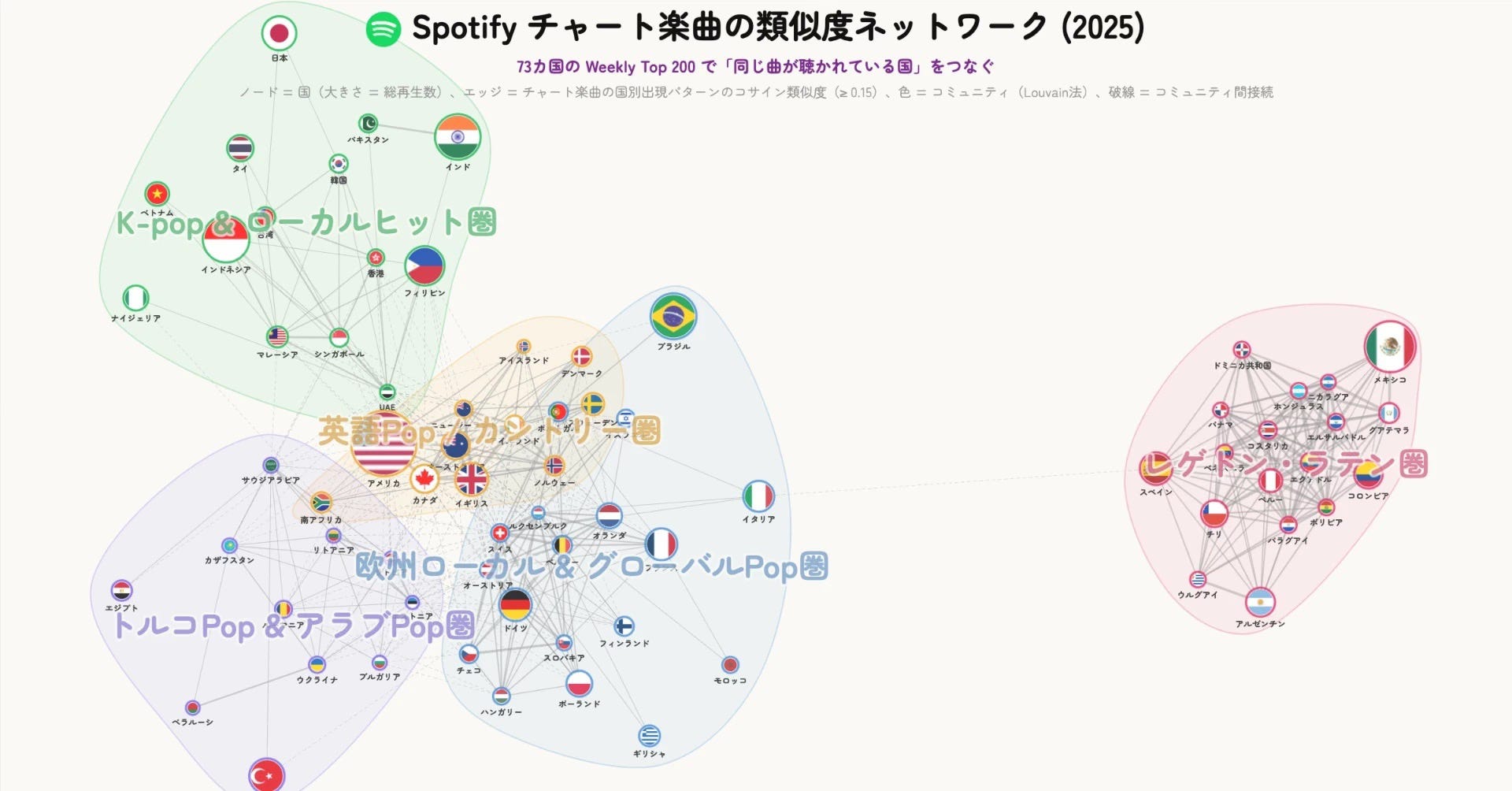
Indo Pop’s share of Spotify Indonesia’s weekly streams climbed from 60% in 2023 to 78% in 2026. Over the same stretch, K-Pop’s slice shrank in near-perfect inverse proportion — a correlation of r = −0.79. That’s not coincidence; it’s a structural shift in listening culture.
A Jakpat survey confirms the mood: 74% of Indonesian listeners now prefer local artists. Only 40% express interest in K-Pop — down sharply from the genre’s recent peak.
For more on Indonesia’s pop ascension, read our piece on No Na’s “Rollerblade” and how Southeast Asia is using orchestral mastery as soft power.
🔍Why It’s On Our Radar
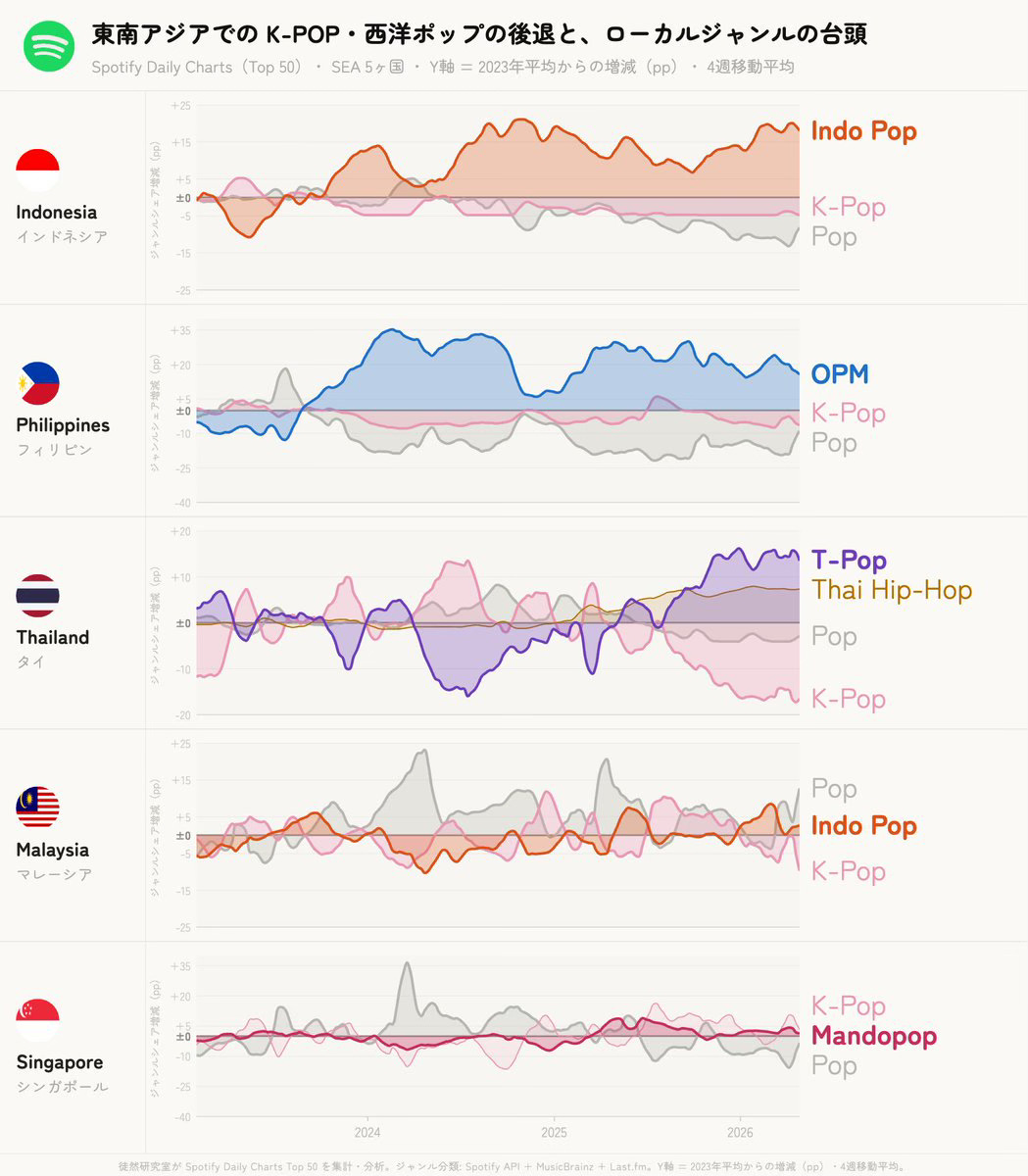
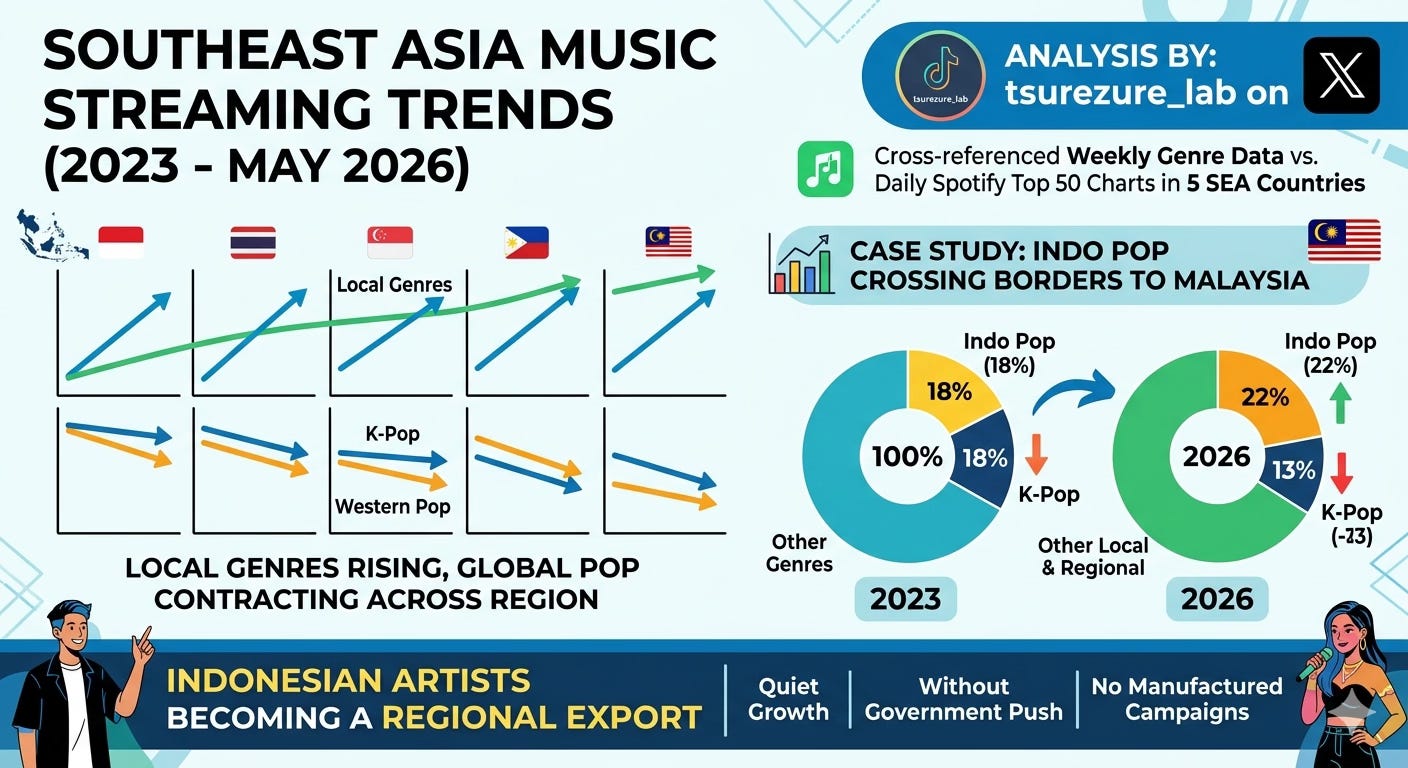
Analyst account tsurezure_lab on X cross-referenced weekly genre-streaming data against daily Spotify Top 50 charts across five Southeast Asian countries — from 2023 through May 2026. Their conclusion: local-genre streams are consistently rising across the region, with K-Pop and Western Pop contracting in tandem.
Indonesian music has even jumped borders. Indo Pop’s share of Malaysia’s Spotify charts moved from 18% in 2023 to 22% in 2026, while K-Pop fell from 18% to 13% in the same market. Indonesian artists are becoming a regional export — quietly, without a government push or a manufactured campaign.
⚖️What’s at Stake
Physical album sales in South Korea peaked at 120 million units in 2023. By 2025, that figure had fallen to 93.5 million — a drop of more than 20%. Paradoxically, export revenue hit a record US$300 million in 2025, suggesting the industry is chasing global audiences while its domestic fanbase grows restless.
The Guardian flagged this tension in March 2025: Korean listeners are reportedly fatigued by an industry that has prioritised international palatability over local authenticity. The very formula that made K-Pop a global phenomenon may be hollowing it out from the inside.
🌏The Big Picture
Southeast Asia absorbed decades of exported pop culture — American, British, then South Korean. What tsurezure_lab’s data reveals is that the region is no longer purely a consumer market. Indonesia, the fourth most populous nation on earth, is generating cultural exports of its own. If this trajectory holds, it has implications not just for streaming economics but for how Southeast Asian identity is imagined and performed.
Jakarta’s Spotify City Top 100 told a clear story across years: in May 2022, at least eight K-Pop tracks appeared on the chart. By the same window in 2026, K-Pop’s presence had dwindled to near-invisibility. The slot it vacated wasn’t filled by American pop. It was filled by Indonesia itself.
🏠Why This Hits Home

The new wave of Indonesian chart-toppers isn’t cookie-cutter. Pop balladeers like Bernadya, Tiara Andini, Mahalini, and Fabio Asher have become fixtures. The alternative wave — Hindia, Perunggu, Sal Priadi, Nadin Amizah — consistently dominates the 2025–2026 period.
More striking still: the Jakarta chart is opening up to voices from beyond the capital. Artists like Ndarboy Genk, Silet Open Up, and Raim Laode are bringing regional accents, local idioms, and non-metropolitan rhythms into mainstream rotation. The centre is decentralising — and audiences are following.
🗺️The Regional Stakes
The cross-border numbers matter. Indo Pop’s rise on Malaysian charts — from 18% to 22% — signals that Indonesian music is beginning to travel. A new generation of artists is also emerging with an eye on synthesis rather than imitation: Tenxi, Naykilla, and Jemsii are blending hip-hop and dangdut (hip-dut/trap-dut) into something distinctly local yet globally legible. No Na is packaging that sensibility in an idol-group format.
This matters because the next decade of Southeast Asian pop will be shaped by whoever creates the template. Right now, Indonesian artists appear to be writing it.
⬛ The Bottom Line
K-Pop’s recession is real — and it’s not merely a blip in fan enthusiasm. It’s a structural consequence of an industry that over-globalised at the expense of domestic authenticity, leaving space for competitors it didn’t take seriously.
Indonesian music filled that space not with mimicry, but with confidence in its own identity — its languages, accents, regional sounds, and hybrid genres. The era of Southeast Asia as a passive consumer of foreign pop is ending. What replaces it is being written, right now, in Bahasa Indonesia.
(ZIL/VBD/ELS)