



🎯 The Main Takeaway
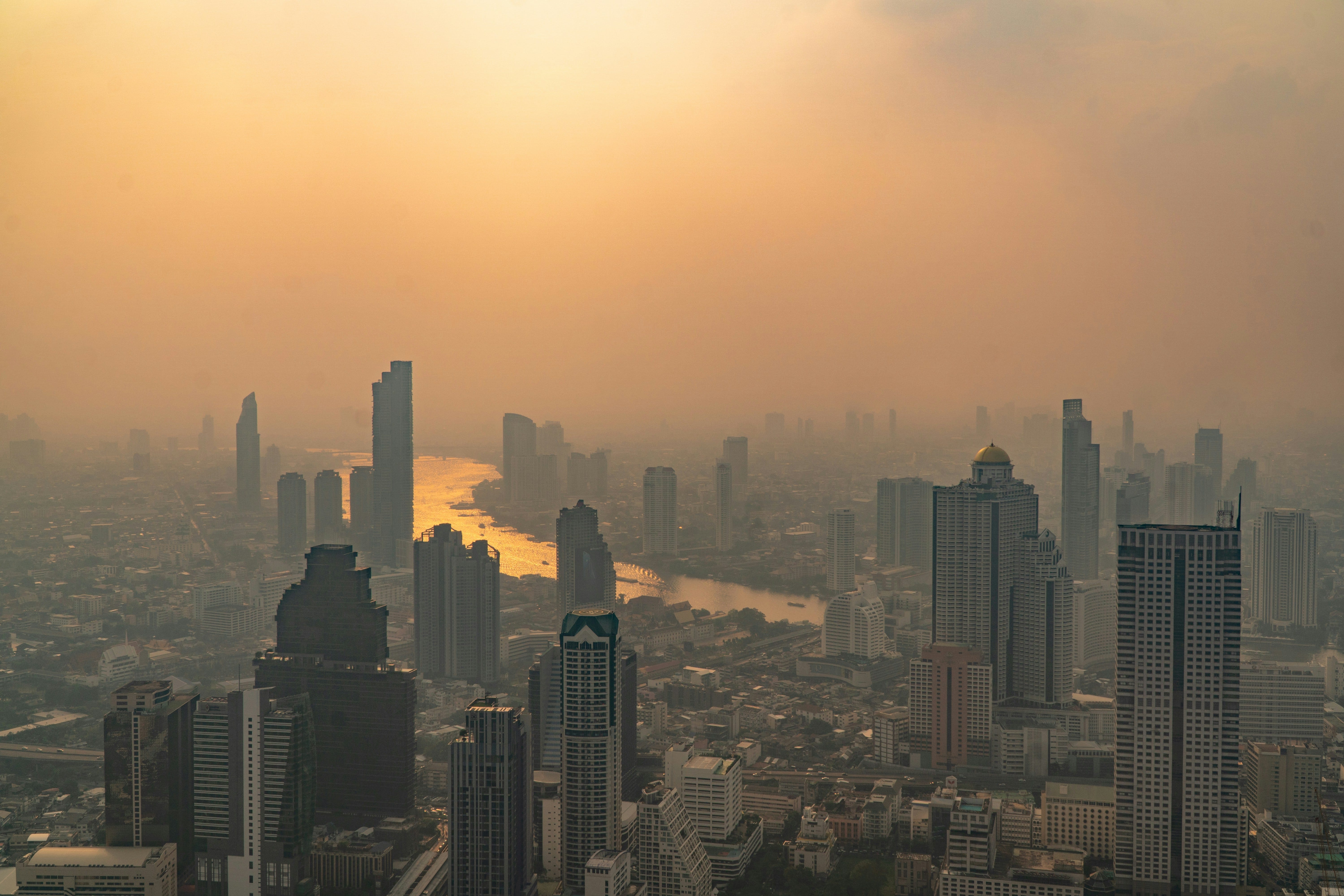
Southeast Asia is enduring a dual climate emergency: extreme humid heat pushing the human body to its limits, and escalating wildfire haze threatening public health.
A Climate Central report reveals that parts of the region now experience at least six months of “dangerous” humid heat days annually, defined by a wet-bulb temperature of 25°C or higher—a threshold where the body’s cooling system becomes strained.
The duration of extreme weather has more than doubled globally, from an average of 10 days per year in the 1970s to 23 days today.
Meanwhile, 81,000 hectares of land have already burned in Indonesia this year amid scorching heat and a strengthening El Niño, with the government warning the situation will worsen through October.
Haze is drifting across the region, with Singapore, Malaysia, Indonesia, and Brunei facing a high risk of severe haze in the coming months.
Curious about the 'Godzilla' El Niño and its looming threat in Southeast Asia? Read our deep dive here.
🌍 The Global Context: Europe and the World Feel the Heat
A NASA Earth Observatory visualization, created by Lauren Dauphin using GEOS data from NASA’s Global Modeling and Assimilation Office, confirms that this heatwave is no local anomaly.
Europe is in the grip of a severe heatwave, which scientists from World Weather Attribution have linked directly to climate change.
In France alone, the crisis has claimed 1,000 excess lives since 20 June—most of them elderly—and Health Minister Stephanie Rist has cautioned that the effects could persist for up to 10 more days.
Across 30 European countries, 45% of 854 cities have either broken or are on track to break their wet-bulb temperature records.
As Imperial College London researcher Theodore Keeping warned: “The science of how climate change is worsening heatwaves is settled.
Continued fossil-fuel emissions are directly responsible for the disruption people are experiencing this week.”
Globally, extreme weather events have more than doubled in duration over the past 50 years, with tropical humid regions such as Southeast Asia experiencing the sharpest increases. Human activity remains the primary driver, responsible for nearly two-thirds of dangerous humid heat days worldwide.
📡 Why It’s on Our Radar
Southeast Asia’s vulnerability to this dual crisis is acute and deeply structural.
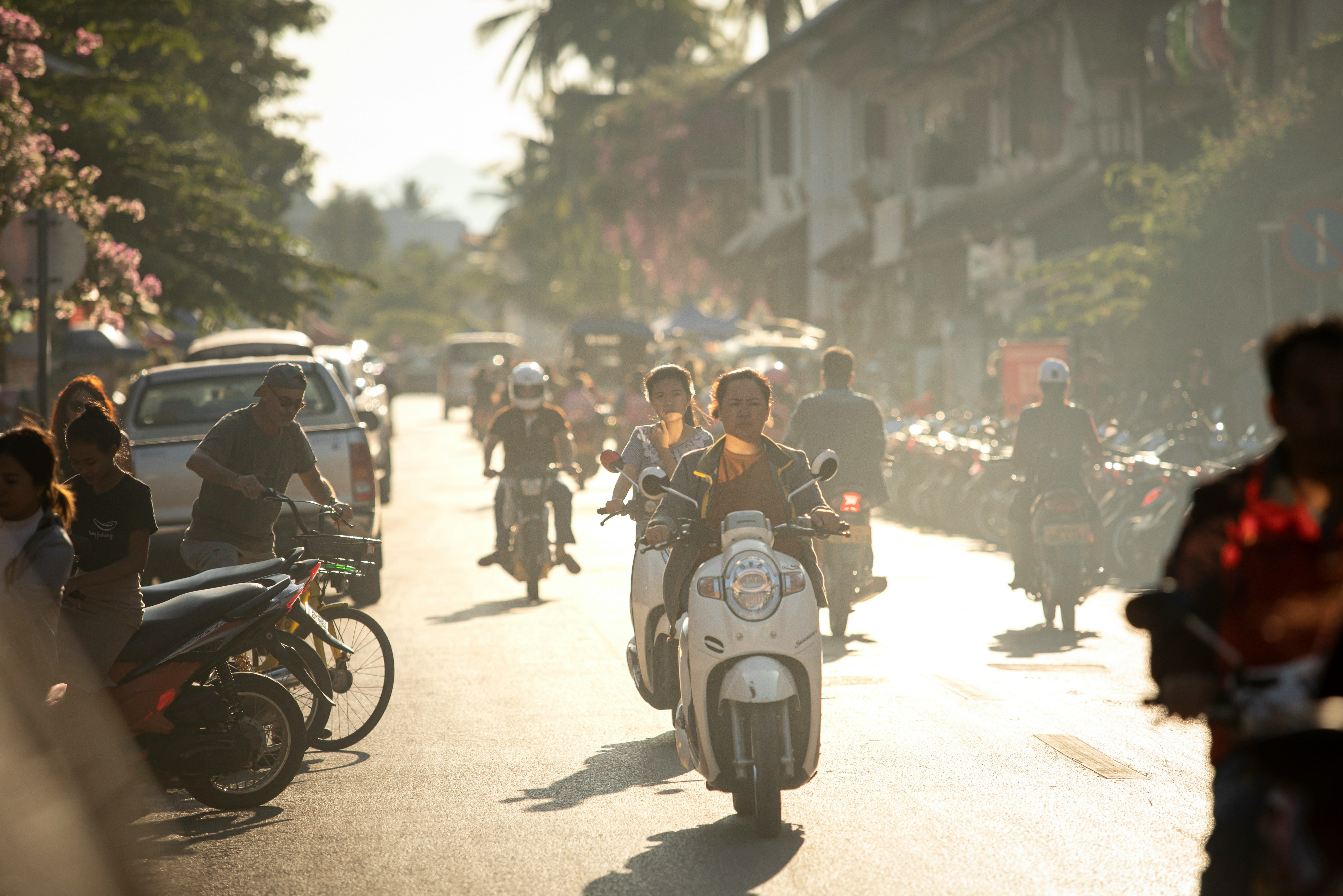
The Climate Central report makes clear that dangerous humid heat has shifted from an anomaly to a defining feature of daily life in parts of the region, pushing conditions closer to the limits of what the human body can safely endure. This is not a distant projection—it is the lived reality for millions.
The economic stakes are equally severe. The McKinsey Global Institute warns that Southeast Asia’s heavy reliance on outdoor labour makes it uniquely exposed to climate hazards.
Agriculture accounts for between 8 and 15 percent of GDP in Cambodia, Indonesia, and Thailand—well above the global average of 4 percent. As heat intensifies, productivity in these sectors will suffer directly, with cascading effects on food supply chains and rural livelihoods.
Compounding the problem is a chronic underinvestment in adaptation. The region currently spends approximately US$12 billion annually on climate measures, including cooling systems, irrigation, stormwater networks, and early warning infrastructure.
To maintain even a basic standard of protection comparable to that of developed economies, that figure would need to nearly triple to US$37 billion per year.
The result is a region caught between escalating hazards and insufficient defences. Without a rapid scaling up of adaptation efforts, the combination of extreme heat, drought, and haze will only tighten its grip on Southeast Asia’s people and economies.
☀️ The Heat Crisis: Bangkok and Beyond
Bangkok is set to become Southeast Asia’s hottest major city by 2050, according to an ASEAN Centre for Energy report. Key projections:
2025: Around 45 “extreme heat days” (>35°C)
2050: Projected to rise to 120 days annually—nearly three times as many
Average daily maximum temperature to climb from 33.3°C in 2000 to 38.1°C by 2050
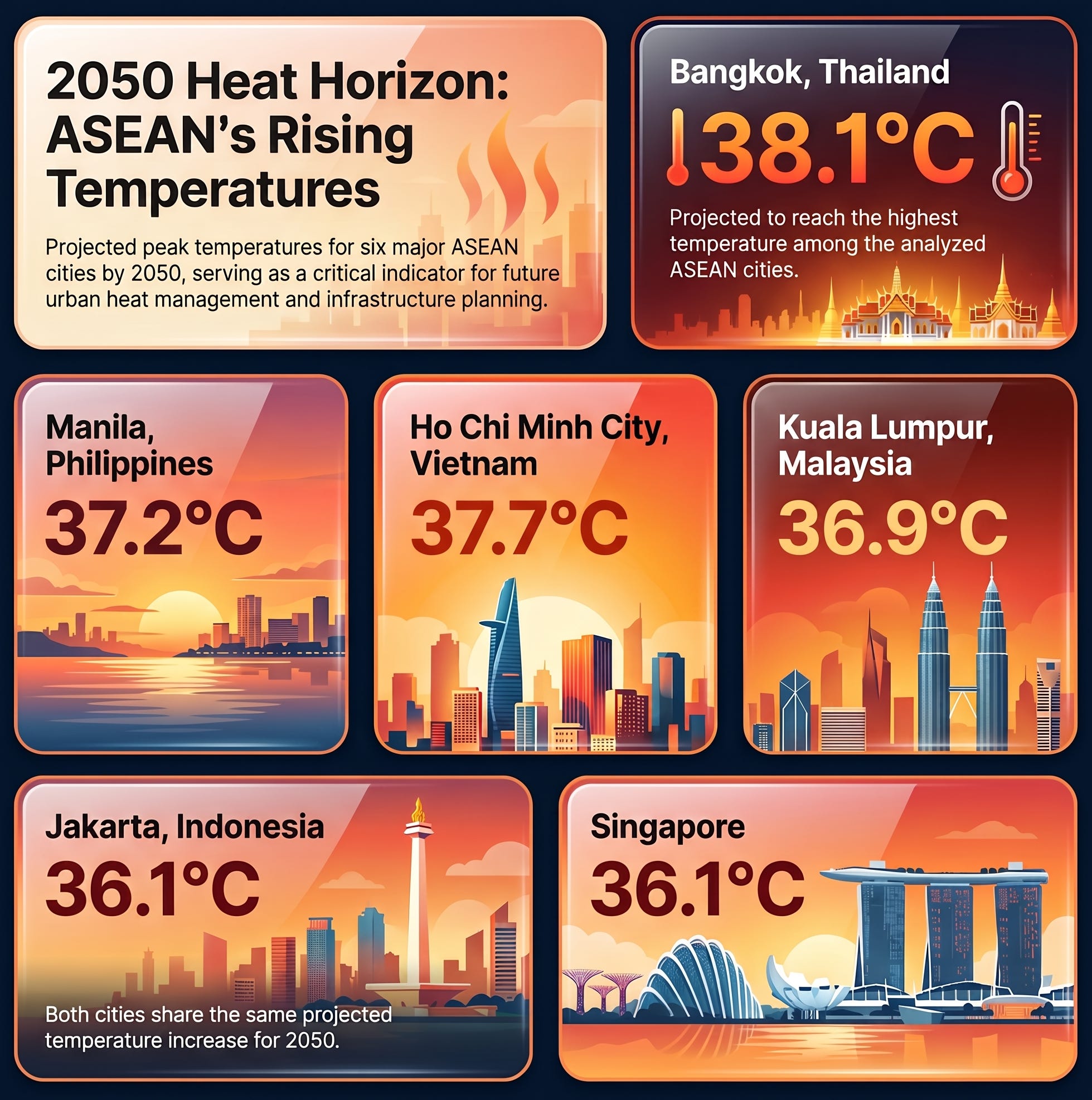
The urban heat island effect makes central Bangkok up to 3°C hotter than the greener outer areas.
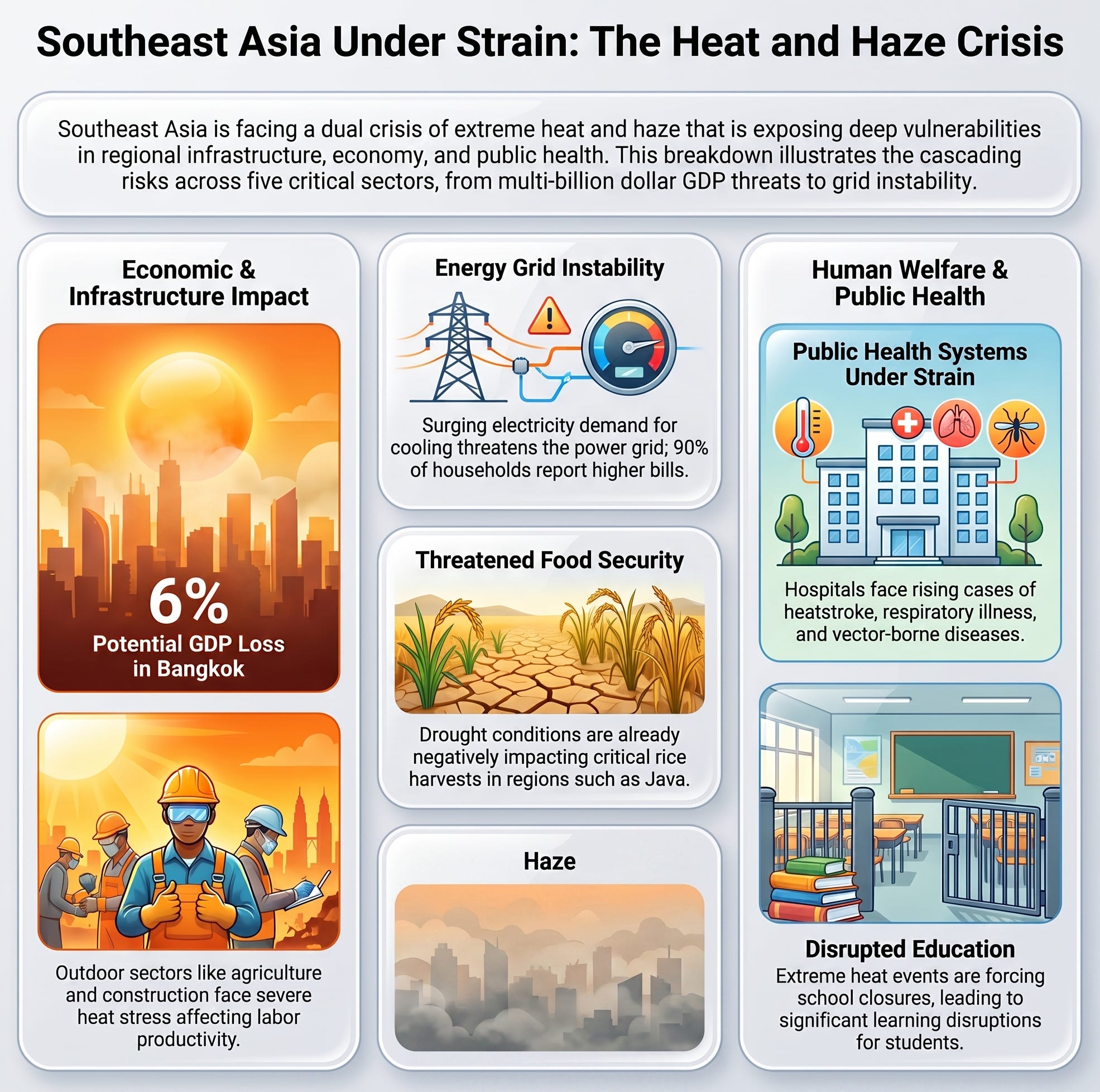
Without proper adaptation, heat-related economic losses in Bangkok could reach 6% of the city's GDP by 2050.
🔥 The Fire Factor: Indonesia’s Burning Crisis
Indonesia’s dry season has expanded significantly, with rainfall now below normal across most of Kalimantan, Sulawesi, Maluku, North Maluku, and Papua.
This is being driven by a strengthening El Niño, with BRIN researchers predicting a strong El Niño by July and a peak drought in August-September.
Key fire data:
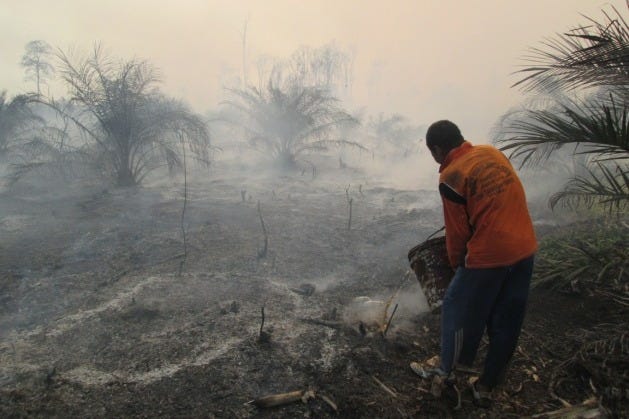
81,000 hectares of land have burned so far this year, exceeding last year’s figures
Forestry Minister Raja Juli Antoni warned the threat will grow “when later in July to October”
1,601 hotspots were detected across Indonesia as of early April, with numbers expected to rise
2,715 hotspots in Aceh province alone between January and May, with Nagan Raya seeing a 43-fold increase compared to the same period last year
The Coordinating Minister for Political and Security Affairs, Djamari Chaniago, has ordered tighter coordination to prevent larger fires.
🏠 Why This Hits Home
Southeast Asian communities are facing real-time consequences:
Drought and water shortages – At least three districts in Java are already experiencing clean water crises, affecting over 1,600 residents. Karawang, Bogor, and Cilacap are among the worst affected.
Health emergencies – Thailand’s heat index reached a staggering 54°C in some districts, heightening the risk of heatstroke. Bangkok’s heat index peaked at 51.9°C.
Economic strain – Households across the region face higher electricity bills as air conditioning becomes essential. Some 90% of Bangkok survey respondents said their energy bills rose by 10-50% during heatwaves. Low-income families in poorly ventilated housing are most at risk.
Mental health impact – Lack of sleep, chronic fatigue, and the stress of living under constant heat and fire threat are taking a toll on quality of life.
⚡ What’s at Stake
🏁 The Bottom Line
Southeast Asia is at the sharp end of global climate change. The combination of naturally occurring El Niño and human-caused warming is pushing the region toward unprecedented heat and haze.
The Climate Central report’s conclusion is stark: dangerous humid heat has become a defining feature of daily life in parts of Southeast Asia, pushing the human body to its limits.
The region’s adaptation investments are less than a third of what is needed to protect communities and economies.
With the dry season still to peak and El Niño set to strengthen, the worst of the heat and fire season may lie ahead.
The window to mitigate the worst impacts is closing fast—and the choices made now will determine whether Southeast Asia can adapt or be overwhelmed by the climate crisis.
🔎 Need More Angles
ABC News Heat stress is intensifying worldwide, scientists say
Bangkok Post Singapore, Indonesia, Malaysia, Brunei face high risk of severe haze
China Daily Bangkok set to be SE Asia’s hottest major city by 2050
Edge, The Climate: Malaysia must prepare for hot and dry weather with impending El Niño
Kompas Parts of Indonesia are Entering the Dry Season, and El Nino Will Soon Become Active
New York Times, The Climate Change Fueling Europe’s Ferocious Heat Wave, Scientists Find
Reuters Record heatwave disrupts Europe as France warns death toll to rise
South China Morning Post Asia’s ‘dangerous’ humid heatwaves push human body to its limits
South China Morning Post Malaysia warns of health risks from heatwave, 2 related deaths recorded this year
Star, The Bangkok heat index reaches 51.9°C, heightening heatstroke risk
Strait Times, The Demand for air-conditioner servicing, repairs heats up in Malaysia amid prolonged hot weather
Tempo Indonesia’s Dry Season Expands, Heavy Rain Unlikely Through June 22
Tempo Singapore Think Tank Warns of Severe Haze Risk in Southeast Asia
VNExpress High humidity pushes heat index of world’s most-visited city into ‘danger’ zone
(ELS/QOB)