




🎯The Main Takeaway
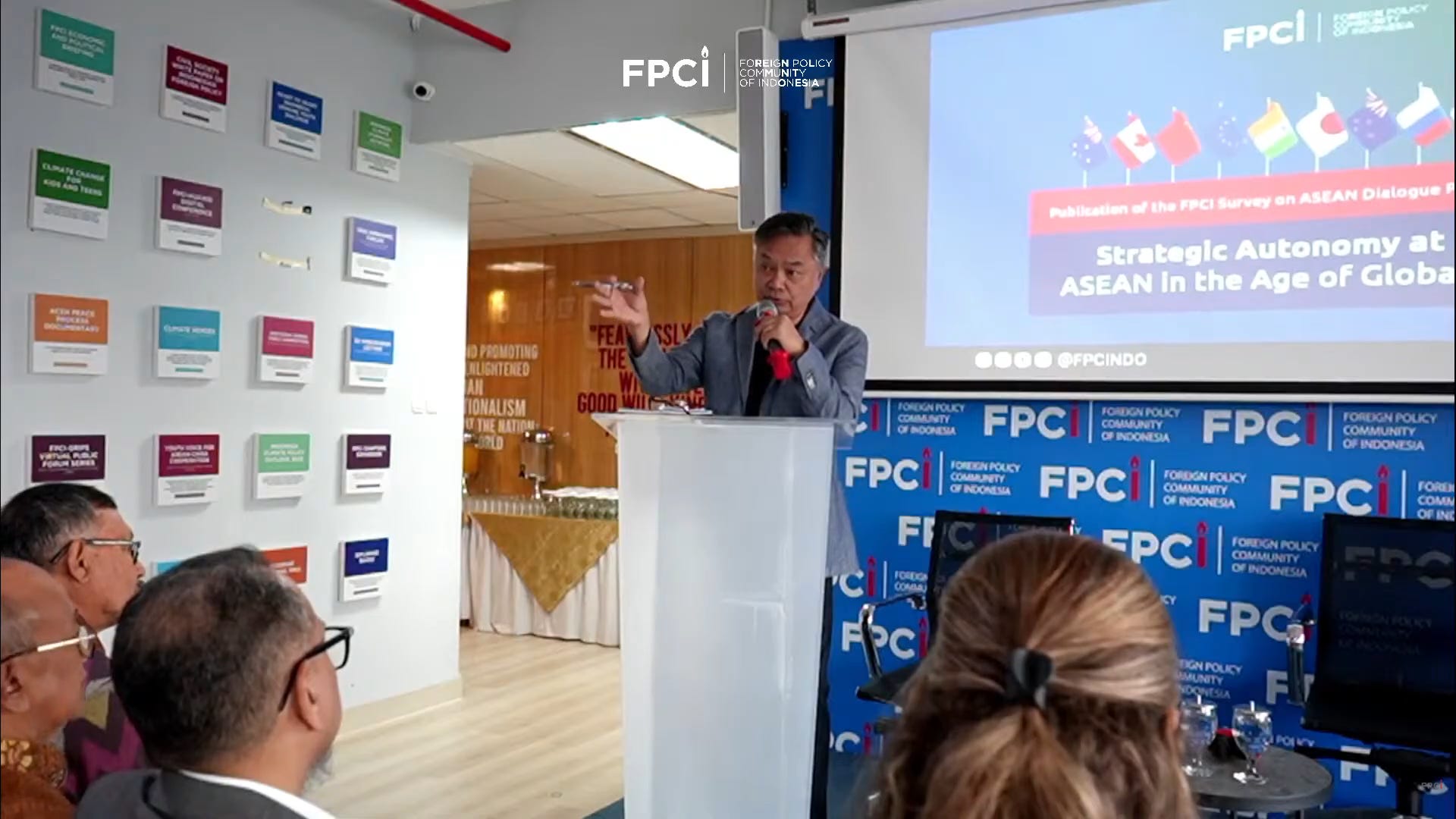
The Foreign Policy Community of Indonesia (FPCI) published its “FPCI Survey on ASEAN Dialogue Partners 2025” on Tuesday, March 31, 2026.
The survey was conducted from October 2025 to February 2026, and consisted of 42 questions answered by 2,012 respondents, across 11 ASEAN member states. Respondents ranged from academics, government officials, the business community, civil society, and students.
The program aims to capture public perceptions and attitudes in Southeast Asia, about relationships with ASEAN Dialogue Partners across the region.
📡Why It’s on Our Radar?
Several key events that occurred last year triggered the survey:
💰The U.S. reciprocal tariff policy: Announced by President Donald Trump on April 2, which imposed additional tariffs of 10% to 50% on imports from various countries, based on U.S. trade deficits.
⚔️Ongoing regional conflicts: Including the Russia–Ukraine war, Israel–Palestine conflict, Thailand–Cambodia tensions, the Myanmar coup, South China Sea disputes, and U.S.–China trade tensions.
🗺️ The next world order: The unipolar and rule-based order of the U.S. is declining, as new multipolar powers such as China, Russia, the Global South, and middle powers are rising, triggering a shift in the global economy and geopolitical maps.
🔍Other issues: Include climate change, food security, the green energy transition, transnational crime, cyber disruptions, and human rights.
⚠️ Why It Matters?
These key events have triggered global and regional impacts, including:
🌍Global uncertainty: Increased risks and instability affecting economies and politics worldwide.
📉Market disruption: Reduce reliance on single partners and force countries to expand sources, supply chains, products, and markets.
🤝Direct negotiation: Countries forced to pursue diplomatic efforts to reduce tariffs and achieve mutual trade goals.
🔄Intensify intra-ASEAN trade: Boost trade within ASEAN member states to strengthen regional resilience.
🌱Climate funding: Allocate more budget to cut emissions through the state budget and joint investments.
🛡️Security cooperation: Strengthen international collaboration, reform domestic laws, and border controls to address cross-border threats.
🏡 Why This Hits Home?
After its establishment in 1967, ASEAN introduced the Dialogue Partner mechanism to strengthen economic and political cooperation with external countries and organizations for mutual benefit.
Australia became ASEAN’s first Dialogue Partner in 1974. As of 2026, ASEAN has 11 Dialogue Partners: Australia, Canada, China, the E.U., India, Japan, New Zealand, South Korea, Russia, the U.K., and the U.S.
Moreover, ASEAN established the Comprehensive Strategic Partnership as its highest level of cooperation in 2021. Currently, seven countries have joined: Australia, China, India, Japan, New Zealand, South Korea, and the U.S.
“Pay attention to ASEAN. What happens at the global level should reinforce our belief that it is in ASEAN that we must prioritize our international relations. If you have regions where there is coherence in peace and cooperation, internally and between regions, then you have a functioning regional order. Because it is very important to understand what the people of ASEAN think about our dialogue partners, especially because I think Southeast Asia, ASEAN, is the only region in the world that has that mechanism.”
Dino Patti Djalal, FPCI Chairman & Founder.
📊 Respondent Profile
The majority of respondents were from 🇮🇩Indonesia (30.42%) and 🇱🇦Laos (10.19%), while other ASEAN Member States accounted for less than 10% each.
Most respondents were 🧑🏫 students (35.04%) and 🎓 academics (20.87%), while government officials, civil society, and business representatives each accounted for less than 20%.
45.53% of respondents were 📱Gen Z, followed by 💻millennials (25.25%), 🧑💼Gen X (22.32%), and 👴👵boomers (6.91%).
51.19% were ♂️male, and 48.81% were ♀️female.
🇺🇸 U.S. Reciprocal Tariff Related Findings
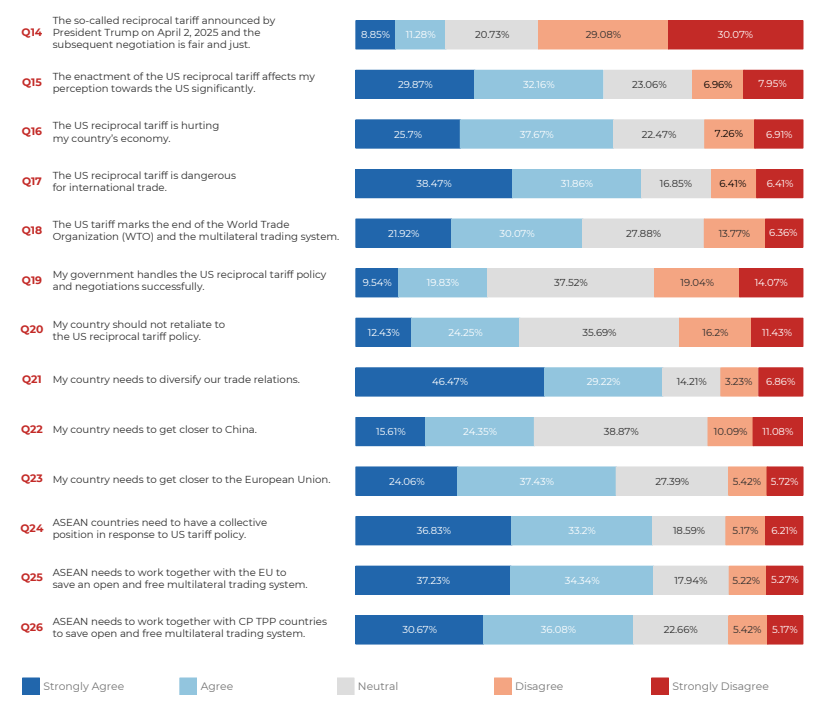
Several key findings were identified regarding the U.S. reciprocal tariff policy:
❌ 59.15% respondents view the policy as unfair and unjust.
💥 63.37% believe it could harm ASEAN Member States’ economies.
⚠️ 70.33% say it poses risks to international trade.
⛔ 51.99% respondents agreed that the U.S. reciprocal tariff policy marks the end of the WTO and the multilateral trading system.
As a result, 62.03% agree it affects their perceptions of the U.S.:
📉 The share of respondents who see the U.S. as the most trusted and most respected partner for ASEAN declined to 5.47% and 6.16% in 2025.
📈Meanwhile, the share for China as the most trusted and most respected partner for ASEAN increased to 12.28% and 12.08%.
The Solutions:
🔀 75.69% believe ASEAN should diversify its partnerships, mainly toward the EU (61.48%) and China (39.96%).
🌏 70.33% support a collective ASEAN response to the tariffs.
🇪🇺71.57% recommend working with the EU to support an open, multilateral trading system.
🤝66.75% urge ASEAN to pursue the Comprehensive and Progressive Agreement for Trans-Pacific Partnership (CPTPP).
“We fully understand the importance of ASEAN, the importance of ASEAN stability, ASEAN centrality, and of the important roles that all of the countries within ASEAN are playing, and will continue to play in the region. We certainly see the grouping of ASEAN as an extraordinarily powerful group of middle powers who have the influence and the ability to shape the rules-based international order and the foreign policies that will be based upon that.”
Ambra Dickie, Ambassador of the Mission of Canada to ASEAN.
🤝 Dialogue Partners Related Findings
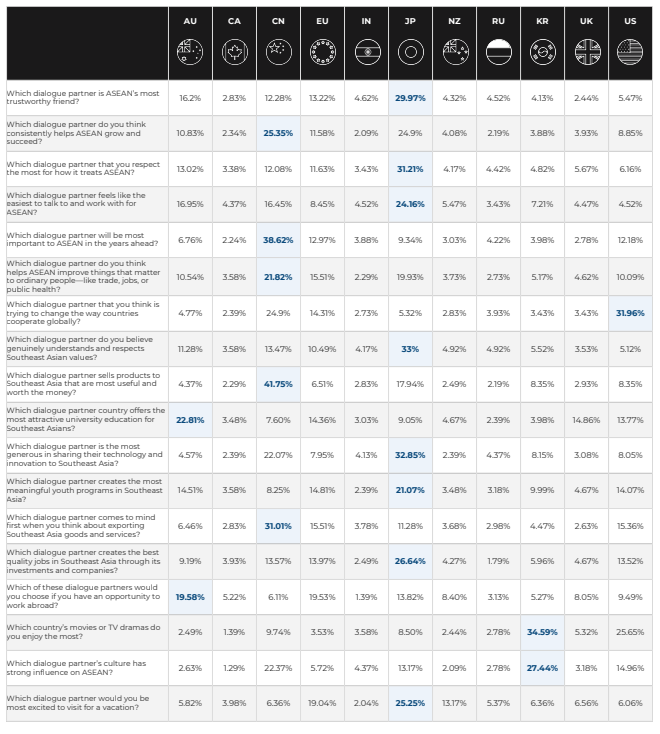
Public perceptions of ASEAN Dialogue Partners across 18 niche attributes:
🇯🇵Japan remains ASEAN people’s top dialogue partner, seen as the most trustworthy and respected, easy to work with, understanding of Southeast Asian values, and offering strong technology, innovation, youth programs, quality jobs, and travel opportunities.
🇨🇳 China is considered ASEAN’s most important dialogue partner, particularly for economic development, as it consistently supports ASEAN’s growth and success, improves people’s daily lives, offers competitive products, and serves as a key export destination.
🇦🇺 Australia is seen as a top destination for higher education and working abroad.
🇰🇷 South Korea is known for its popular movies and TV dramas, with a strong cultural influence in ASEAN.
🇺🇸 The U.S. is seen as a dialogue partner that shapes global cooperation.
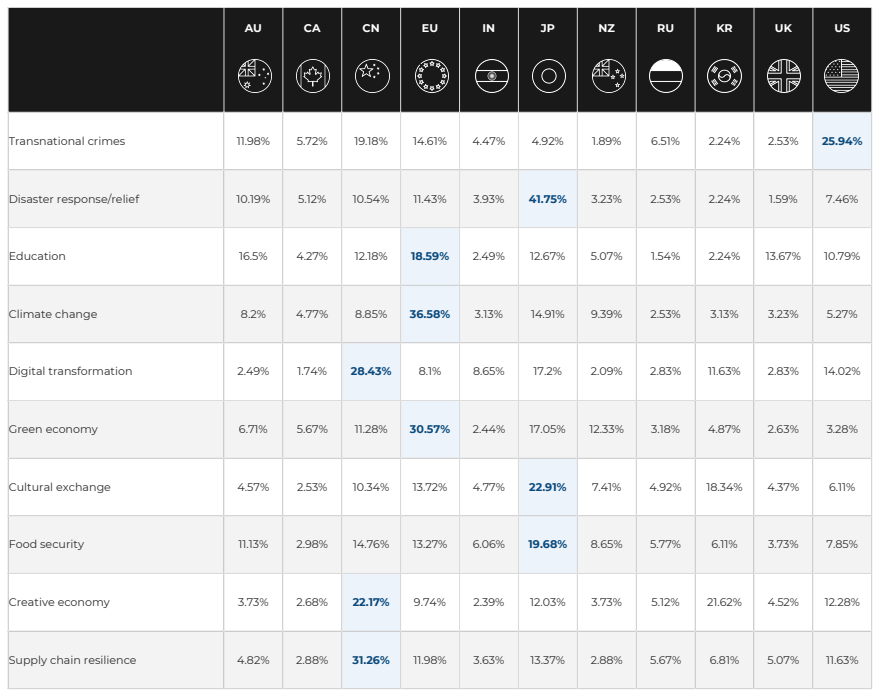
Respondents’ views on dialogue partners that ASEAN should prioritize across 10 sectors based on their cooperation advantages:
🇨🇳 China is recommended for cooperation in digital transformation, the creative economy, and supply chain resilience.
🇪🇺 The EU is prioritized for cooperation in education, climate change, and the green economy.
🇯🇵Japan is highlighted for its partnerships in disaster response, cultural exchange, and food security.
🇺🇸 The U.S. is recommended for cooperation in combating transnational crime.
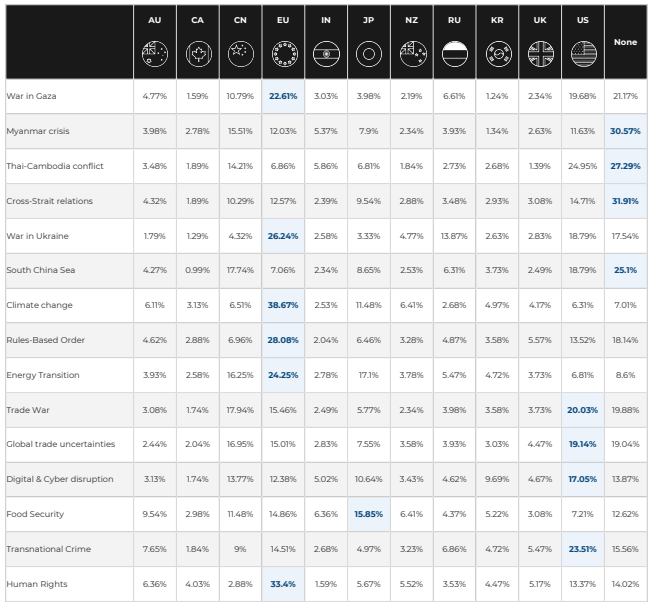
Respondents’ views on Dialogue Partners’ contributions to addressing 15 key issues:
🇪🇺 The EU is seen as making strong contributions to addressing the Gaza war, the Ukraine war, climate change, the rules-based order, energy transition, and human rights.
🇺🇸 The U.S. is highlighted for its role in addressing trade wars, global trade uncertainty, digital and cyber disruptions, and transnational crime.
🇯🇵 Japan is recognized for its contributions to addressing food security.
🚫 No dialogue partner is seen as effectively addressing the Myanmar crisis, Thailand–Cambodia tensions, cross-strait relations, or the South China Sea dispute.
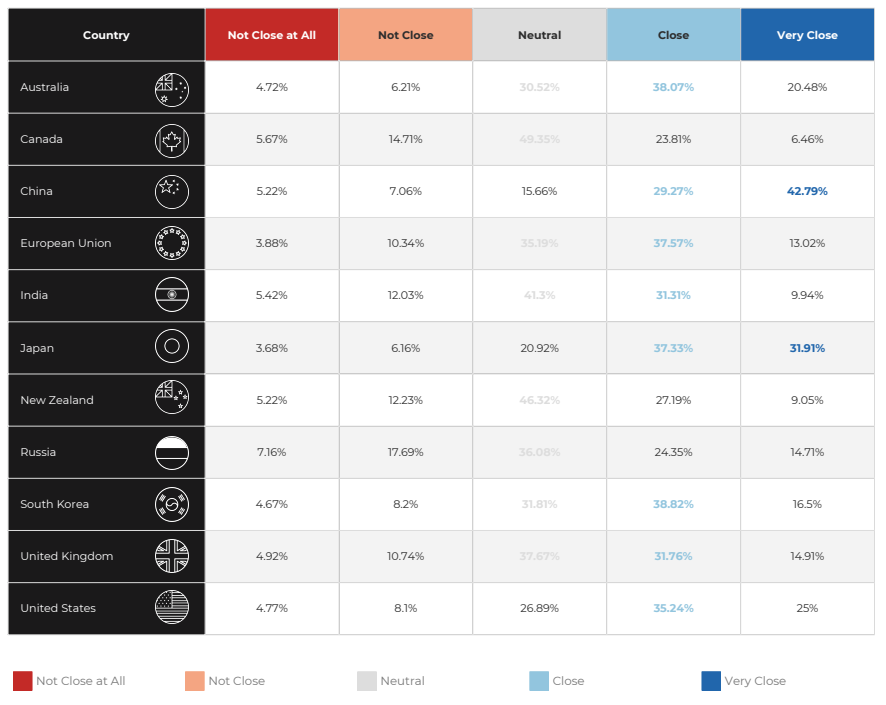
How close respondents’ countries are to ASEAN Dialogue Partners in political, economic, and socio-cultural sectors:
📊 A majority of respondents said their countries are close to Australia, China, the EU, Japan, South Korea, and the U.S.
⚖️ Meanwhile, Canada, India, New Zealand, Russia, and the U.K. are viewed as neutral partners.
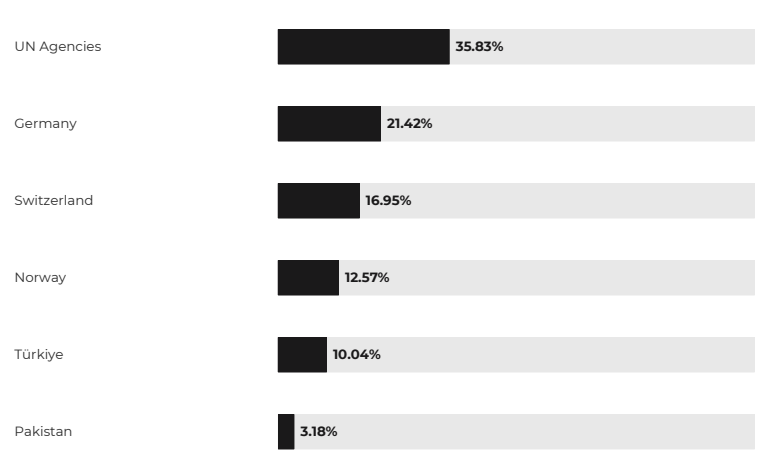
Respondents’ views on potential candidates for the next ASEAN Dialogue Partner:
🇩🇪 Germany was chosen by 21.42% of respondents as a potential 12th ASEAN Dialogue Partner.
🇺🇳 UN agencies received the highest support (35.83%), but are not eligible under ASEAN rules.
“In terms of ASEAN, we put too much emphasis on the chair. We look to the ASEAN chair for leadership for this particular year and the next year, and so on. But in terms of this survey, maybe one takeaway is that, should ASEAN be looked at within the notion of leadership, where leadership can be sectorial, can be peak meal, whichever country AMS that maybe has the capacity, maybe has the political will, let them lead, working with the ASEAN chair in that sense. “
Tang Siew Mun, Senior Fellow of the Regional Strategic and Political Studies Program at ISEAS - Yusuf Ishak Institute.
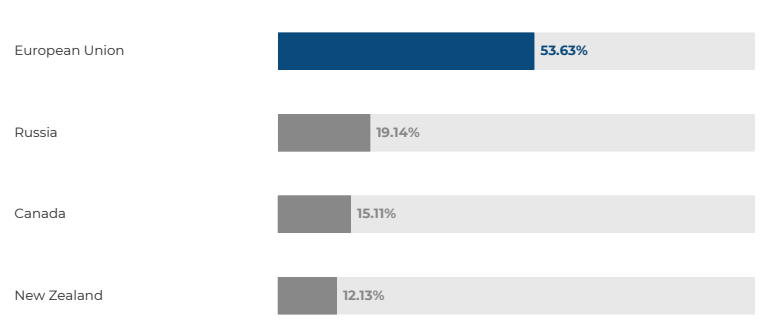
Respondents’ views on potential candidates for the next ASEAN Comprehensive Strategic Partner (CSP):
🇪🇺The EU emerged as the top choice for the next CSP, with 53.63% of the vote.
🇷🇺Russia, 🇨🇦Canada, and 🇳🇿New Zealand were also recommended by respondents.
“When you look at who you want to work with, who do we think should be the ASEAN partner to support what has been destroyed by the global power, multilateralism, rule-based international order, free trade, democracy, EU. I believe it's not just middle powers, because a lot of EU countries are middle powers, a lot of ASEAN countries are middle powers, but in terms of regional organizations, the middle powers' cooperation, and then regional cooperation between ASEAN and the EU, I think, can really be the way forward to champion all of these causes. So this is a more bottom-up process.”
Dewi Fortuna Anwar, FPCI Co-Founder.
🌏 ASEAN Member States Related Findings
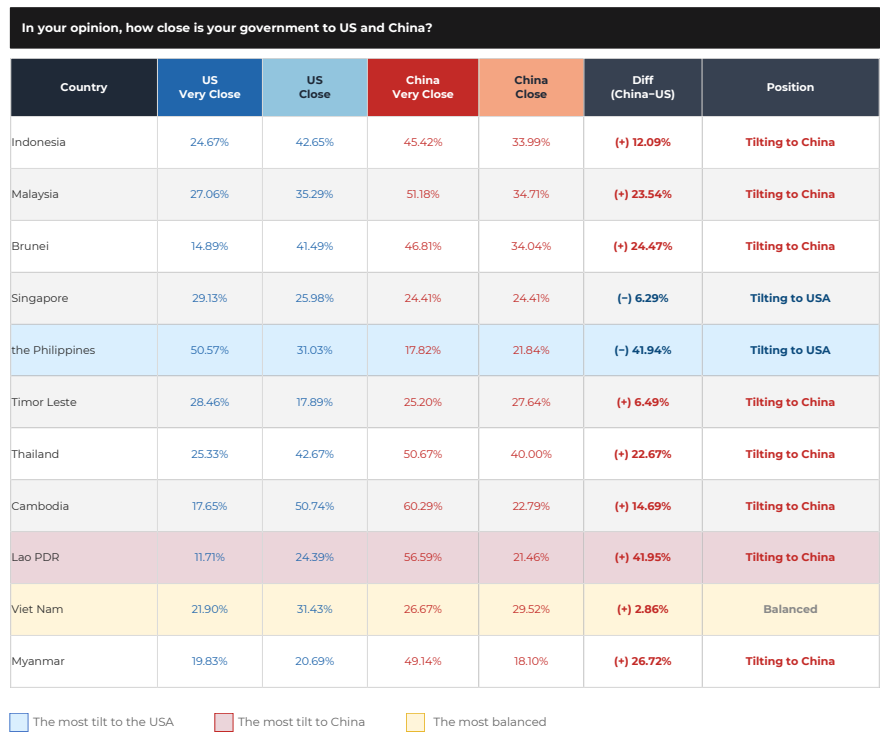
Respondents’ views on ASEAN Member States’ foreign policy positions amid rising geopolitical and geoeconomic tensions, particularly between the U.S. and China:
Respondents indicated that 🇧🇳Brunei Darussalam, 🇰🇭Cambodia, 🇮🇩Indonesia, 🇱🇦Lao PDR, 🇲🇾Malaysia, 🇲🇲Myanmar, 🇰🇭Thailand, and 🇹🇱Timor-Leste tend to lean toward 🇨🇳China.
🇸🇬 Singapore and 🇵🇭 the Philippines are seen as leaning toward 🇺🇸 the U.S.
🇻🇳Vietnam is viewed as maintaining a balanced position between the two powers.
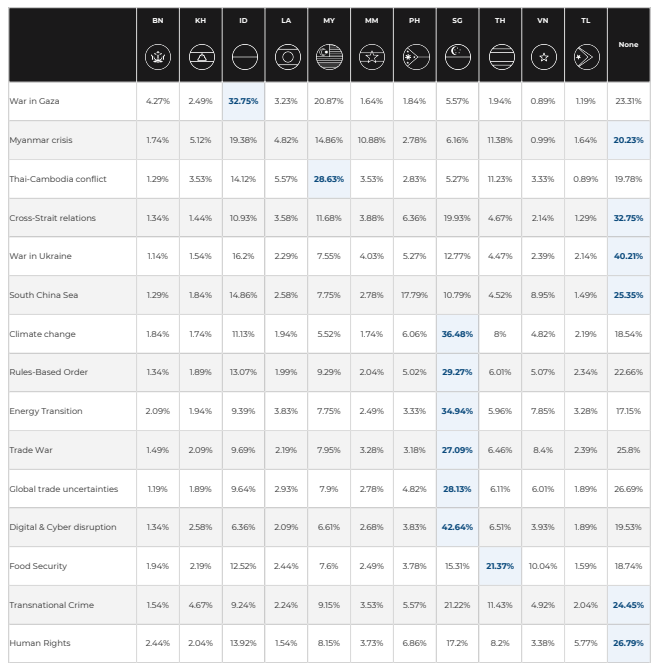
Respondents’ views on ASEAN Member States contributions to addressing 15 key issues:
🇸🇬Singapore is viewed positively for actively contributing to addressing climate change, the rules-based order, the energy transition, trade wars, global trade uncertainty, and digital and cyber disruptions.
🇮🇩Indonesia is seen as contributing to addressing the war in Gaza.
🇲🇾Malaysia is considered to be addressing the Thailand–Cambodia border conflict.
🇰🇭Thailand is recognized for its contribution to food security.
However, 🚫no ASEAN Member State is seen as contributing to resolving the Myanmar crisis, cross-strait relations, the war in Ukraine, the South China Sea dispute, transnational crime, or human rights issues.
🏛️ Policy Recommendations
Based on the findings of the survey on ASEAN Dialogue Partners, in line with the ASEAN Community Vision 2045—which envisions ASEAN as a “Resilient, Innovative, Dynamic, and People-centered” region—FPCI proposes several policy recommendations to maintain regional stability, resilience, and cooperation:
🧭Develop a collective strategy: Strengthen ASEAN’s Geopolitical Task Force with broader input beyond major power responses.
🔎Identify economic risks: Map dependencies and vulnerabilities to better respond to geopolitical pressures.
🤝Build trust with partners: Strengthen cooperation with dialogue partners and rebuild trust amid global tensions.
🌐Strengthen multilateral trade: Enhance regional trade networks by linking major agreements like RCEP, the EU, and CPTPP.
🔀Diversify relations: Reduce over-dependence by expanding political and economic partnerships.
🚀Leverage strengths: Maximize each partner’s strengths and cooperate on global issues like energy and climate.
🔎 Need More Angles?
ASEAN Secretariat ASEAN External Relations
FPCI 2025 FPCI Survey on ASEAN Dialogue Partners
(NGO/QOB)