




A Telegram channel with thousands of subscribers may look like an attractive advertising opportunity. But those subscribers have chosen a particular community, not necessarily the product being advertised.
Across Southeast Asia, where languages, digital habits and regulatory conditions vary widely, confusing audience size with commercial opportunity can become an expensive mistake.
GWI data from Q2 2025, published in the Digital 2026 Global Overview Report, shows monthly Telegram usage among internet users aged 16 and above ranging from 60.7% in Malaysia to 20% in Thailand.
Yet these figures measure app usage, not advertising reach. Telegram operates through channels, subscriptions and context rather than a conventional algorithmic feed.
Advertisers who ignore that distinction, or treat Southeast Asia as one market, risk spending on audiences that never become customers.
Telegram Advertising Starts with the Community
Unlike algorithmically ranked feeds, Telegram’s channels distribute content to people who choose to subscribe.
Users also participate in groups, interact with bots and access Mini Apps, which are applications operating within Telegram.
These activities serve different purposes. A public channel may introduce a product. A bot can answer questions or collect registrations.
A Mini App can support more involved interactions, such as completing an order.
Under Telegram’s standard advertising platform, sponsored messages appear in eligible public channels with at least 1,000 subscribers.
Advertisers can select channels and bid using cost per mille (CPM), the price paid for 1,000 advertising views.
Direct placements arranged with channel owners offer more flexible content integrations. Bots and Mini Apps are primarily interaction tools, not advertising inventory.
Subscriber numbers alone don't provide a complete picture of a channel’s advertising value.
In its guide to selecting Telegram channels, Magnetto, a Telegram infrastructure partner, identifies post reach, audience engagement, subscriber growth patterns and unsubscribe rates as useful indicators when evaluating placements.
These signals help assess audience quality but cannot establish whether a campaign will generate customers.
An important distinction exists between Telegram advertising account types.
The standard self-service interface restricts sponsored messages to links leading to Telegram channels or bots.
Certain Business Telegram Ads account configurations offer additional capabilities, including external website destinations and expanded targeting options.
Advertisers should verify the features available through their specific account before planning the campaign journey.
Advertisers must decide whether their objective is acquiring subscribers, generating enquiries or supporting purchases. Each requires different measurement methods.
Six Markets, Different Commercial Risks
Country-level usage data offers a starting point but cannot determine whether relevant channels exist, or whether their audiences are commercially valuable.
Four factors shape advertising decisions in each market: how widely Telegram is used, which audiences and languages a campaign needs to address, how customers can complete payments, and which local regulations apply.
Together, these factors determine not just who advertisers can reach, but whether that reach translates into measurable business results.
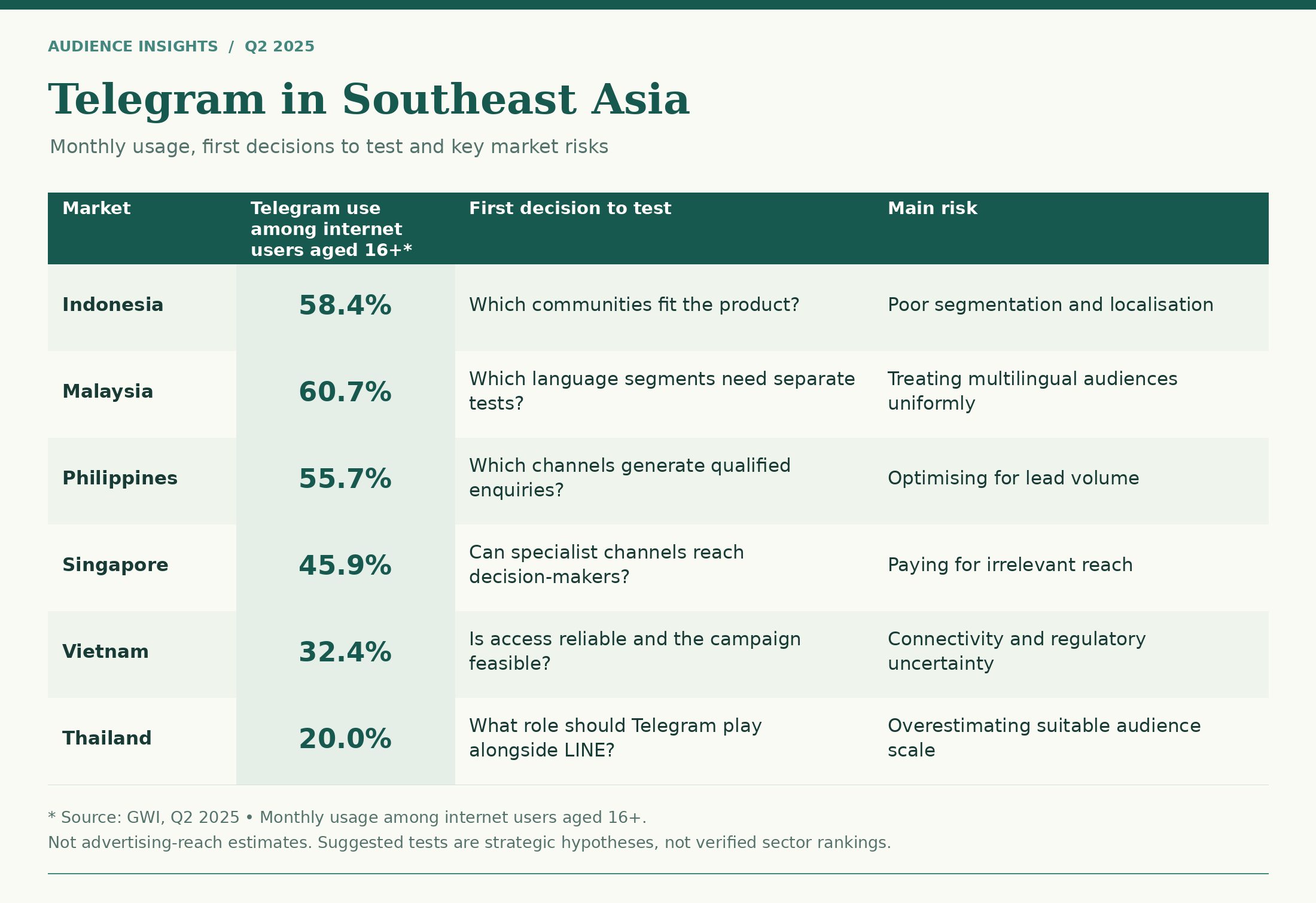
Indonesia and Malaysia: Segmentation Comes First
In Indonesia, language alone cannot identify valuable Telegram audiences.
For example, an education provider could test professional-development channels alongside student communities to identify which audience generates more qualified applications.
The customer journey should remain consistent in Bahasa Indonesia, from the initial advertisement to the final registration step.
Bank Indonesia’s QRIS framework illustrates local payment infrastructure, while Law No. 27 of 2022 sets personal data protection requirements that apply when advertisers collect customer information.
For advertisers, these requirements affect the entire conversion journey. A campaign may attract relevant users, but an unfamiliar checkout or poorly designed data-collection process can prevent them from completing the intended action.
Therefore, check payment compatibility and compliance before the campaign launches.
Malaysia presents a multilingual challenge. A financial education campaign could test Malay- and English-language communities separately rather than assume one translation suits every audience.
Malaysia’s DuitNow QR system provides local payment infrastructure. Advertisers collecting identifiable information through forms or bots must also consider the Personal Data Protection Act.
Both markets require alignment between the advertising context and customer journey.
Philippines and Singapore: Quality Before Volume
In the Philippines, enquiry volume alone should not define success.
An online education provider could test student communities against professional channels to understand which audience generates more valuable enquiries.
Completed registrations, enrolments and other relevant conversion outcomes would help determine which approach delivers stronger commercial results.
English and Filipino messaging may warrant separate testing.
Payment arrangements should consider QR Ph, while personal-data processing must follow applicable National Privacy Commission guidance. Consent requirements depend on the activity and its lawful basis.
Singapore presents another question: whether smaller specialist communities can reach purchasing decision-makers.
A business software advertiser could compare a specialist professional channel with a larger general-interest community. Qualified enquiries would provide a useful measure of commercial value.
Local payment methods such as PayNow and Singapore’s Do Not Call requirements also matter.
Joining a Telegram channel does not automatically authorise unrelated telephone marketing.
Vietnam and Thailand: Feasibility Before Expansion
Vietnam’s key consideration is whether campaigns can operate reliably.
In May 2025, Vietnamese authorities instructed telecommunications providers to block Telegram. Research organisation OONI reported that restrictions detected on affected networks were lifted by 10 July that year.
In September 2026, Vietnamese media reported a separate disruption affecting Telegram users, but its cause was not established. Neither event determines current accessibility.
Advertisers should verify connectivity, restrictions and available inventory before investing. Vietnamese-language creative and suitable transaction processes remain necessary but cannot compensate for unreliable access.
Thailand requires consideration of established messaging competitors.
LINE reported more than 56 million users in Thailand in 2025, while GWI found that 20% of surveyed internet users aged 16+ had used Telegram during the previous month.
These different measures cannot establish relative advertising reach, but they can help validate Telegram’s role before allocating significant budgets.
Thai-language technology or gaming campaigns could test relevant communities with sufficient inventory.
Payment arrangements may also require PromptPay compatibility.
National payment infrastructure is not automatically available within Telegram. Advertisers must verify integrations and applicable Telegram payment rules, which differ for physical versus digital goods.
Creative Mistakes Often Begin After the Click
Telegram creative should reflect a channel’s subject and why users follow it.
A generic promise of attractive offers provides little context.
An advertisement in an education channel could instead invite readers to explore certification requirements.
The bigger mistake may occur after the click.
Consider an Indonesian-language advertisement opening an English-language bot with unfamiliar payment instructions.
Interested users could abandon the process, making the campaign appear ineffective when the problem is the destination.
This illustrative scenario shows why localisation must cover advertisements, initial interactions, instructions and transactions.
Telegram’s advertising guidelines also require language alignment and destination alignment.
The practical principle: one proposition, one call to action and one understandable next step.
Measurement Must Follow the Destination
Views and clicks help assess engagement but cannot establish commercial success.
Click-through rate (CTR) measures clicks relative to impressions. Cost per click (CPC) measures spending per click. Standard Telegram Ads uses CPM-based buying, and reporting differs between formats.
For channel campaigns, advertisers can compare spending with attributable subscriptions and subscriber retention, the proportion of acquired subscribers who remain subscribed after a defined period. Reliable engagement indicators can provide additional context.
Bots require different measures: starts, completed registrations and qualified enquiries.
Telegram’s bot documentation describes start parameters that help identify entry points.
Mini Apps need event tracking for registrations and transactions. External websites require separate analytics after users arrive through permitted routes.
The methodological challenge is maintaining consistency across campaigns.
Cost per subscriber, qualified enquiry and purchase describe different outcomes and should not be treated as interchangeable.
What matters is whether advertising generates commercially valuable actions, not inexpensive attention.
Five Decisions Before Launch
Before committing a regional budget, advertisers need answers to five questions.
Which country offers a testable opportunity? Which channels reach the intended audience? How much localisation does the customer journey require? What budget can support an initial test? Which commercial outcome, supported by reliable measurement, will determine further investment?
Telegram provides access to interest-based communities operating within different commercial and regulatory environments.
Treating it as a distinct advertising channel, with a separate strategy for each country, is more defensible than buying regional reach and hoping a translated message works everywhere.
***
Alex Malgin is the CEO of Magnetto, a Telegram infrastructure partner and the world’s largest direct seller of Telegram Ads. Since 2021, he has grown Magnetto into a team of 200+ working with global brands. With over a decade in performance marketing and analytics, Alex has built Telegram into a channel brands can plan, measure, and scale, supported by exclusive Business Telegram Ads accounts and proprietary AdTech.
(QOB)
A useful detailed report on the intricacies of Telegram advertising Alex