



🎯 The Main Takeaway
Southeast Asia’s comedy circuit is having a major moment. Driven by political friction, cultural quirks, and global digital appetites, local comics are filling arenas and exporting distinct, unvarnished regional humour to the West.
🔍 Why It’s on Our Radar
The regional circuit has moved past copying Western tropes. Comedians across these five countries are weaponising sharp, localized observation to build multi-market fanbases. Crucially, they are using the mic as a trojan horse—using laughter to bypass censorship, inform their audiences on domestic crises, and connect regional realities to global geopolitical shifts.
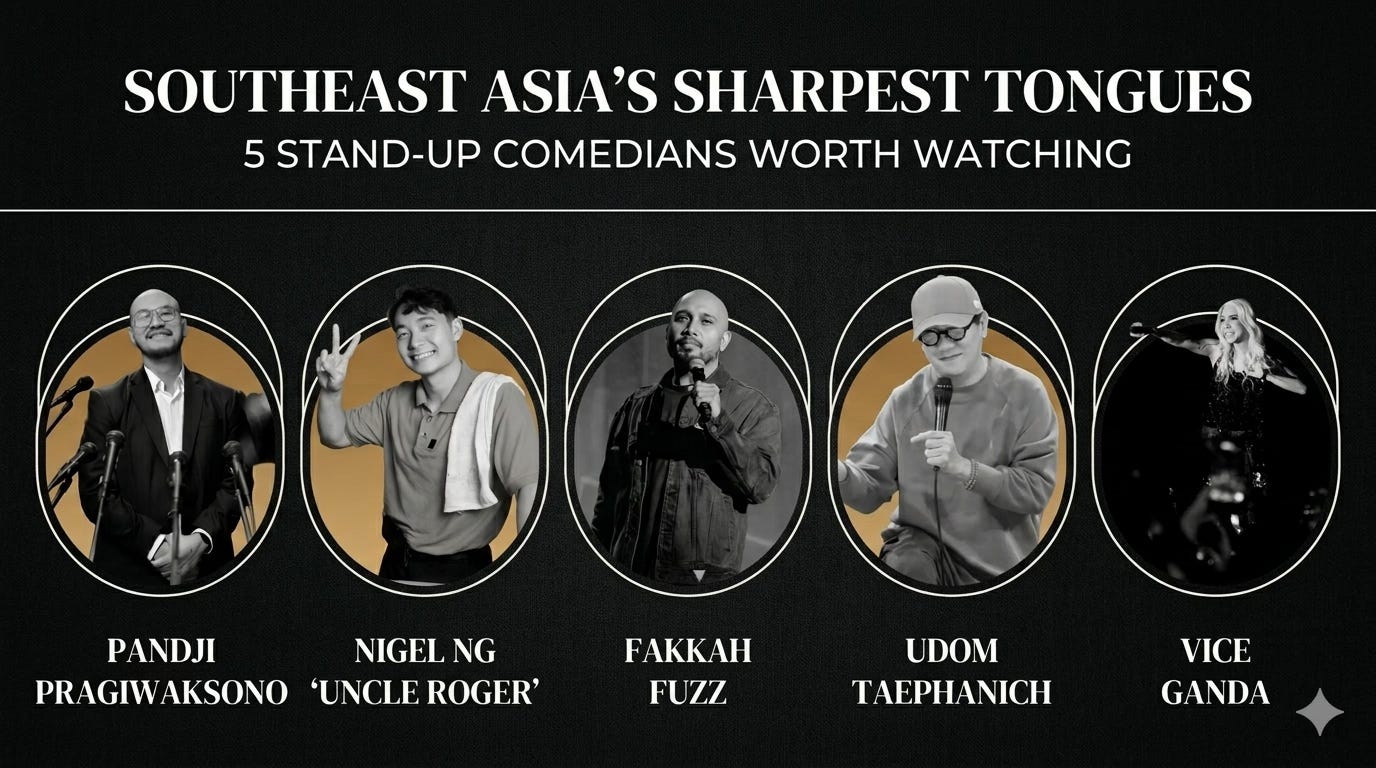
Here is the essential watchlist:
🇮🇩 Indonesia: Pandji Pragiwaksono
The undisputed titan of Indonesian stand-up. His blockbuster Netflix special, Mens Rea, serves as a masterclass in civic education. He uses biting satire to dissect government policies, corruption, and state power, forcing audiences to look squarely at the country’s changing democratic landscape.
🇲🇾 Malaysia: Nigel Ng (”Uncle Roger”)
A global digital phenomenon who weaponized a hyper-specific, orange-polo-clad caricature of a judgmental Asian uncle to conquer the internet. His breakout viral video reviewing a BBC Food fried rice recipe exploded into a multi-million subscriber empire, where he shrewdly contrasts Asian cultural conservatism with Western sensibilities, making cross-cultural dynamics globally digestible.
🇸🇬 Singapore: Fakkah Fuzz
One of the first Singaporean comedians to land a global Netflix stand-up special (Almost Banned). Fuzz delivers high-energy, raw commentary that masterfully breaks down racial nuances, local politics, and class structures in the Lion City, famously using bits about cross-border friction with Malaysia to push the boundaries of what can be openly spoken about in a highly regulated society.
🇹🇭 Thailand: Udom Taephanich (”Note”)
The absolute pioneer of Thai stand-up whose legendary Deawstadium shows and recent Netflix hit Deaw Special: Super Soft Power have captivated millions for decades. Taephanich is a cultural institution; he uses observational comedy to hold up a massive mirror to Thai social hierarchies, family pressures, and shifting generational divides, subtly addressing the nation’s complex cultural undercurrents.
🇵🇭 Philippines: Vice Ganda
A generational phenomenon and cultural powerhouse who rules the Filipino box office, television, and arena comedy stages, culminating in massive historic stand-up concerts at the Araneta Coliseum. Vice Ganda uses quick-witted, unvarnished, and hyper-relatable sarcasm to dissect the harsh everyday economic realities, societal double standards, and complex political landscapes of the Philippines.
⚖️ What’s at Stake
Soft power and political literacy. In a region where formal journalistic critique can carry heavy legal, social, or digital risks, stand-up comedy has evolved into a vital mechanism of social control and civic awareness. By wrapping taboo news in a punchline, these comics keep their audiences informed and engaged when traditional media channels fall silent.
🌏 The Big Picture
Global entertainment networks are hunting for authentic, fresh cultural perspectives. Southeast Asian comics provide exactly that, bridging the gap between deep local traditions and Western comedy structures while keeping a firm, critical pulse on global affairs.
💥 The Dynamic
Indonesia (Pandji Pragiwaksono): Focuses heavily on government accountability, electoral politics, and individual constitutional rights in a rapidly shifting democratic climate.
Malaysia (Nigel Ng): Decodes the friction of the Asian diaspora, using cross-cultural satire to highlight the gap between Western lifestyles and Eastern cultural expectations.
Singapore (Fakkah Fuzz): Navigates sensitive domestic issues, specifically race relations, local minority experiences, and the constraints of a hyper-regulated urban environment.
Thailand (Udom Taephanich): Unpacks the deep-seated social hierarchies, rigid family expectations, and massive generational divides reshaping modern Thai society.
Philippines (Vice Ganda): Dissects harsh economic disparities, working-class realities, and the blatant double standards present in everyday Filipino culture.
The Borderless Punchline: Comedy in this region has evolved. The modern generation values sharp, structure-heavy writing and mass cultural reach over simple slapstick. It is comedy designed to make you laugh first, and think immediately after.
🏡Why This Hits Home
For years, Southeast Asian representation in global comedy was limited to Westernized diaspora voices telling “strict immigrant parent” jokes. This new wave offers an authentic look inside the modern geography—written by people who actually live, work, and tackle everyday realities there. They don’t just mock their cultures; they explain their systems.
🗺️ The Regional Stakes
This movement is building a robust creative economy that doubles as an informal newsroom. Success for headliners like Pandji and Ng creates a viable blueprint for younger comics, proving that tackling heavy domestic and global truths can fill seats rather than just court controversy.
🏁 The Bottom Line
Southeast Asian stand-up is no longer a niche, local warm-up act. It is a highly competitive, rapidly growing creative market that demands global attention—and functions as one of the region’s most honest mirrors to power.
(ZIL/VBD/ELS)