



✍️ Editorial Note
Good day.
A particular kind of story defines a week in Southeast Asia: not the dramatic rupture, but the quiet gap between what was promised and what was delivered.
This week gave us several.
A maritime code that will not meet its deadline. A vice-president who chose to step away rather than explain. A climate-tech sector with plenty of policy and no financing in the middle. None of these are crises in the headline sense. All of them are the kind of slow, structural shortfall that shapes a region.
The through-line is durability.
Rules that may not bind, institutions that coordinate more than they control, capital that does not quite reach the middle, ecosystems that protect us in ways we only count once they are gone.
Southeast Asia is not short of ambition. The work—the unglamorous, incremental, often invisible work—is in building the layers that turn ambition into something that lasts.
Here is what we are watching this week.
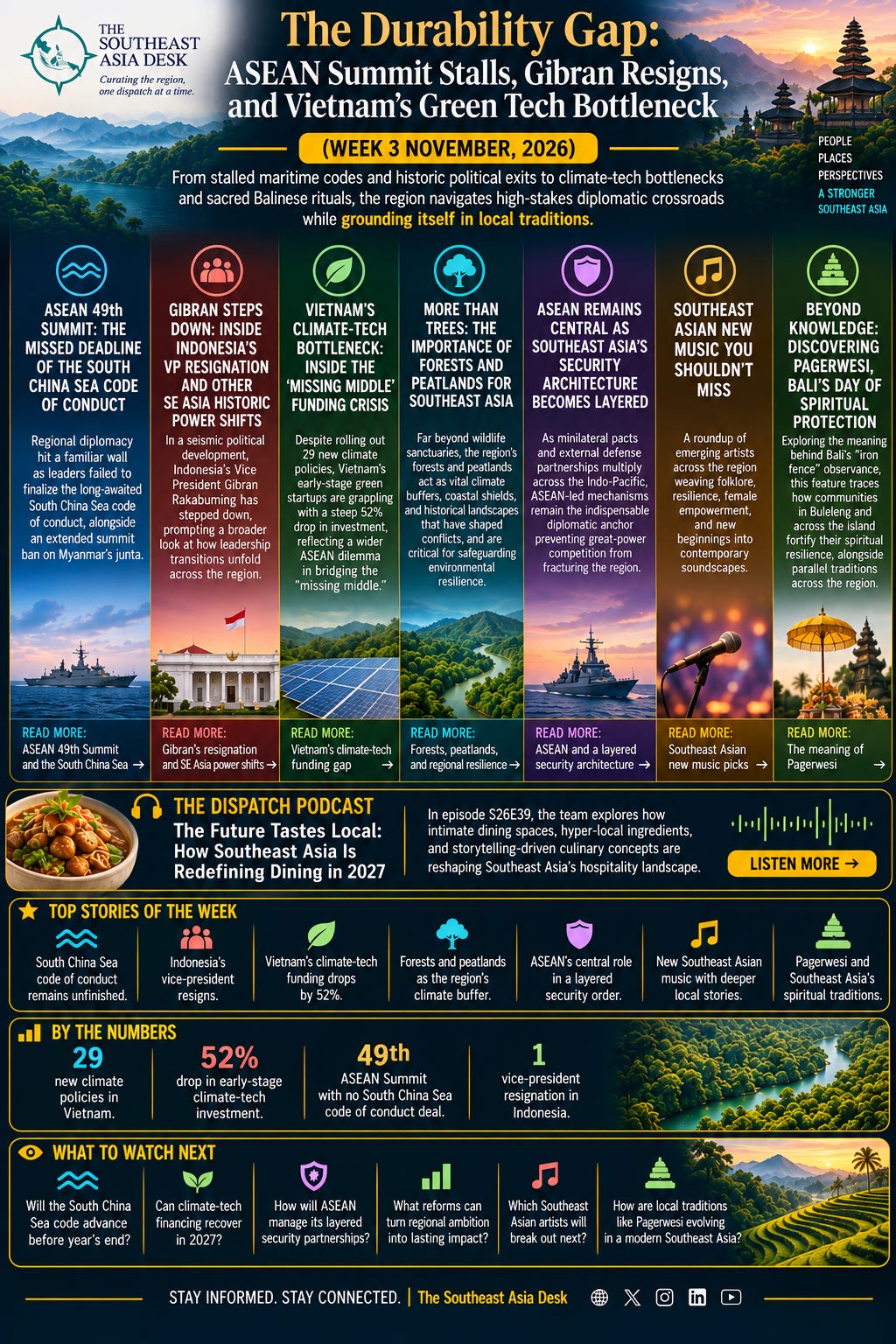
🌊 ASEAN 49th Summit: The missed deadline of the South China Sea code of conduct and Myanmar’s status
Regional diplomacy hit a familiar wall as leaders failed to finalize the long-awaited South China Sea code of conduct, leaving maritime rules of engagement ambiguous. Alongside an extended summit ban on Myanmar’s junta, the gathering underscores the mounting limits of ASEAN’s consensus-driven model in resolving entrenched regional crises
Read more: https://www.thesoutheastasiadesk.com/p/asean-49th-summit-the-missed-deadline?r=2sv6y6
📩 Gibran steps down: Inside Indonesia’s VP resignation and other SE Asia historic power shifts
In a seismic political development, Indonesia’s Vice President Gibran Rakabuming has stepped down, prompting a broader look at how leadership transitions unfold across the region. Whether driven by voluntary exits, institutional friction, or public pressure, these moments reveal the evolving mechanics of executive power and political accountability in Southeast Asia.
🌱 Southeast Asia’s climate-tech bottleneck: Inside Vietnam’s ‘Missing Middle’ funding crisis
Despite rolling out 29 new climate policies, Vietnam’s early-stage green startups are grappling with a steep 52% drop in investment. This acute capital gap reflects a wider ASEAN dilemma: bridging the “missing middle” between seed funding and large-scale infrastructure finance is essential to turning green policy ambitions into scalable reality.
Read more: https://www.thesoutheastasiadesk.com/p/vietnam-climate-tech-funding-missing-middle-asean?r=2sv6y6
🌳 More than trees: The importance of forests and peatlands for Southeast Asia
Far beyond serving as wildlife sanctuaries, the region’s dense forests and carbon-rich peatlands act as vital climate buffers, coastal shields, and historical landscapes that have shaped conflicts. Protecting these ecosystems is critical not only for global emissions targets, but for safeguarding the everyday environmental resilience of local communities.
🛡️ ASEAN remains central as Southeast Asia’s security architecture becomes layered
As minilateral pacts and external defense partnerships multiply across the Indo-Pacific, security analysts point out that regional defense is becoming increasingly multi-tiered. Yet despite overlapping alliances, ASEAN-led mechanisms remain the indispensable diplomatic anchor preventing great-power competition from fracturing the region.
Read more: https://www.thesoutheastasiadesk.com/p/asean-minilateralism-layered-security-architecture?r=2sv6y6
🎵 Southeast Asian new music you shouldn’t miss
Curating the freshest tracks from across the archipelago and mainland, this roundup spotlights emerging artists weaving themes of folklore, resilience, female empowerment, and new beginnings into contemporary regional soundscapes.
Read more: https://www.thesoutheastasiadesk.com/p/southeast-asian-new-music-you-shouldnt?r=2sv6y6
🙏 Beyond knowledge: Discovering Pagerwesi, Bali’s day of spiritual protection
Exploring the meaning behind Bali’s “iron fence” observance, this cultural feature traces how communities in Buleleng and across the island fortify their spiritual resilience, alongside parallel traditions of sacred protection across Southeast Asia.
Read more: https://www.thesoutheastasiadesk.com/p/discover-pagerwesi?r=2sv6y6
🎙️ Podcast | The Future Tastes Local: How Southeast Asia Is Redefining Dining in 2027
In episode S26E39, the team explores how intimate dining spaces, hyper-local ingredients, and storytelling-driven culinary concepts are reshaping Southeast Asia’s hospitality landscape. Moving away from standardized global luxury, the region’s food scene is doubling down on authentic identity and personal connection.
Listen more: https://www.thesoutheastasiadesk.com/p/future-of-food-southeast-asia-2027?r=2sv6y6
✍️ Closing Note
This week’s stories sit at different altitudes: a maritime code that will not be finished, a vice-president who chose to step down, a funding gap that is quietly holding back a generation of climate startups, forests that do more than we notice, and a pop stage where local roots are the point.
What connects them is the question of what actually holds a region together: rules that may not bind, institutions that coordinate more than they control, capital that does not quite reach the middle, and ecosystems that protect in ways we only count once they are gone.
Southeast Asia is not short of ambition.
The work is in building the layers: financial, institutional, ecological, cultural, that turn ambition into something durable.
Thanks for lingering with us.
✨ Stories to linger over, one week at a time.
(ELS/QOB)