



Your curated wrap-up from The Southeast Asia Desk.
✍️ Editorial Note
Hello and welcome back,
What makes a region influential?
Military capabilities and economic weight certainly matter. But so do the skills of its young people, the products it takes to international markets, the relationships it builds through culture, and even the music, films, and food through which others encounter it.
This week, we look at Southeast Asia from all of these angles.
From debates over AUKUS and ASEAN’s place in the regional security architecture to questions about whether education is preparing young people for an AI-shaped workplace, the bigger story is about capacity: the ability of Southeast Asian societies to navigate change while retaining agency over what comes next.
And, as always, some of the most interesting forms of regional influence emerge far from formal diplomacy: on dinner tables, cinema screens, and concert stages.
Thank you for joining us; here are your readings from last week.
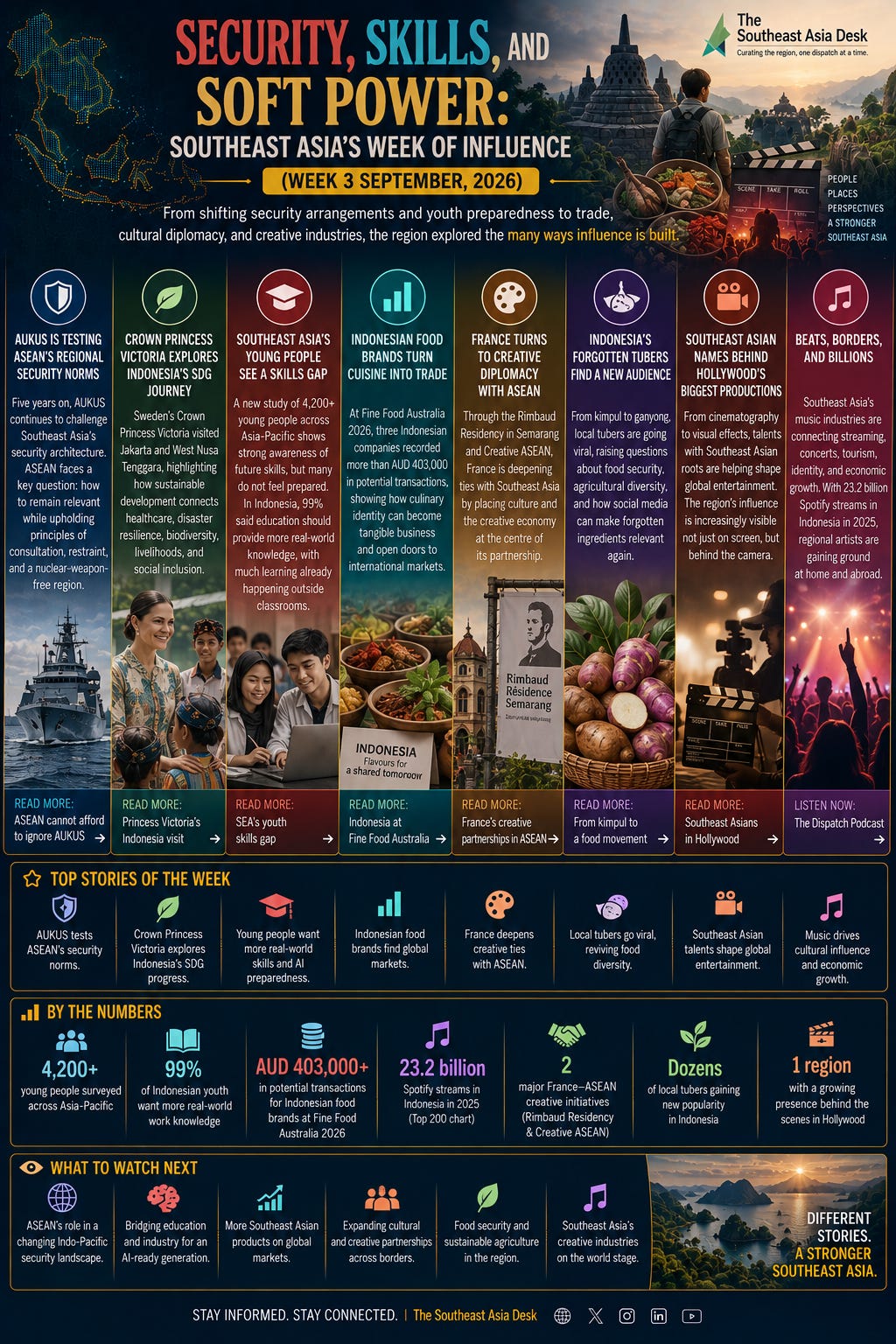
🛡️ AUKUS Is Testing ASEAN’s Regional Security Norms
Five years after Australia, the United Kingdom, and the United States announced AUKUS, its implications for Southeast Asia remain contested.
In this week’s Regional Line, Fitra Shaumi Az Zahra argues that ASEAN needs to engage more substantively with the strategic changes accompanying AUKUS rather than treating it as an exceptional development outside the region’s own security architecture.
The commentary points to differing positions among ASEAN members: Indonesia and Malaysia have raised concerns over arms competition and proliferation risks, while other members have taken more accommodating views of expanded U.S.-partner security cooperation.
The question is therefore not simply whether ASEAN supports or opposes AUKUS, but how the grouping preserves the relevance of principles such as consultation, restraint, peaceful coexistence, and the Southeast Asia Nuclear Weapon-Free Zone amid a changing Indo-Pacific security environment.
Read more: ASEAN cannot afford to ignore AUKUS
🇸🇪🇮🇩 Crown Princess Victoria Takes a Closer Look at Indonesia’s SDG Journey
Swedish Crown Princess Victoria, a UNDP Goodwill Ambassador, visited Jakarta and West Nusa Tenggara during a five-day trip focused on Indonesia’s progress toward sustainable development.
Her itinerary connected some remarkably different issues: genomics and outbreak preparedness, interfaith harmony, post-earthquake reconstruction in Lombok, digital healthcare, community entrepreneurship, coral restoration, and indigenous forest management.
Rather than treating sustainable development as a single environmental agenda, the visit showed how the SDGs intersect with healthcare, disaster resilience, biodiversity, livelihoods, technology, social inclusion, and how international partnerships can support locally grounded solutions.
Read more: Swedish Crown Princess Victoria visits Indonesia to check on SDG progress
🎓 Southeast Asia’s Young People See a Skills Gap
A new study involving more than 4,200 young people across Asia-Pacific suggests that many understand the skills they will need in tomorrow’s workplace, but do not necessarily feel adequately prepared to use them.
Across the survey, adaptability and problem-solving emerged among the most valued skills, while 97% of respondents wanted greater exposure to real-world work. Although 84% expected to work alongside AI, only 56% felt confident using it professionally.
The Southeast Asian results are particularly revealing. In Indonesia, 99% of the 552 respondents said education should provide more knowledge about working life. Meanwhile, much practical learning across the region appears to happen through personal projects, extracurricular activities, competitions, social media, and self-directed learning rather than exclusively inside classrooms.
The challenge, then, may be less about replacing formal education than connecting it more effectively with the wider ecosystem in which young people already learn.
Read more: SEA’s youth skills gap
🥘 Indonesian Food Brands Turn Cuisine Into Trade
Indonesia’s participation at Fine Food Australia 2026 showed how culinary identity can move beyond gastrodiplomacy and become tangible business.
Three companies featured through the Indonesian Pavilion (representing chocolate and cocoa products, speciality agricultural ingredients, and marine-based foods) recorded more than AUD 403,000 in potential transactions during the Melbourne exhibition.
A separate delegation coordinated by the Indonesia Trade Promotion Centre also brought additional Indonesian businesses to the event.
Against the backdrop of the Indonesia–Australia Comprehensive Economic Partnership Agreement, events like this give smaller producers an opportunity not only to sell products but also to understand Australian regulations, meet distributors, test market demand, and establish longer-term commercial relationships.
Read more: Indonesia F&B wins big at Fine Food Australia 2026
🎨 France Turns to Creative Diplomacy With ASEAN
France is expanding its relationship with Southeast Asia through two initiatives placing culture and the creative economy at the center of diplomacy.
The Rimbaud Residency creates a reciprocal literary exchange between France and Indonesia anchored in Semarang, while Creative ASEAN is designed as a regional framework encompassing all 11 ASEAN member states and supporting contemporary arts and creative industries.
The initiatives build on a broader France–ASEAN relationship spanning diplomacy, development cooperation, climate initiatives, the blue economy, energy, and cultural exchange. They also illustrate an increasingly important dimension of international relations: partnerships are being built not only through governments and markets, but through writers, artists, cultural institutions, and creative communities.
Read more: France launches Creative ASEAN and Rimbaud Residency
☕ Weekend Brew
🌿 Spices, Herbs, and the Many Flavours of Southeast Asia
Southeast Asian cuisine is often described overseas with the same handful of words: spicy, fragrant, rich, and bold.
But look more closely and different culinary traditions emerge.
Maritime Southeast Asian cooking has historically leaned heavily on spices derived from roots, bark, seeds, and fruits, while many mainland traditions make extensive use of fresh herbs, leaves, stems, and flowers. Rendang and tom yum may both be unmistakably Southeast Asian, but the techniques and flavour philosophies behind them tell very different histories.
Understanding those distinctions helps us appreciate regional cuisine not as a single culinary category, but as a collection of traditions shaped by geography, agriculture, trade, and migration.
Read more: Spices or herbs? The traditions defining Southeast Asian cuisine
🍠 Indonesia’s Forgotten Tubers Find a New Audience
“Because I didn’t have any, I used kimpul instead.”
What began as a memorable social-media phrase has become an unlikely gateway into a bigger conversation about Indonesia’s food diversity.
Creators are introducing younger audiences to overlooked tubers such as kimpul, ganyong, gembili, and garut by incorporating them into contemporary recipes rather than presenting them only as traditional foods. Indonesia has dozens of carbohydrate-rich food sources, yet rice remains overwhelmingly dominant in the national diet.
That makes the viral rediscovery of local tubers more than a food trend. It raises questions about food security, agricultural diversity, and how social media can make forgotten ingredients relevant again.
Read more: From kimpul to mie ganyong: Indonesia’s forgotten tubers go viral
🎬 The Southeast Asian Names Behind Hollywood’s Biggest Productions
Representation does not stop with the actors we see on screen.
Across cinematography, visual effects, stunt coordination, and action design, professionals with Southeast Asian roots are contributing to some of Hollywood’s biggest productions.
Filipino-American cinematographer Autumn Durald Arkapaw, action specialists Robert Alonzo and Jonathan “Jojo” Eusebio, and Indonesian visual-effects artists are among the names highlighted in this week’s story.
Their work offers another way of thinking about Southeast Asia’s growing cultural footprint: sometimes regional influence appears not in front of the camera, but deep inside the creative and technical machinery that makes global entertainment possible.
Read more: Hollywood’s Southeast Asian names behind the lens
🎧 The Dispatch Podcast: Beats, Borders, and Billions
Music is emotional. It is cultural. And increasingly, it is serious economic infrastructure.
This week’s Weekly Dispatch Podcast explores how Southeast Asia’s music industries are connecting streaming, concerts, tourism, identity, and economic activity.
Indonesia alone generated 23.2 billion streams on Spotify’s Top 200 chart in 2025, while local genres and artists are gaining ground across Indonesia, the Philippines, Thailand, and elsewhere in the region.
As audiences travel across borders for concerts and regional artists find wider markets, music is becoming another arena in which Southeast Asia can transform cultural energy into economic and international influence.
Listen here: Beats, Borders, and Billions: How Music Is Powering Southeast Asia
✍️ Closing Note
This week’s stories may seem to travel in very different directions: submarines, classrooms, trade fairs, literary residencies, forgotten tubers, Hollywood credits, and concert stages.
But together they tell us something important about Southeast Asia.
Power is becoming more multidimensional.
It lives in military and diplomatic institutions, certainly. But it also lives in whether young people have the skills to navigate technological change, whether local businesses can reach international consumers, whether artists can build relationships across borders, and whether Southeast Asian stories, flavours, and sounds can travel without losing the identities that produced them.
For us, understanding the region means paying attention to all of these spaces.
Thank you for reading, questioning, sharing, and continuing to explore Southeast Asia with us.
Until next week, take care, stay curious, and keep looking beyond the headlines.
✨ Stories to linger over, one week at a time.
(QOB/RHZ)