



🎯 The Main Takeaway
📝 Conducted by the ASEAN Studies Centre at the ISEAS - Yusof Ishak Institute, this survey captures the geopolitical and economic sentiments of 2,008 regional opinion-makers across all ASEAN member states, administered in seven languages.
Southeast Asia is gripped by multidimensional anxiety. While climate change remains the undisputed existential threat 🌪️, a deep geopolitical dread is taking hold.
The region feels trapped in a vise 🗜️ between a highly distrusted China and the unpredictable trajectory of U.S. leadership.
Instead of picking sides, ASEAN leaders are playing defense 🛡️ doubling down on internal unity and quietly outsourcing their trust to reliable middle powers 🤝.
📡 Why It’s on Our Radar
These shifting sentiments are a bellwether for global stability. There are three immediate flashpoints shaping the region’s posture:
💥 The accidental war risk: Tensions in the South China Sea have moved past political rhetoric into direct fears of physical, escalatory clashes.
🚢 Supply chain shockwaves: Export-heavyweight nations are sweating the economic gravity of superpower trade wars and protectionist policies 📉.
🚨 The new security frontier: Borderless, digital crimes specifically global scam operations 💻 have exploded into a top-tier regional threat, rivaling traditional hard-power concerns.
📊 What’s at Stake?
Beyond the immediate anxieties, the 2026 data points to systemic shifts that will alter Southeast Asia’s long-term trajectory:
⚖️ The survival of the rules-based order: ASEAN’s diplomatic shield relies entirely on multilateralism. If superpowers normalize bypassing international law, that shield shatters 🔨.
⚓ A lopsided leadership burden: The bloc is heavily dependent on just three nations (Singapore, Indonesia, and Malaysia) to steer the ship. Domestic distractions in any of these capitals could create a critical regional leadership vacuum 🕳️.
🧠 The battle for human capital: As domestic economic pressures mount, nations that fail to align with the normative and lifestyle appeal of trusted global partners face a severe talent drain of their most influential minds ✈️.
🌍 The 2026 Regional Outlook: By the Numbers
The hard data behind the region’s biggest threats.
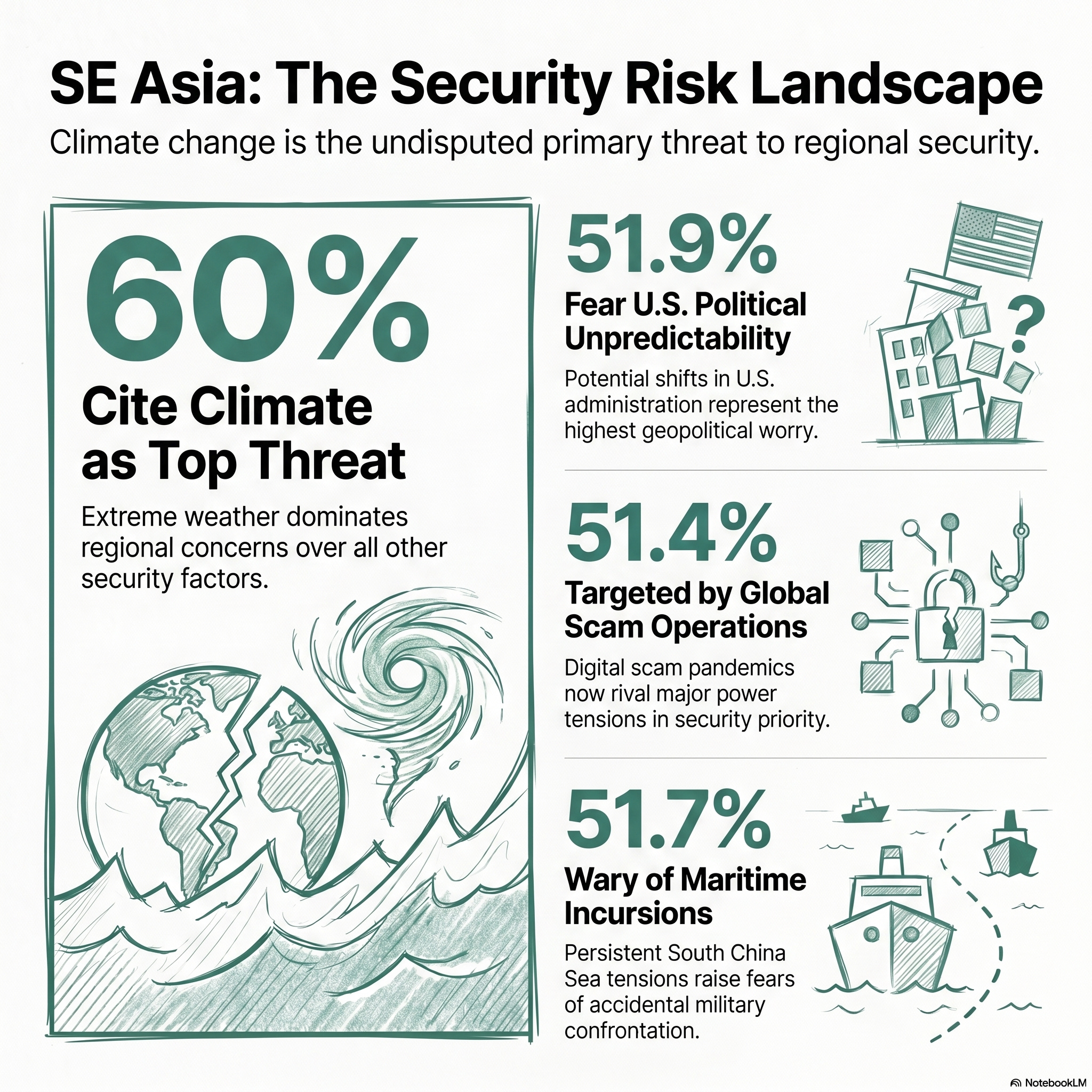
⛈️ The Big Three: Climate change and extreme weather dominate (60.0%), followed by intensifying major power economic tensions (51.7%) and domestic political instability (46.1%).
🦅 The Trump Factor: A potential U.S. administration shift under Donald Trump is the region’s highest geopolitical worry (51.9%).
📱 The Scam Pandemic: Tied almost evenly with U.S. unpredictability, the threat of global scam operations sits at 51.4%.
🌊 South China Sea: 51.7% are highly concerned by China’s incursions into Exclusive Economic Zones (EEZs), with 45.2% fearing an accidental military confrontation could spark a full-blown crisis 🧨.
⚖️ The Influence of Major Powers
Economic dominance is generating more dread than welcome.
🇨🇳 China’s expanding footprint: China holds the most dominant economic and strategic position, but it generates deep anxiety. 68.5% of respondents worry about its economic influence; only 31.5% welcome it.
🇺🇸 The U.S. economic squeeze: Regional concern regarding U.S. economic impact now outweighs its welcome (53.8% worry vs. 46.2% welcome), a fear intensely concentrated in export-driven economies like Thailand and Malaysia 🏭.
🔄 The Middle Power pivot: To buffer against the superpower binary, the region is elevating alternative partners. The EU 🇪🇺 is valued as a normative and regulatory partner, while Australia 🇦🇺, South Korea 🇰🇷, and India 🇮🇳 maintain steady strategic relevance.
⚔️ Navigating the U.S.-China Rivalry
How the region plans to survive the clash of the titans.
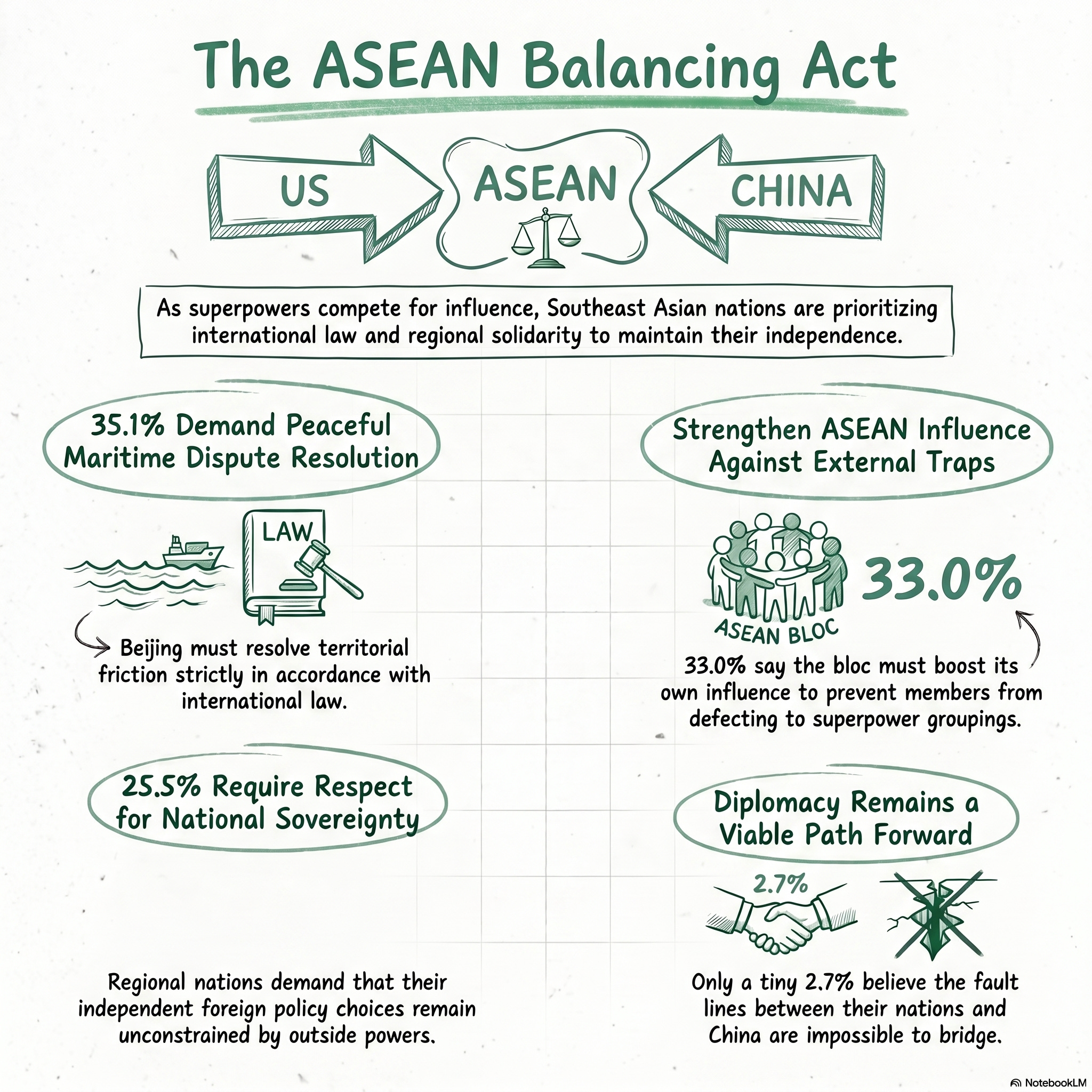
📜 The Demand for Beijing: When asked how China can repair regional friction, the absolute top demand (35.1%) is for Beijing to resolve all territorial and maritime disputes peacefully and strictly in accordance with international law.
🛑 Respecting Sovereignty: 25.5% state that China must respect the sovereignty of Southeast Asian nations and stop constraining their independent foreign policy choices.
🛡️ The Minilateral Trap: As the U.S. and China create competing international groupings (like the Quad or BRICS+), the region’s reflex is to pull together, not fracture. 33.0% say ASEAN must aggressively strengthen its own normative influence to keep members committed to the bloc, rather than defecting to external superpower groupings.
🕊️ A Sliver of Hope: Despite the high tensions, diplomacy isn’t dead. Only a tiny fraction (2.7%) takes the bleak, fatalistic view that the fault lines between their country and China “cannot be bridged.”
🤝 The Trust Deficit & Regional Playbook
Where Southeast Asia places its faith when the superpowers fall short.
🥇 Japan remains the gold standard: For the eighth consecutive year, Tokyo 🇯🇵 is the region’s most trusted partner (58.9%), viewed as a reliable stakeholder that respects international law without demanding political concessions.
⚠️ China remains the most distrusted: A massive 62.5% express distrust in Beijing, driven overwhelmingly by fears that its military and economic weight will be used to coerce smaller nations.
⚡ The U.S. polarizes: Trust in Washington sits at 42.4%, but distrust is creeping closely behind at 38.6%, reflecting fears of domestic U.S. volatility.
🏰 The defensive strategy: To survive this trust deficit, the most popular strategy (33.0%) is to aggressively strengthen ASEAN’s internal convening power, preventing member states from defecting to competing minilateral groupings.
🧲 The Soft Power Index
Hard power doesn’t dictate cultural affinity.
🧳 The metric: When measuring “soft power,” asking where thought leaders prefer to relocate or travel, the survey reveals a stark contrast to geopolitical metrics.
🌟 The reality: The data highlights which nations hold the strongest educational 🎓, tourism 🏖️, and lifestyle pull, ultimately deciding where Southeast Asia’s top talent wants to build their future.
The Bottom Line
Southeast Asia is officially playing defense 🛡️. Caught in a geopolitical vise, the region is abandoning the hope of superpower benevolence.
To survive the coming years, Southeast Asia nations’ alliance must rapidly fortify its internal unity 🔗, manage the strain of new memberships of its regional organization like Timor-Leste, and lean on trusted middle powers before external pressures force its famed consensus to snap ⚡.
Need More Angles?
CGTN US tops Southeast Asia’s geopolitical concerns, survey shows
Global News Southeast Asians cite US, scams, climate as major concerns: survey
(ARS/QOB)