



🎯Main Takeaway
Southeast Asia’s energy security cannot rely solely on fuel reserves.
As geopolitical tensions, supply disruptions, and climate pressures intensify, experts argue that the region must accelerate a shift toward a more integrated, diversified, and resilient energy system.
Speaking at a public discussion jointly organized by the Foreign Policy Community of Indonesia (FPCI) Climate Unit and the ISEAS – Yusof Ishak Institute, energy experts Dr. Christopher Len, Peter Godfrey, and Dr. Dinita Setyawati emphasized that regional cooperation, clean energy deployment, and stronger cross-border connectivity (and not simply stockpiling fossil fuels—will determine Southeast Asia’s ability to withstand future energy shocks.

📡 Why It’s on Our Radar
Deep Fossil Dependence: Around 80% of Southeast Asia’s primary energy mix still relies heavily on fossil fuels, leaving regional economies intensely vulnerable to external geopolitical shocks.
The Energy Trilemma: Decarbonization cannot happen in a vacuum; governments must simultaneously balance energy security, economic affordability, and environmental sustainability.
A New Industrial Strategy: Clean energy is no longer just an environmental goal—it is becoming the core baseline for attracting global manufacturing and investment.
Regional Grid Integration: Initiatives like the ASEAN Power Grid offer a practical pathway to connect diverse resource nodes, balance regional supply and demand, and pool local competitive advantages.
⛽ The Fossil Dependence Dilemma & The Energy Trilemma
In fact, 80% of Southeast Asia's energy demand is currently met by fossil fuels. This heavy reliance explains why political conflicts occurring thousands of miles away—such as heightened tensions in the Middle East or supply chain disruptions around critical maritime bottlenecks like the Strait of Hormuz—instantly destabilize local fuel prices and industrial output across ASEAN.
The central challenge discussed was navigating the classic Energy Trilemma: balancing security, affordability, and sustainability. Panelists noted that the goal should not be viewed as a blunt, overnight shutdown of existing infrastructure, but rather a strategy to improve, diversify, and modernize energy architectures.
Given that fossil fuels are deeply integrated into manufacturing and baseline power generation, abrupt cuts without immediate, reliable alternatives risk tanking economic competitiveness and disproportionately impacting low-income populations.

⚡🪫 Energy Security 2.0: Beyond Supply and Demand
For decades, energy security was treated as a basic supply-and-demand problem: Do we have enough fuel? Who controls it? Can we physically move it? Is it affordable? While those questions still matter—especially when you look at geopolitical choke points like the Strait of Hormuz, the Strait of Malacca, or the ongoing crisis with Iran—the actual lesson from global conflicts and energy disruptions is different.
During the session, Dr. Christopher Len advocated for an "Energy Security 2.0" framework in which energy policy serves as an industrial strategy. According to him, a robust energy transition relies on four aligned pillars:
Grid Alignment: Dynamically matching supply nodes with fluctuating demand across regional lines.
Geopolitical Alignment: Structuring international agreements to prevent supply chain blockages and mitigate international conflict risks.
Supply Chain Alignment: Building resilient domestic manufacturing supply chains that generate local employment rather than new dependencies.
Price & Subsidy Alignment: Managing price sensitivity carefully. Because coal remains artificially cheap compared to initial renewable setups, targeted government subsidies play a crucial role in buffering citizens and ensuring a smooth, politically stable transition.
He noted that if countries want to attract foreign investment today, a clean, reliable power grid is a must. International manufacturers are picking their production bases based on who can offer green energy, mainly because they have to hit tough global carbon targets.
🏗️ System Architecture and Redesigning Modern Industry
Peter Godfrey highlighted that substituting fossil fuels with renewable electricity requires a complete rethink of industrial organisation. Moving from centralized fossil-fuel infrastructure to distributed, regional energy sources demands automated, localized units that can operate reliably without constant central control.
Key insights from Peter Godfrey included:
Isolating Price Volatility: Global commodities such as crude oil and natural gas expose local markets to sharp price swings. By localizing supply chains and tapping indigenous renewable resources, regional economies can effectively insulate themselves from external market volatility.
Step-by-Step Evolution: Rather than trying to rebuild an entire national economic infrastructure simultaneously, progress comes from building smaller, self-sustaining industrial clusters that capitalize on specific local advantages.
System Integration: Energy transition plans must look beyond power generation to consider how heavy industries, transport sectors, and urban centers physically consume and trade energy with one another.
📊 Data, Awareness, and the ASEAN Power Grid
Dr. Dinita Setyawati presented key findings from Ember’s global energy data, highlighting both major challenges and rapid shifts across the region.
On one hand, adoption is accelerating rapidly in specific sectors—evidenced by a 125% surge in electric vehicle (EV) sales in Indonesia. On the other hand, heavy industry and utilities continue to rely on coal due to its low initial cost.
She believed there are several solutions that might be put into consideration, that includes:
Prioritizing Home-Grown Energy: Over-reliance on imported fossil fuels drains foreign exchange reserves and exposes nations to external risks. Developing homegrown renewable energy creates self-reliance and keeps economic value within national borders.
Breaking Down Divisions: Right now, governments tend to handle energy by focusing only on buying fuel and keeping factories running. However, energy affects everything: public health, clean air, worker jobs, and technology. To make real progress, the Energy Ministry can't work alone, and every government department needs to share data and make decisions together.
Leveraging the ASEAN Power Grid: Regional interconnections allow member states to balance their geographical strengths. Regions with immense solar capacity, such as Sumatra, can generate and export power across borders to high-demand industrial nodes, creating a mutually beneficial ecosystem.
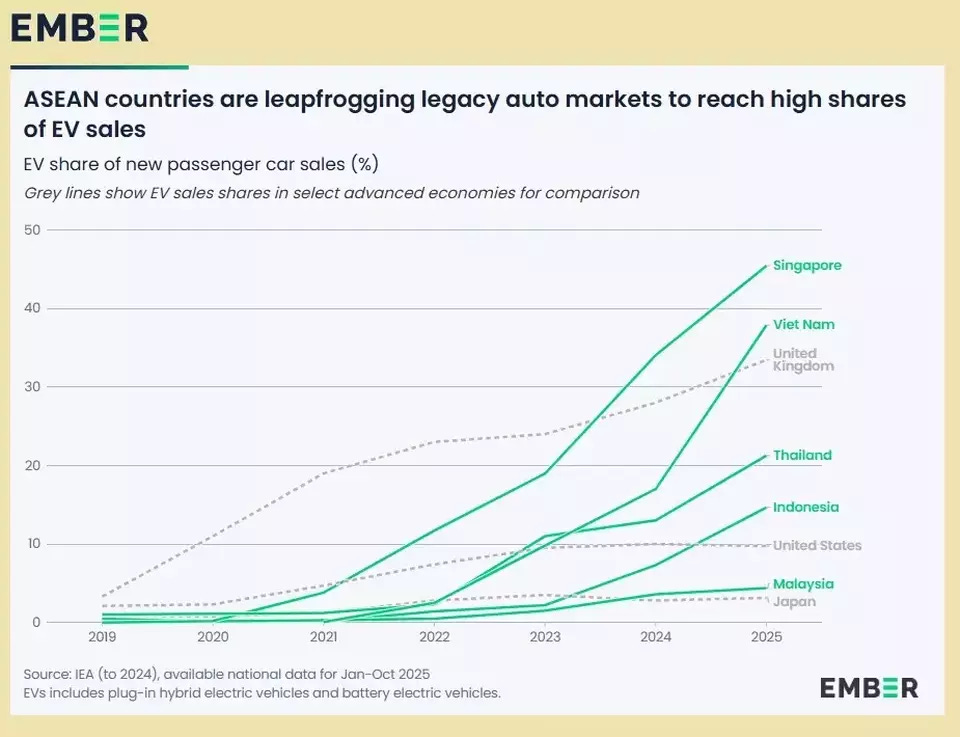
Data from Ember shows a rapid surge in EV market share across ASEAN member states, with nations like Singapore and Vietnam outpacing major economies like the US and UK. (Graphic: Ember Climate).
🌐 The Role of ASEAN & Unlocking Global Investment
The most important point throughout the discussions was whether regional bodies like ASEAN can drive the execution of these goals. The agreement was clear: while ASEAN provides the vital diplomatic architecture and policy framework for coordinating cross-border projects such as power grids, the bloc cannot fund the transition on its own.
In response, Southeast Asian nations must make their energy markets structurally attractive to international private investors. This requires transparent regulations, standardized power purchase agreements, and clear risk-sharing mechanisms.
By acting collectively, ASEAN member states can leverage their regional strengths—combining manufacturing hubs, natural resource pockets, and capital centers—to build a compelling, bankable destination for global green capital.
🧭 The Bottom Line
Switching to clean energy in Southeast Asia is no longer just about saving the planet; it’s about economic survival. To stay competitive, the region must treat energy as an industrial strategy, break down government divisions, and link up cross-border grids.
Crucially, this requires deep regional teamwork to make sure the transition is fair, inclusive, and leaves no country or community behind.
(AKO/ANN/QOB)