



A year ago, The Southeast Asia Desk began with a relatively simple idea.
Southeast Asia did not need another publication racing to repeat what had already happened.
It needed more spaces willing to stop, verify, connect the dots, and ask a different question:
What does this development actually mean for the region?
We started small.
There was no large newsroom behind us. No extensive infrastructure. No guarantee that readers would find us.
There was only a conviction that Southeast Asia deserved journalism that treated the region not as a collection of disconnected national stories, but as a shared political, economic, cultural and human space.
One year later, that conviction remains.
But today, it is accompanied by something we did not have when we started: evidence that people are willing to read, return, participate and grow with us.
And before speaking about any number, milestone or future ambition, we want to begin with the most important part.
❤️ First, Thank You
To everyone who opened one of our newsletters.
To those who found an article through Google while trying to understand something happening somewhere in Southeast Asia.
To those who shared our work with a colleague, a student, a friend or a family member.
To the readers who followed us on LinkedIn and Instagram.
To those who listened to The Dispatch.
To the journalists, researchers, students, diplomats, civil-society workers, professionals and curious readers who sent us corrections, suggestions, invitations and questions.
And especially to those who simply kept coming back:
Thank you.
The Southeast Asia Desk exists because you decided that regional journalism was worth your time.
We do not take that attention for granted.
🌱 What One Year Has Taught Us
Our first year was, in many ways, an experiment.
Could a small independent newsroom produce regular regional journalism without chasing every breaking headline?
Could explanatory reporting about ASEAN, climate, economics, culture, energy, politics and everyday life find an audience?
Could readers discover us without enormous advertising budgets?
The answer, cautiously, has been yes.
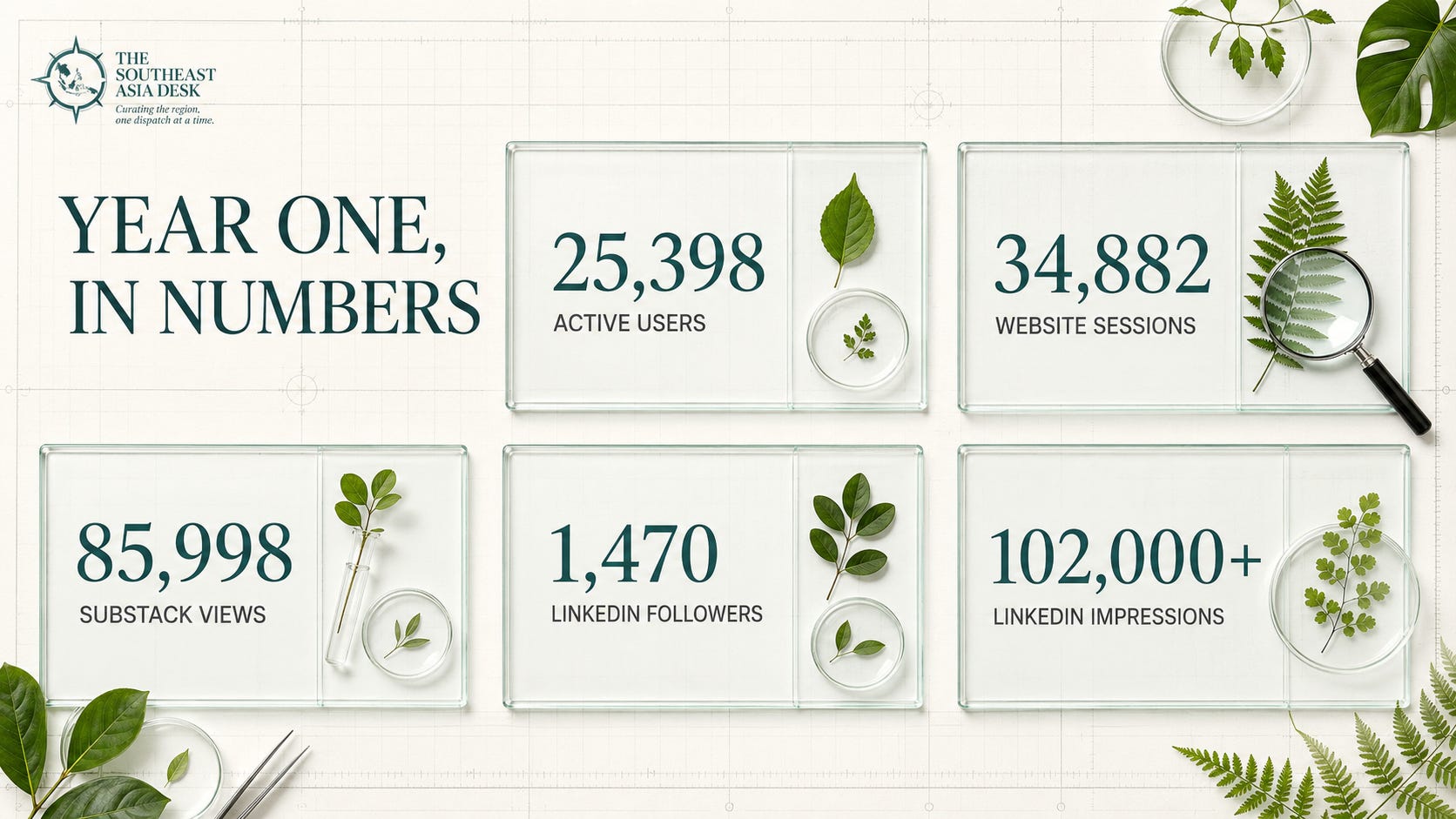
Between January and early August 2026, our website recorded 25,398 active users and 34,882 sessions. Across its first 50 reported weeks, our Substack generated 85,998 views. On LinkedIn, the Desk gained 1,470 followers organically and generated more than 102,000 impressions during the reporting year.
These are modest numbers compared with major media organisations.
For us, however, they mean something important.
The model has begun to validate itself.
Even more encouraging is how readers found us.
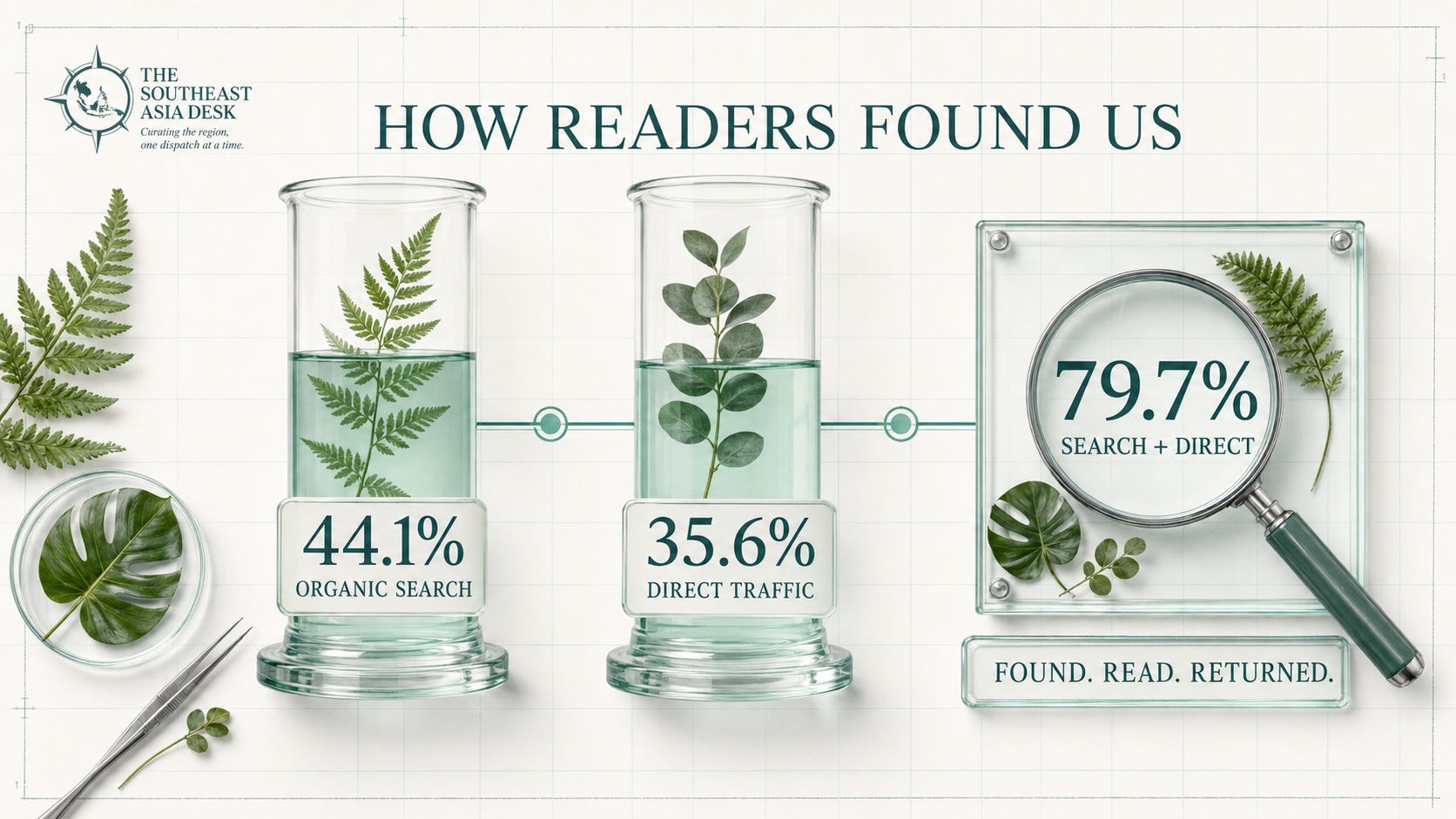
Around 44.1% of website sessions came through organic search, while another 35.6% came through direct traffic. Together, those channels accounted for nearly four-fifths of recorded sessions.
That matters because it suggests our growth is becoming less dependent on whether one social-media algorithm happens to favour us on a particular day.
People are searching for issues.
They are finding our work.
And some are returning directly.
For a publication built around context rather than clicks, that may be one of our most meaningful achievements.
🧭 We Also Learned What Readers Come to Us For
Our most-read stories did not belong to one narrow category.
They included climate risks, Southeast Asian representation in global entertainment, Indonesia’s proposed Biak spaceport, Malaysia’s tourism growth, the Strait of Hormuz and regional energy security, artificial intelligence governance, and currency pressures in Indonesia.
That diversity helped clarify what The Southeast Asia Desk should be.
We are not trying to become a publication about one government, one policy field or one professional community.
Our strongest work often sits between categories:
🌏 regional politics and everyday consequences
⚡ global crises and Southeast Asian vulnerabilities
💹 economics and human livelihoods
🎬 culture and representation
🌱 climate and development
🤖 technology and governance
The common thread is not the subject.
It is the lens.
Southeast Asia first. Context before noise. Verification before speed.
📰 From Newsletter Experiment to Newsroom
Another transformation took place behind the stories.
What began with relatively simple writing, editing and publishing roles gradually developed into a more structured production system involving editorial meetings, writing, editing, SEO, visual design, social distribution, podcasts, regional contributors and quality checks.
Our editorial portfolio now includes products such as The Daily Angle, Weekend Brew, The Desk Briefing, The Regional Line, The Dispatch, The Centripetals, and other experimental formats.
We have also begun documenting the less visible parts of journalism:
How contributors are assigned.
How work is valued.
How corrections should be handled.
How sponsorship should be separated from editorial judgment.
How AI may assist our work without replacing human editorial responsibility.
How we protect the independence of the newsroom as the organisation grows.
This institutional work may never generate the most clicks.
But without it, there is no durable newsroom.
⚖️ We Are Proud of the Progress; but We Know What Has Not Been Solved
Our anniversary is not an announcement that we have figured everything out.
We have not.
Audience growth has outpaced our institutional capacity.
Our first-year review identified recurring challenges involving financial sustainability, administrative capacity, workload concentration, and the need for a clearer business development function.
A small group of people still carries a significant share of the work.
Some products remain difficult to sustain consistently.
Original reporting requires time and resources that a volunteer-heavy model cannot always provide.
Revenue has not yet grown at the same pace as readership.
These are not problems we want to hide behind anniversary graphics.
They are precisely why our second year needs to be different from our first.
Year One was about proving that the idea could work.
Year Two must be about building something capable of lasting.
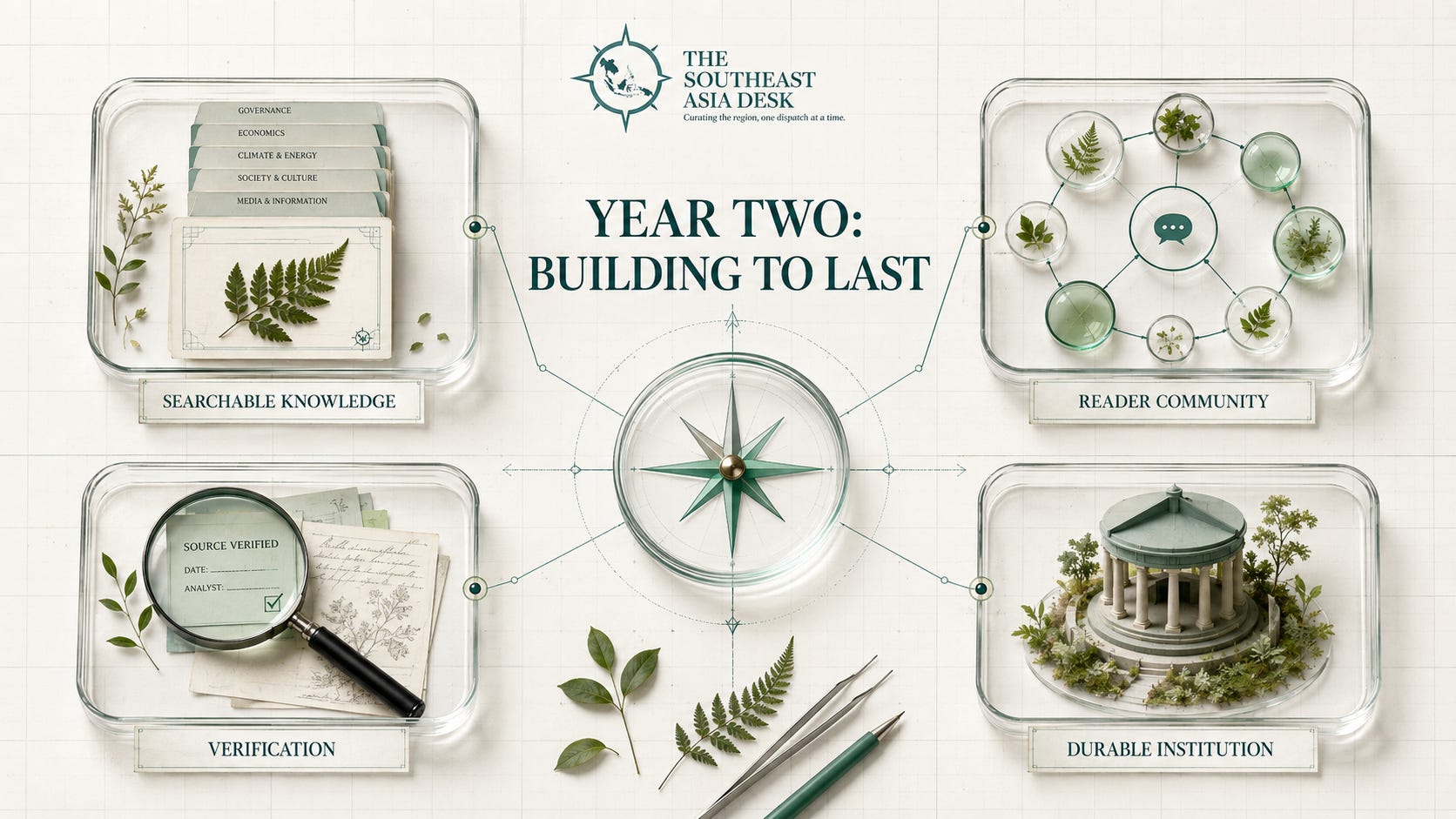
🌿 Year Two: From Proof of Concept to a Durable Regional Institution
Our next phase will not be defined by publishing as much content as possible.
Our internal Year Two masterplan deliberately takes the opposite position:
Sustainability cannot simply mean producing more.
Publication volume must match the resources, time and people available to produce journalism responsibly.
Instead, we intend to concentrate on several deeper priorities.
🔎 1. Building a Searchable Southeast Asian Knowledge Platform
Hundreds of stories disappear from public attention simply because the news cycle moves on.
We want some of our journalism to do the opposite.
Year Two will place greater emphasis on evergreen reference journalism: carefully sourced, regularly updated explainers designed to remain useful beyond the day they are published.
Areas we intend to develop include:
🌏 ASEAN Explained
💹 Regional Economy
🌱 Climate & Energy
🧳 Moving Southeast Asia
🎬 Media & Culture
🗺 Regional Power Map
Our goal is to gradually build an archive where students, journalists, researchers, policymakers and everyday readers can return when they need reliable regional context; not merely yesterday’s headline.
👥 2. Turning an Audience Into a Community
Numbers tell us how many people arrived.
They do not tell us whether we have built a relationship.
That is one of the biggest tasks ahead.
Our Year Two plans include stronger newsletter pathways, reader surveys, virtual roundtables, regional expert networks and opportunities for readers to participate more directly in shaping the questions we investigate.
We also want to create more spaces where our journalists meet the people who read their work.
Because journalism should not only speak to a community.
Good journalism should also listen with one.
🧪 3. Investing in Verification and Original Journalism
As AI-generated information, synthetic media and manipulated narratives become easier to produce, verification cannot remain an occasional newsroom exercise.
It must become infrastructure.
We intend to gradually strengthen fact-checking, source verification, newsroom AI governance and deeper original reporting through initiatives including The Desk Truth Lab and expanded Centripetals investigations and analyses.
The long-term ambition is straightforward:
When information becomes easier to produce, trustworthy journalism must become harder to compromise.
🏛️ 4. Building the Institution Behind the Journalism
Perhaps the most significant Year Two project will happen behind the bylines.
We are preparing the institutional foundations needed to move The Southeast Asia Desk from an informal independent newsroom toward a durable media organisation.
Our current planning explores establishing Koperasi Media Ruang Asia Tenggara, with The Southeast Asia Desk/SEA Desk Common Cooperative as its public identity.
The documents remain in development, and the legal transition is not yet complete.
But the principle guiding the process is already clear:
The institution supporting the journalism should reflect the collaborative values of the journalism itself.
The proposed cooperative framework is designed around collective participation, professional independence, transparent governance, fairer recognition of contributors, and a firm separation between commercial interests and editorial decision-making.
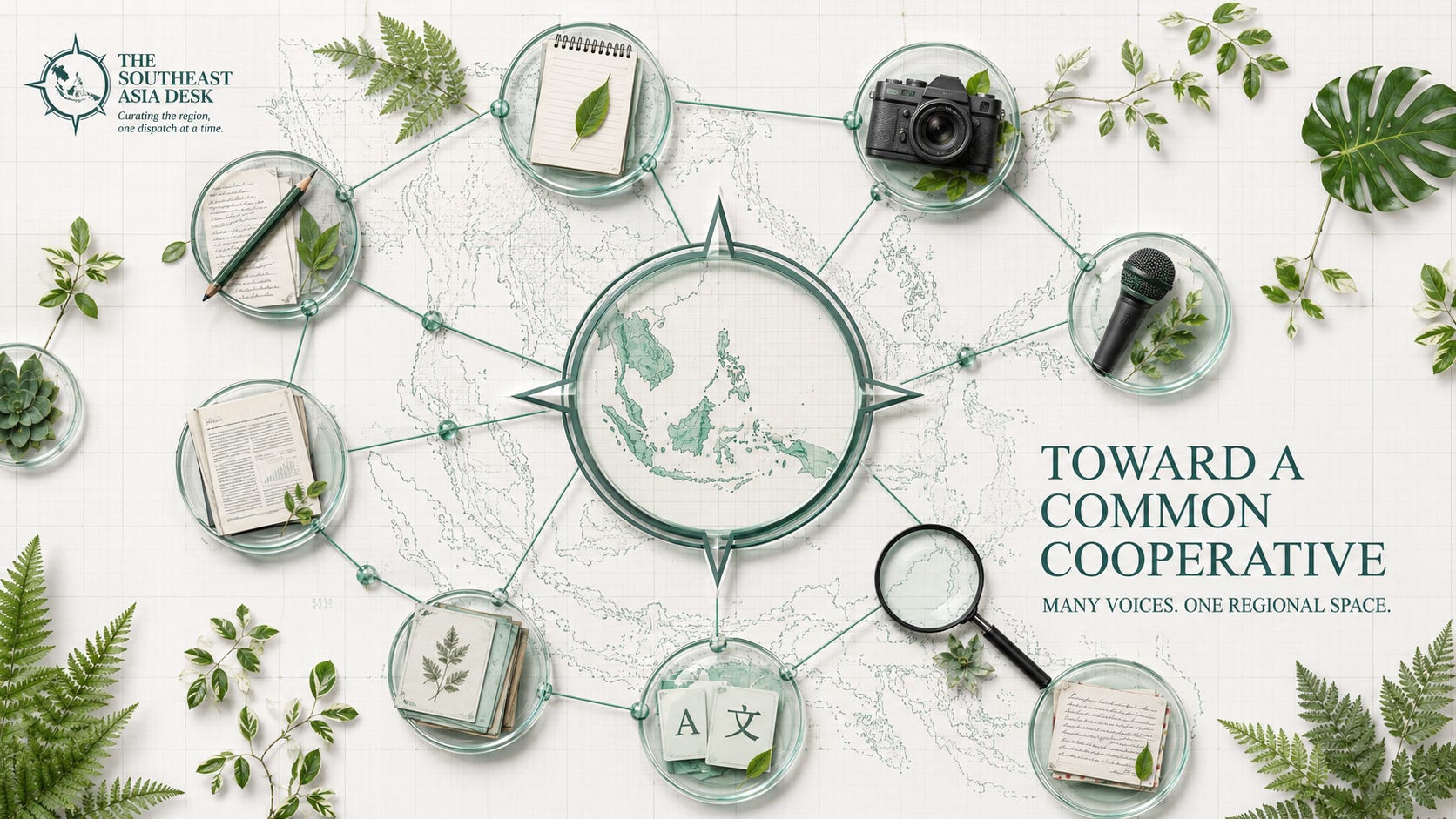
🤝 Toward a Common Cooperative
The word common matters to us.
Southeast Asia is too large, too diverse and too complicated to be understood from one desk, one city or one perspective.
A regional newsroom should therefore be built through a network.
Journalists.
Editors.
Researchers.
Photographers.
Visual storytellers.
Fact-checkers.
Podcast producers.
Translators.
Academics.
Students.
Community members.
And readers who care enough about Southeast Asia to help sustain serious journalism about it.
Our proposed cooperative model is intended to create a stronger institutional home for that ecosystem while preserving one boundary we consider non-negotiable:
Those who fund, administer or support the institution must not control independent editorial decisions.
That separation is written into the principles we are currently developing for our governance structure.
Because sustainability without independence would defeat the purpose of building the institution in the first place.
🌏 And We Would Like You to Be Part of What Comes Next
This anniversary is therefore not only a moment to look backwards.
It is an invitation.
If you have been reading quietly for the past year, we would like to hear from you.
If you are a journalist somewhere in Southeast Asia who believes an overlooked local story deserves a regional audience, talk to us.
If you are a researcher who can help readers understand a complicated issue, work with us.
If you are a designer, photographer, translator, fact-checker, producer or creator who believes in regional public-interest journalism, introduce yourself.
If you represent a university, newsroom, civil society organisation, research institute, or responsible institution interested in knowledge exchange, media literacy, research, or public-interest collaboration, our door is open.
And if you are simply a reader:
Stay with us.
Subscribe.
Reply.
Correct us when we are wrong.
Tell us what we have missed.
Join our future reader discussions.
Recommend the Desk to someone who wants to understand Southeast Asia a little better.
And as the SEA Desk Common Cooperative develops, we will open more structured opportunities for those interested in contributing to, supporting and helping shape this shared experiment.
🧭 What Will Not Change
Institutions evolve.
Products change.
Formats come and go.
Technology certainly will.
But several principles should remain constant.
We will continue to value verification over velocity.
We will continue to distinguish reporting from promotion.
We will continue to approach Southeast Asia as a region of many voices rather than a single narrative.
We will continue trying to explain not only what happened, but why it matters.
And we will continue believing that regional journalism can be serious without becoming inaccessible, analytical without becoming detached, and sustainable without surrendering editorial independence.
Our Year Two masterplan describes our direction as a transition “from proof of concept to a durable regional institution.”
That is an ambitious destination.
We know we have not arrived.
💚 One Dispatch at a Time
The first year of The Southeast Asia Desk was built from hundreds of small acts.
Someone pitched a story.
Someone checked a number.
Someone edited a paragraph late at night.
Someone translated an idea.
Someone designed a visual.
Someone recorded a podcast.
Someone opened a newsletter.
Someone clicked through from a search result.
Someone decided to come back the following week.
That is how this newsroom grew.
Not through one viral moment.
Not through one person.
But gradually.
Collectively.
One dispatch at a time.
To everyone who helped bring us through our first year:
Thank you for trusting us with your attention.
For our second year, we hope to earn something even more valuable:
Your participation.
The Southeast Asia Desk began as an attempt to understand this region better.
Our next chapter is about building the institution, community and common space capable of doing that work for years to come.
Come build it with us.
Again, thank you, and thank you
- The Editorial Team
The Southeast Asia Desk
Curating the Region, One Dispatch at a Time.
(QOB/ELS)