




🎯 The Main Takeaway
For years, digital transformation focused on connecting us to the world, for example, expanding broadband, improving mobile networks, and bringing services online.
Artificial Intelligence is changing that.
AI is increasingly being built into the infrastructure that carries, processes, and uses digital information. The United Nations Economic and Social Commission for Asia and the Pacific (ESCAP) calls it “AI-native network infrastructure.”
“Ensuring that AI-native network infrastructure benefits all economies of the region, rather than deepening existing inequalities, will require deliberate and coordinated policy action by Governments individually and through regional cooperation” - Armida Salsiah Alisjahbana, United Nations Under-Secretary-General and Executive Secretary of ESCAP.
ESCAP’s Asia-Pacific Digital Transformation Report 2026, released on 2 September 2026, argues that this transition could reshape how economies compete and how governments deliver services.
It also raises a question: If countries start from uneven levels of digital readiness, will AI narrow existing gaps or create another layer of inequality?
📡 Why It’s on Our Radar?
The shift toward AI-native infrastructure matters to Southeast Asia, where governments are expanding digital economies, developing national AI strategies, and investing in data centre and computing capacity, but the region is not starting from the same level of digital readiness.
ESCAP’s Asia-Pacific Digital Transformation Report 2026 benchmarks 110 economies worldwide through its updated Digital Transformation Index (DTI).
The report finds that Asia-Pacific performs only marginally above the global average, while significant gaps remain within the region.
Among the 29 Asia-Pacific economies assessed in depth, only Singapore and the Republic of Korea are classified as Digital Leaders, while most remain in the Emerging Performers category.
The gap goes beyond internet access. ESCAP’s assessment looks at network infrastructure, government, businesses, people and innovation ecosystems areas that increasingly determine whether countries can move from simply adopting digital technologies to deploying AI at scale.
🔄 The Shift
The easiest way to understand the change is to think about what digital infrastructure was expected to do before AI became embedded.
The first-generation AI model was relatively straightforward: connect → transmit → access.
AI-native infrastructure adds several layers, such as connect → compute → process → analyse → respond.
This means network, computing capacity, cloud infrastructure, data systems, and AI models need to work as an integrated ecosystem.
ESCAP also describes a new phase of digital transformation where the boundaries between AI and network infrastructure are blurring.
An AI system depends on access to data, computing power, a reliable network, cloud and processing capacity, skilled human resources, and institutions to deploy the technology.
🤖 What AI-Native Infrastructure Can Actually Do
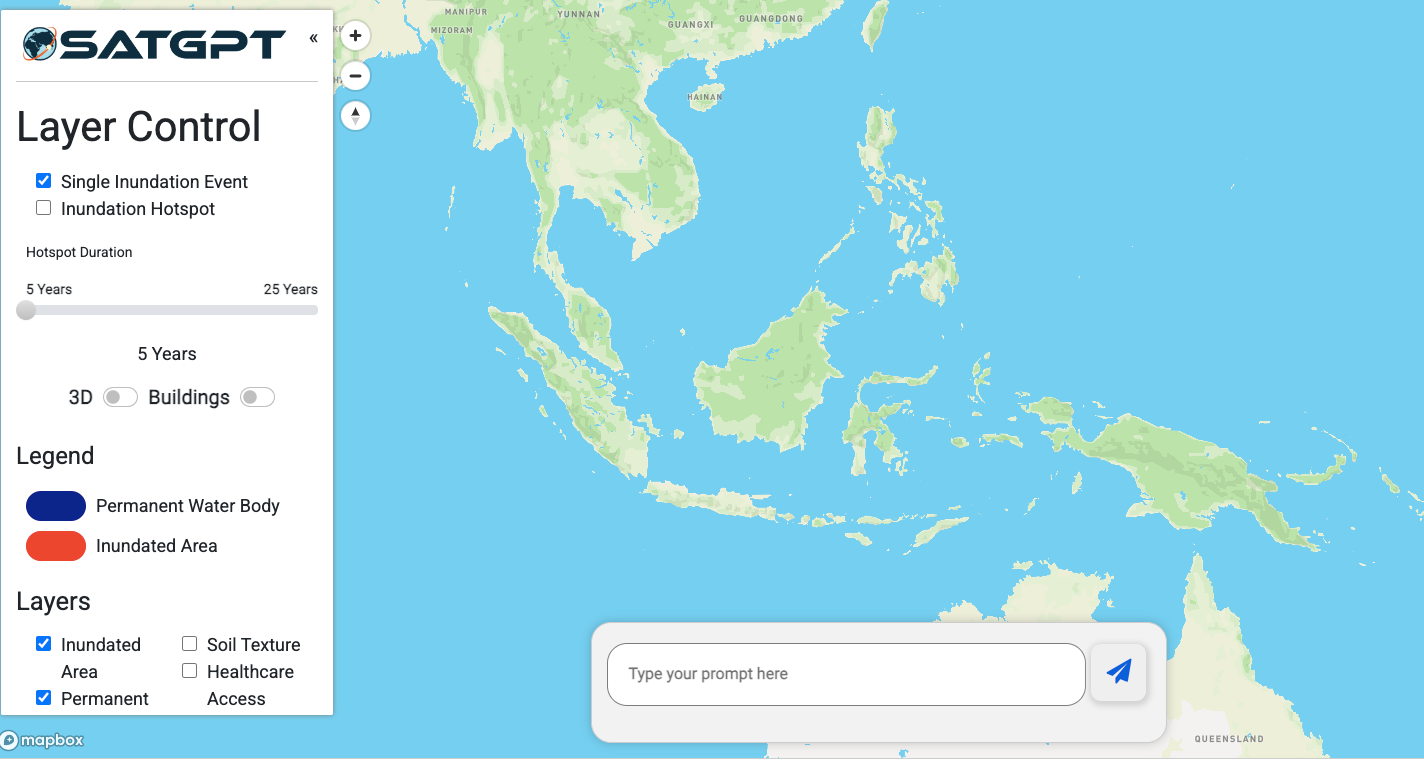
Have you ever heard about SatGPT?
The example clearly shows what an AI-native system can do.
SatGPT is an AI-powered spatial decision support system that combines large language models, cloud computing, and earth observation data.
The system can generate flood-prone maps from simple prompts, enabling authorities to process complex geospatial information faster during disaster prevention and response.
This is not a simple service; it is an AI tool that produces a map.
Multiple layers work together in one process: satellite data, computing resources, cloud systems, AI models, and networks, turning a large amount of information into a result that can support a real-world decision.
The same mechanism can extend beyond disaster response.
ESCAP identifies potential applications across financial inclusion, public services, agriculture, education and disaster resilience.
AI-native infrastructure could help government process information more efficiently, improve public service delivery and support decision-making.
But greater capability also creates greater dependency.
As more critical services rely on interconnected digital systems, cybersecurity and resilience become more important.
Concentrated infrastructure and technology providers can create dependencies, while weak governance can raise questions about accountability, data use, and trust.
The infrastructure itself therefore becomes part of the policy challenge.
Building more computing capacity or deploying more AI systems is not enough. Countries also need systems that are secure, resilient, sustainable, and governed in ways that let people and institutions trust them.
🏁 The Bottom Line
For Southeast Asia, this makes infrastructure a key part of the AI conversation. Reliable connectivity alone will not be enough.
Countries will also need computing capacity, skilled workers, digital government systems, innovation capabilities and resilient infrastructure to turn AI investment into practical economic and public-service applications.
This is where regional differences matter. According to ESCAP's DTI analysis, Southeast Asia has the greatest subregional diversity in digital transformation performance.
It means the region may require different approaches depending on each country’s existing infrastructure, skills and institutional capacity, rather than a one-size-fits-all AI strategy.
The bigger question for the region is therefore not simply how quickly Southeast Asia adopts AI, but whether its digital infrastructure can keep pace and who benefits from it.
As AI transforms digital infrastructure from systems that primarily connect people into systems that increasingly compute, process and make decisions, Asia-Pacific faces a new challenge: how to build that infrastructure without widening the gaps in who can benefit from it.
🔎 Need More Angle
Bangkok Post Researchers eye AI revolution in natural disaster forecasts
Bangkok Post New AI platform to enhance government services nationwide
BRIN Indonesia Hosts ASEAN–Korea High Performance Computing Facility
The Diplomat Will Southeast Asia Actually Benefit From Its AI Boom?
(NML/QOB)