



How It Reignite?
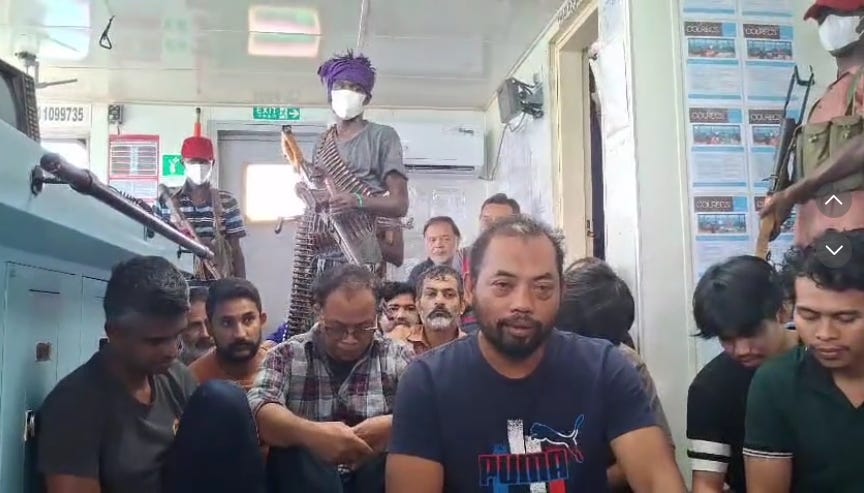
A desperate video message, a $3 million ransom demand, and families begging for government intervention—a new hostage crisis off the Horn of Africa signals a terrifying return to a threat the world thought it had neutralized.
As Indonesian and regional diplomats scramble to negotiate with heavily armed syndicates, the resurgence of Somali piracy is no longer a warning sign; it is an active, escalating crisis.
Why It Hits Home
For Southeast Asia, maritime security is not an abstract geopolitical issue; it is a direct threat to both the regional workforce and the domestic economy.
Indonesia, the Philippines, and Myanmar form the backbone of the global seafaring labor pool. Whenever international waters become unstable, Southeast Asian families bear the immediate human cost.
This dynamic turns a distant African security failure into a local tragedy, driven by two compounding factors:
The Remittance Shockwave: Southeast Asian seafarers do not just navigate ships; they are the economic anchors for their home countries. Maritime workers pump tens of billions of dollars annually into regional economies, driving local consumption, housing, and education. When a breadwinner is held hostage in Somalia for months or even years, that critical financial lifeline is instantly severed. Extended families are thrown into immediate poverty, and the economic ripple effect chills their local communities.
The Vulnerability Gap: Southeast Asian crews are disproportionately hired to staff “Flag of Convenience” vessels—ships registered in countries like Palau to minimize corporate taxes and bypass strict labor laws. These vessels frequently operate with lower security budgets, lacking the private armed guards that richer national fleets employ. Consequently, Southeast Asian workers are often the least protected targets navigating the world’s most dangerous chokepoints simply to earn a living.
If global shipping companies begin to lose confidence in the safety of these routes—or if the cost of ransoms and insurance becomes untenable—it threatens the long-term job security of hundreds of thousands of Southeast Asian maritime workers.
The Somali Context
Modern Somali piracy is rooted in a complex blend of economic desperation and organized crime. It originally began in the 1990s as a violent but defensive measure by local fishermen protesting illegal, unreported, and unregulated (IUU) fishing by foreign trawlers, as well as toxic waste dumping in their waters.
Today, however, it operates as a highly organized, lucrative criminal enterprise. Syndicates, particularly in the semi-autonomous Puntland region, are well-resourced. They reinvest ransom money into local coastal economies, purchasing heavy weapons, navigation equipment, and large traditional fishing boats (dhows) to use as “mother ships.” These larger vessels allow them to launch attack skiffs hundreds of nautical miles deep into the ocean.
The Ransom Economy: Follow the Money
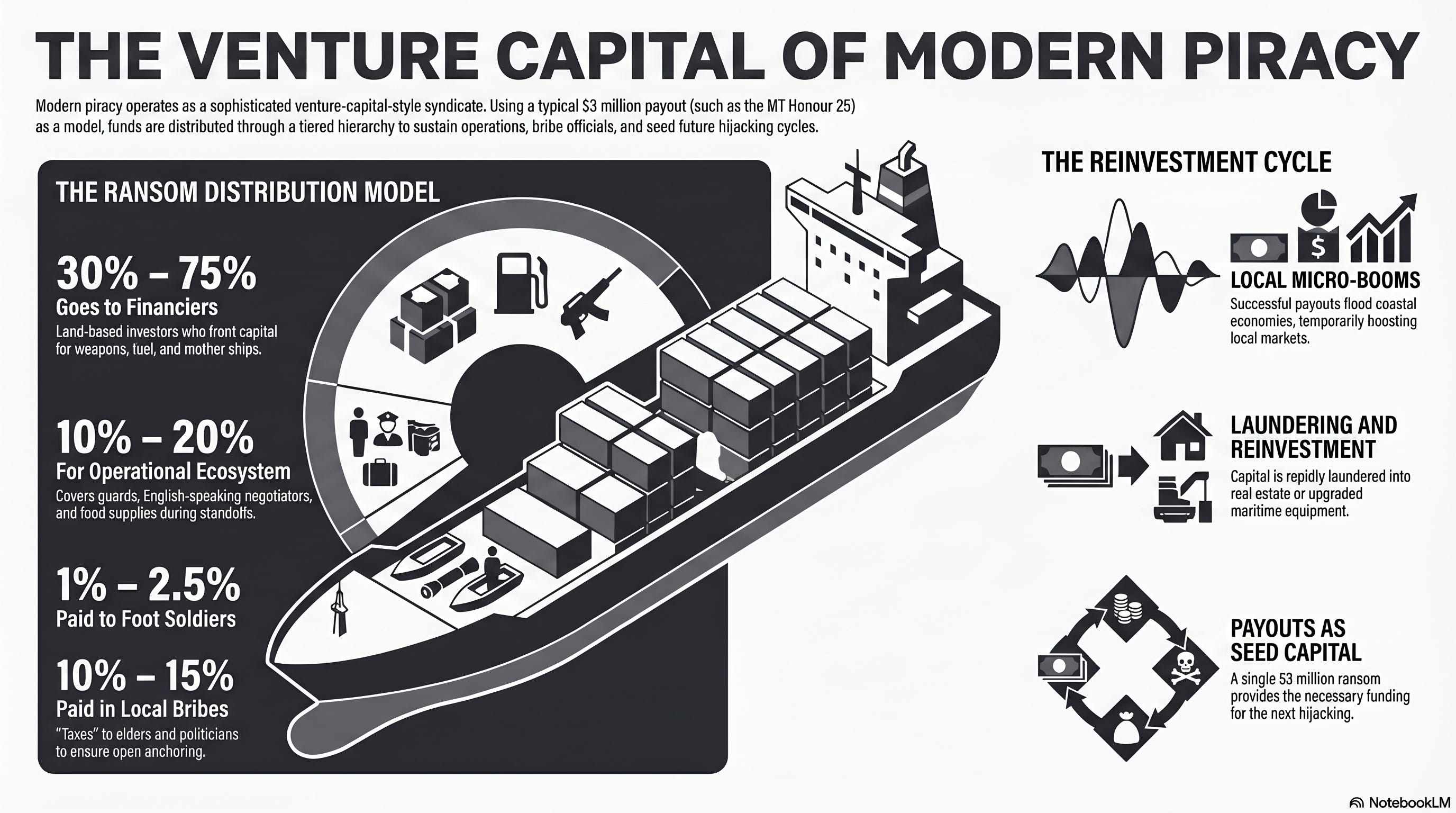
Piracy is not a chaotic grab for cash; it is a highly structured, venture-capital-style enterprise. According to the World Bank’s financial tracking study on piracy (often referred to as the “Pirate Trails” model), a $3 million payout does not sit in a single warlord’s vault. It is systematically distributed:
Estimated Cut on Syndicate Function
The Financiers 30% – 75%: Land-based investors who front the capital required for heavy weapons, fuel, and mother ships.
Operational Ecosystem: 10% – 20%Pays the guards, English-speaking negotiators, and local merchants who supply food during standoffs.
Local Bribes: 10% – 15%”Taxes” paid to local elders, politicians, and port officials to ensure the syndicate can anchor openly.
Foot Soldiers: 1% – 2.5%Flat, pre-negotiated fees paid to the young men risking their lives on the actual attack skiffs.
This illicit capital floods the coastal economy. Following a successful payout, local markets experience micro-booms, and the funds are rapidly laundered into real estate or reinvested into larger ships to fund the next hijacking.
The Lawless Sea
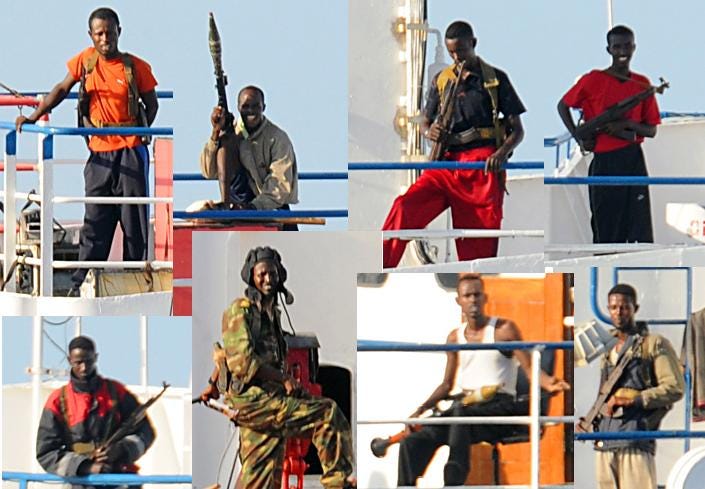
The sea off the Horn of Africa is becoming lawless again largely due to an international security vacuum. For the past decade, sustained naval patrols by international coalitions successfully suppressed pirate attacks.
However, recent geopolitical shocks have diverted these crucial naval assets. With warships redirected to the Red Sea to manage Houthi attacks, the deterrent effect has vanished. According to the International Chamber of Commerce’s International Maritime Bureau (IMB), this vacuum has directly emboldened pirate groups, allowing them to capture deep-sea targets up to 600 nautical miles from shore.
The Shipping Situation: The Red Sea Detour
Global shipping is currently facing a logistical nightmare that heavily favors piracy, driven entirely by the collapse of the Red Sea shipping corridor.
Before the current crisis, the United Nations Conference on Trade and Development (UNCTAD) reported that the Suez Canal facilitated up to 20% of all global container shipping and 15% of total maritime trade. Today, World Bank tracking data shows that container ship transits through the Suez Canal have plummeted by over 50%.
To bypass this hostile chokepoint, the shipping industry has been forced into a massive structural detour. Data from global supply chain analysts indicates a staggering 98% increase in ships routing through the Cape of Good Hope. This detour adds roughly 3,500 nautical miles to a typical Asia-to-Europe voyage.
For Somali pirates, this is a historic opportunity. The detour artificially forces thousands of slow-moving, heavily laden commercial vessels directly past the Horn of Africa just as international naval protection is at its weakest.
The Hostages History
Southeast Asian crews have a long, painful history with Somali pirates. During the absolute peak of Somali piracy between 2008 and 2012, hundreds of Indonesian, Filipino, and Thai sailors were taken hostage.
The threat never disappeared. According to the IMB’s latest Piracy and Armed Robbery Report, global maritime incidents surged by 23% throughout 2025, with violence against crews escalating dramatically.
1. Oil Tanker Honour 25 (April 2026)
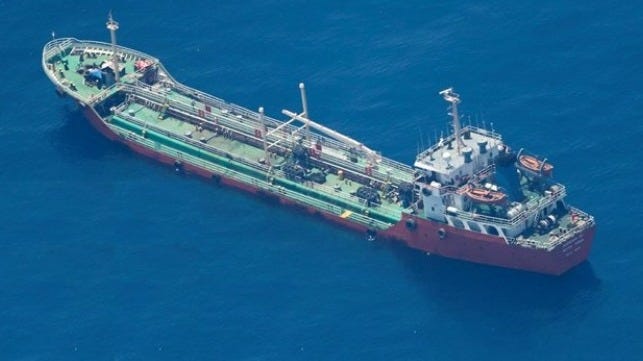
The Incident: Hijacked by heavily armed pirates off the coast of Puntland, Somalia, while carrying a highly flammable cargo.
Hostages: 17 crew members, including 4 Indonesian and 1 Myanmar national.
Ransom Demand: Initial reports indicated an exorbitant demand of $10 million, which pirate leaders later purportedly reduced to a non-negotiable $3 million.
Hostage Status (Currently Captive): As of mid-2026, the crew is still being held hostage. The seafarers are enduring dire conditions, with families reporting that they are facing severe food shortages and being forced to drink contaminated tank water. International authorities and the victims’ governments are actively monitoring the situation while delicate negotiations continue.
2. Omani Fishing Vessel Naham 3 (March 2012)
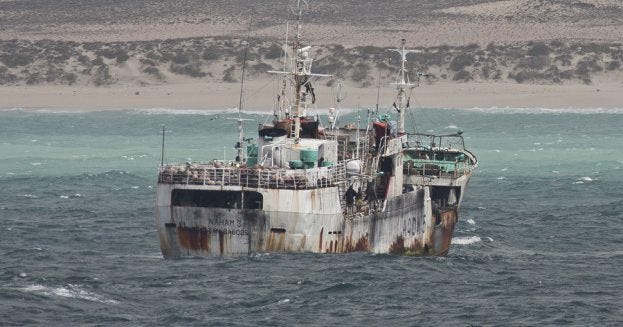
The Incident: Intercepted in the remote waters of the Seychelles, this hijacking turned into one of the most grueling maritime hostage crises in modern history.
Hostages: 29 sailors, predominantly from Indonesia, the Philippines, Vietnam, and Cambodia.
Ransom Demand: The pirates initially demanded an astronomical sum. After years of agonizing negotiations, a ransom of approximately $1.5 million was ultimately paid.
Rescue Method: The surviving hostages were released via ransom payment in October 2016. They endured four-and-a-half years of brutal captivity, starvation, and disease. Tragically, several crew members perished before the ransom could secure their freedom.
3. MT Gemini (April 2011)
The Incident: The Singapore-flagged chemical tanker was captured while navigating toward Mombasa, Kenya.
Hostages: 25 seafarers, heavily represented by Southeast Asian mariners, including 13 Indonesian and 3 Myanmar nationals.
Ransom Demand: A massive ransom of $6 million was demanded and subsequently paid by the ship’s owners.
Rescue Method: The Southeast Asian crew members were released via ransom payment in November 2011, after seven agonizing months. (Note: The pirates treacherously broke their agreement and held four South Korean crew members back for over a year to demand further political concessions, though the Southeast Asian crew was successfully evacuated).
4. MV Sinar Kudus (March 2011)
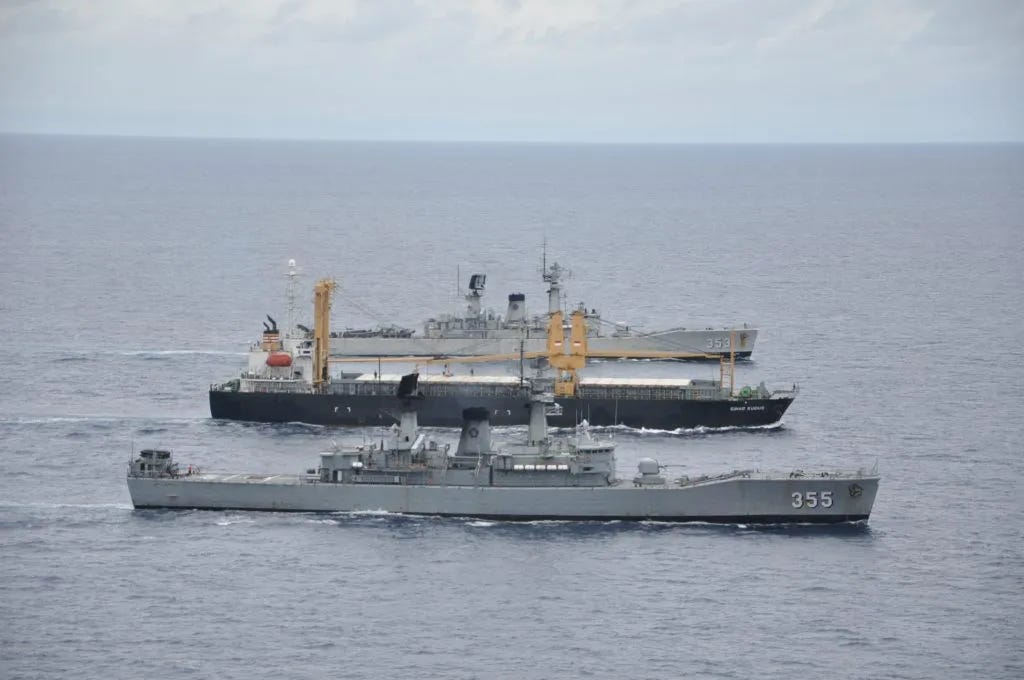
The Incident: A large Indonesian bulk carrier was hijacked deep within the Somali basin.
Hostages: 20 crew members, all of whom were Indonesian citizens.
Ransom Demand: The pirates demanded and received a staggering $4.5 million ransom.
Rescue Method: The crew was rescued through a highly coordinated ransom-and-military hybrid operation. Once the Indonesian shipping company air-dropped the ransom money onto the ship to secure the immediate safety of the crew, elite Indonesian military forces (in Operation Merah Putih) immediately launched a covert tactical strike from the sea, fully securing the vessel and chasing down the fleeing pirates.
5. MT Bunga Laurel (January 2011)
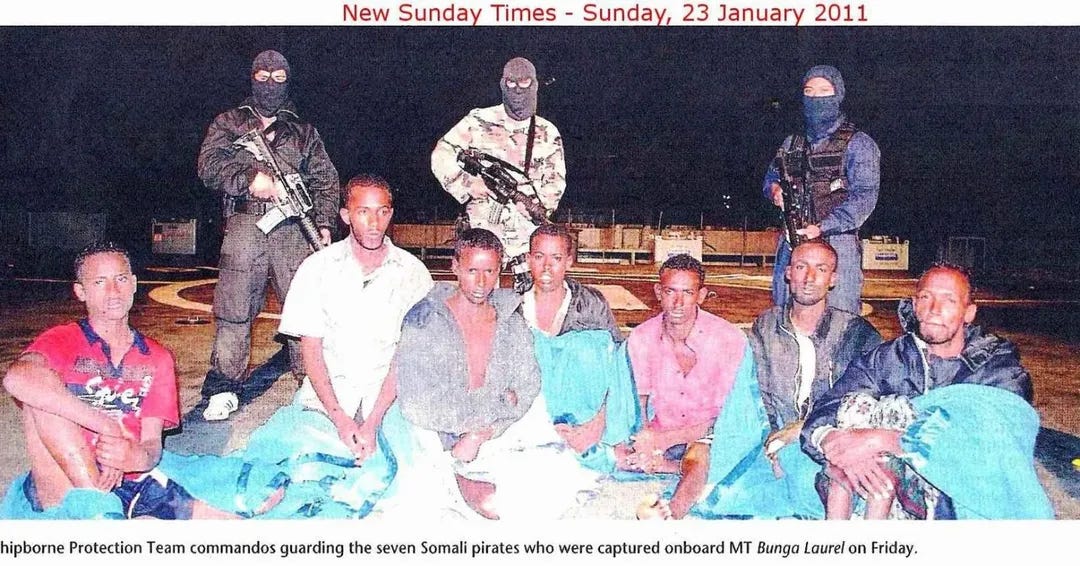
The Incident: Hijacked amidst the perilous shipping lanes of the Gulf of Aden, the pirates aimed to seize the Malaysian chemical tanker and its highly valuable cargo.
Hostages: 23 crew members, comprising Filipino and Malaysian nationals.
Ransom Demand: The pirates intended to extort a multi-million dollar ransom, but they never got the chance to negotiate a price. $0 was paid.
Rescue Method: The hostages were rescued by a military raid on the exact same day they were captured. Elite Malaysian naval commandos (PASKAL) launched a daring, precision boarding operation under the cover of darkness. They successfully engaged and neutralized the heavily armed pirates, rescuing every single hostage without a scratch.
6. MV UBT Ocean (March 2010)
The Incident: The Marshall Islands-flagged fuel tanker was hijacked off the eastern coast of Madagascar and anchored at a pirate stronghold.
Hostages: 21 crew members, entirely composed of Myanmar nationals.
Ransom Demand: A ransom of $4 million was demanded and paid.
Rescue Method: The crew was released via ransom payment in July 2010. After the European shipowners finalized the financial transaction, the pirates vacated the vessel, and the Myanmar crew sailed to safety unharmed.
7. MV Pramoni (January 2010)
The Incident: Intercepted in the Gulf of Aden while en route to India.
Hostages: 24 crew members, including 17 Indonesian and 1 Vietnamese national.
Ransom Demand: The pirates demanded an undisclosed multi-million dollar ransom to spare the crew and the volatile chemical cargo.
Rescue Method: The crew was released via ransom payment in late February 2010. The cinematic rescue saw a small aircraft circle the hijacked vessel and literally air-drop the ransom cash in a sealed container directly onto the deck. Upon retrieving the money, the pirates fled, leaving the hostages unharmed.
8. MT Longchamp (January 2009)
The Incident: Hijacked while navigating through the notoriously pirated waters of the Gulf of Aden.
Hostages: 13 crew members, consisting of 12 Filipino nationals and 1 Indonesian citizen.
Ransom Demand: The pirates successfully extorted an undisclosed multi-million dollar ransom (part of a massive wave of pirate payouts in early 2009).
Rescue Method: The seafarers were released via ransom payment in late March 2009. The German owners of the liquefied gas tanker conceded to the extortion demands, allowing the vessel and all personnel to be safely released.
9. MT Bunga Melati Dua (August 2008)
The Incident: A Malaysian-flagged tanker hijacked in the volatile Gulf of Aden corridor while carrying a highly lucrative cargo of palm oil.
Hostages: 39 crew members, entirely comprising Malaysian and Filipino nationals.
Ransom Demand: The pirates initially demanded close to $10 million, but eventually settled for a $2 million ransom.
Rescue Method: The surviving crew members were released via ransom payment in September 2008 following back-channel negotiations. However, the rescue was deeply marred by tragedy; one Filipino crew member was killed by a stray bullet during the initial violent takeover of the ship.
The Bottom Line
The hijacking of the MT Honour 25 is a symptom of compounding global crises. As long as Middle Eastern conflicts divert naval protection and force commercial ships into dangerous detours, the threat of Somali piracy will persist. For Southeast Asia, this must serve as an urgent wake-up call to demand stronger international protections.
Need More Angles
Antara Four Indonesian crew safe after Somalia ship hijacking: MoFA
Hiiraan Family of tanker captain pleads for help after Somali pirate hijacking
ICC Global Maritime Piracy and Armed Robbery Increased in 2025
Melbourne Law School The Bunga Melati Dua Piracy, Ransom and Marine Insurance
The Guardian Somali pirates hijack German tanker and seize crew of 13
The Maritime Executive Somali Pirates Reportedly Demand $10M to Release Small Product Tanker
The World Bank Pirate Trails: Tracking the Illicit Financial Flows from Piracy off the Horn of Africa
VOA Somali Pirates Release 26 Foreign Crew Held for Nearly Five Years
(ARS/QOB)