



🎯 Main Takeaway
A study titled “Shaping Tomorrow’s Workforce - Asia Pacific Youth Insights” was published by JA Institute, celebrating the 20th FedEx/JA International Trade Challenge (ITC).
Federal Express Corporation (FedEx) is a multinational holding company, and Junior Achievement (JA) is a coordinating body of the Junior Achievement Network from the United States.
The study reveals how the next-generation workforce across the Asia Pacific views their readiness for the future, with over 4200 participants.
From Southeast Asia, participants include Indonesia, Singapore, Vietnam, Malaysia, Thailand, and the Philippines.
Among the results, Indonesia stands as an outlier. Of the 552 participants, 99% agree that their education should provide more knowledge regarding work life.
The results give us insight into what the regional education field should move toward to support the next generation of the workforce.

📡 Why it’s on our radar
The aim of this study is to produce data regarding the youth’s readiness in four different sections, which are:
Practical skills and education: examines the skills young people across ten Asia Pacific countries and territories see as most critical for the future.
Entrepreneurial readiness: examines how important young people think entrepreneurship skills are for the future.
Global trade readiness: examines how much young people think it's important and how well they understand how business works across economies.
Artificial Intelligence (AI) readiness: examines young people's readiness for the fastest-growing skill requirement going into 2030 and beyond.
These 4 areas capture many important qualities needed for the workforce Southeast Asia requires as the world becomes more complex and challenges arise.
Practical skills cover how prepared these participants are fundamentally, entrepreneurial covers how ready they are to create innovation, global trade allows us to see how prepared they are to adapt to the current existing system in the world, and AI readiness covers their readiness to face one of the biggest growing challenges and innovations the world is facing today.

⚠️ Why it’s important
Studies like these help those between education and job opportunity better understand the next generation.
Educators: can better understand what the next generation deems most important for their careers and what blind spots may arise from their focus.
Employers: can understand where the next generation is learning their skills before entering job positions.
Policymakers: the study results can help policymakers deal with the harder structural task of improving education nationwide.
Young people: if institutions and parties take the results seriously, they can target more young people who could see better education and opportunities in the future.
Moreover, the findings also reveal that the next generation is learning to be ready for the future not just in schools or through primary education. Rather, learning comes from a variety of places that are currently still not yet sufficiently connected, coherent, or equally accessible.
At the same time, the data shows schools haven't failed, because many still think education's important. Rather, the ecosystem where young people learn needs improvement.
📝 What the study says
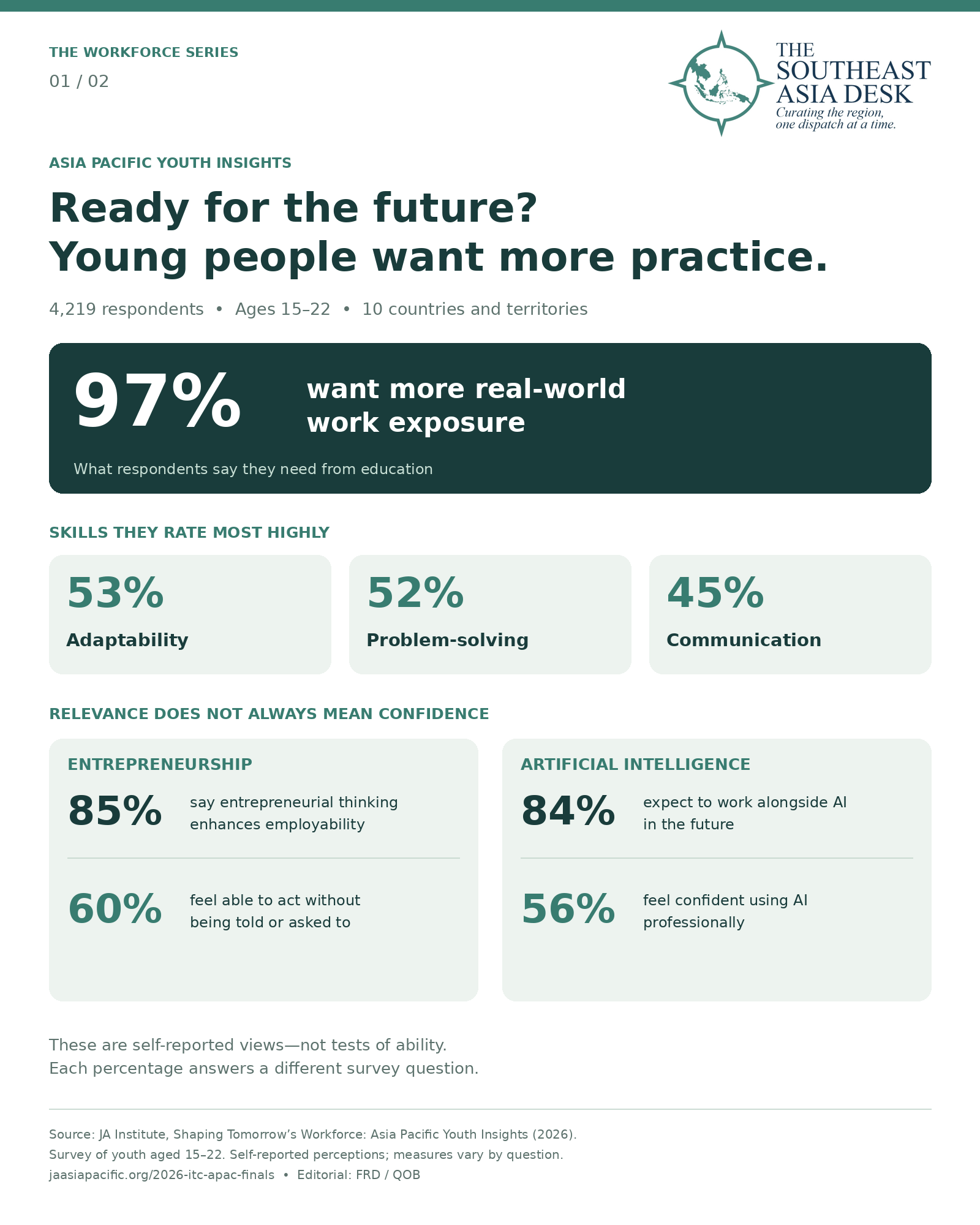
The overall result of the study reveals that over 4200 Asia Pacific youths view that:
Adaptability and problem-solving skills rank highest, at 53% and 52%, respectively. Communication follows in third place (45%).
97% of youths want more real-world work exposure, and 52% say the curriculum needs stronger problem-solving and creative thinking.
85% agree that entrepreneurial thinking enhances employability. However, only 48% are confident across all four core autonomous behaviours combined.
90% agree that understanding how business works across the economy will be relevant to their future career. However, when asked about three trade mechanisms, less than 40% claim to understand them well.
84% say they will need to work alongside AI, not just use it, in the future, and 82% agree AI will change the jobs available in their generation. However, only 56% are confident to use AI professionally.
Another important piece of information the study reveals is where these youth learn their skills to gain the confidence in how prepared they are for the future:
Across all eight skills examined (adaptability, problem solving, communication, technology, creativity, financial, leadership, and international business trade) school was rarely viewed as the primary source of learning rather it was places such as personal projects, clubs/competitions, and social media.
School clubs & extracurriculars are where youths have had the most opportunity to develop initiative, problem-solving, and independent thinking.
Only 62% say their current education is preparing them well enough to use AI in a real working environment, with 41% saying they learn most by teaching themselves and 35% from social media content.
🌏 Regional stakes
Unfortunately, the study does not present a country-by-country breakdown for each section. However, some country-specific data are given:
🇮🇩 Indonesia:
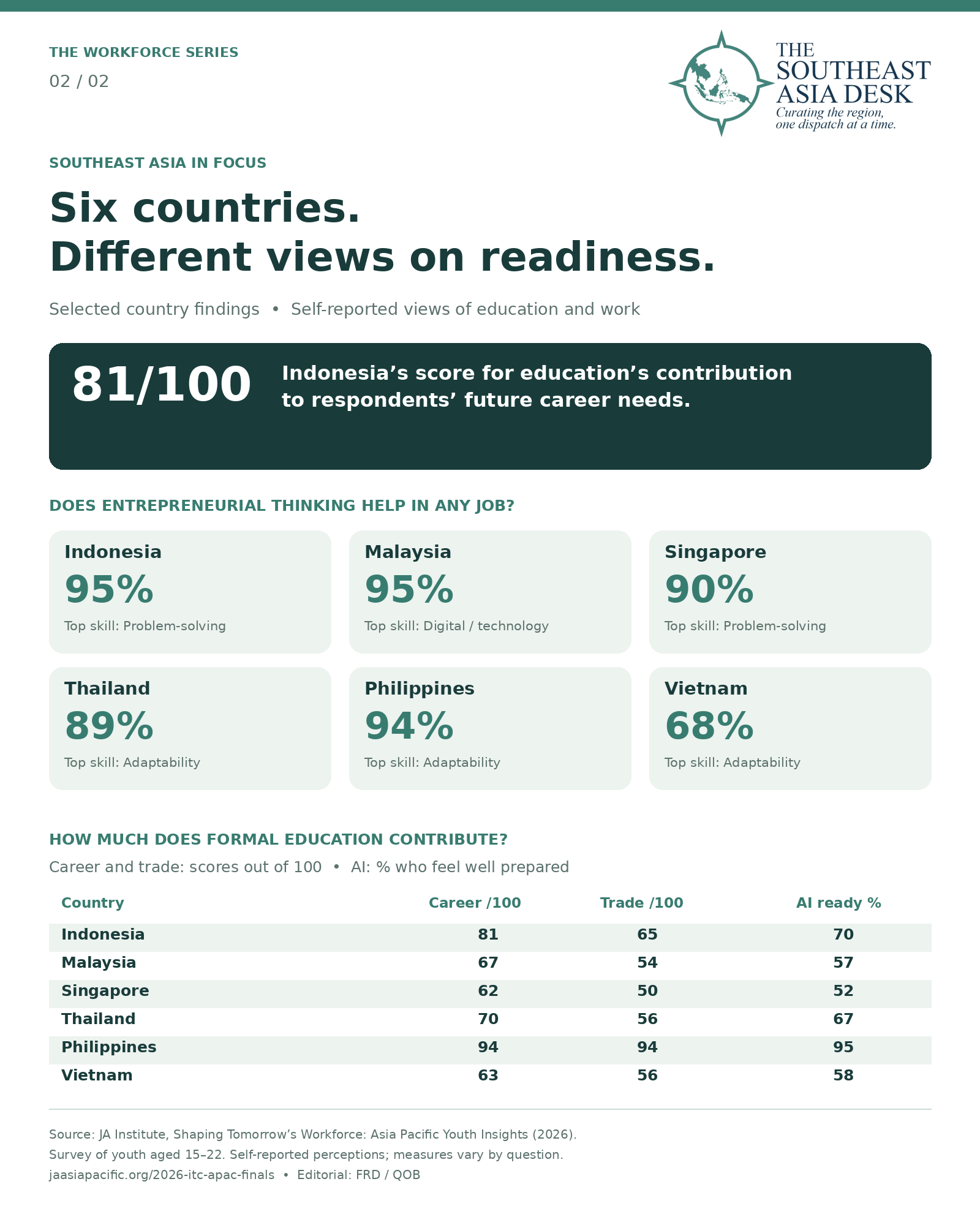
99% of participants say their education should provide more knowledge about life at work.
Problem-solving is named the most important skill.
95% believe that thinking like an entrepreneur helps succeed in any job.
81% believe education is important for a career, 65% for trade, and 70% for AI readiness.
🇲🇾 Malaysia:
95% believe that thinking like an entrepreneur helps you succeed in any job.
Digital and technological skills are viewed as most important.
67% believe education is important for a career, 54% for trade knowledge, and 57% for AI readiness.
🇸🇬 Singapore:
90% believe that thinking like an entrepreneur helps you succeed in any job.
Problem-solving skills are viewed as most important.
62% believe education is important for a career, 50% for trade, and 52% for AI readiness.
🇹🇭 Thailand:
89% believe that thinking like an entrepreneur helps you succeed in any job.
Adaptability is viewed as the most important skill.
70% believe education is important for a career, 56% for trade knowledge, and 67% for AI readiness.
🇵🇭 The Philippines:
94% believe that thinking like an entrepreneur helps you succeed in any job.
Adaptability is viewed as the most important skill.
94% believe education is important for a career, 94% for trade knowledge, and 95% for AI readiness.
🇻🇳 Vietnam:
68% believe that thinking like an entrepreneur helps you succeed in any job.
Adaptability is viewed as the most important skill.
63% believe education is important for a career, 56% for trade knowledge, and 58% for AI readiness.
🏁 Bottom line
The results show that youths across the Asia Pacific understand what matters for their future. However, a large portion of the study reveals that they are not confident in actually doing it.
This does not mean youth or learning institutions have failed, but rather that the ecosystem where youth learn isn't connected yet.
Understanding what matters for the future shows that the next generation of youth can handle it; with the right support, Southeast Asia's future workforce looks bright.
Need More Angles?
JA Asia Pacific: Shaping Tomorrow’s Workforce: Asia Pacific Youth Insights
#ASEANWorkforce #FutureOfWork #AIReadiness #EdTechSEA #SoutheastAsia #FedExJAITC
(FRD/QOB)