




What community waste initiatives in a Sarawak industrial town on Borneo can tell us about turning sustainability campaigns into working local systems?
At a Ramadan food bazaar in Bintulu in 2025, the idea was relatively simple.
At the end of each trading day, food that might otherwise have been discarded was separated into two streams.
Edible surplus could be redistributed, while unavoidable food waste could be collected for composting or biogas rather than sent for conventional disposal.
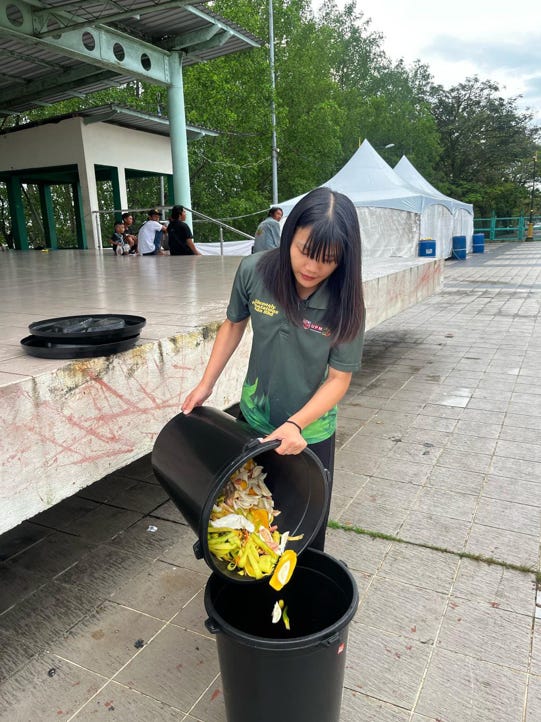
Thirty-four food-stall operators participated. Over the initiative, more than 500 kilograms of food were diverted from landfill.
More than 300 kilograms of edible surplus were redistributed to the community, while more than 200 kilograms of unavoidable food waste were separated for resource recovery.
There was nothing technologically remarkable about any of this.
Food donation is not new. Composting is not new. Waste segregation is certainly not new.
What was more interesting was everything that had to happen around those familiar solutions.
Stall operators had to participate. Food had to be separated correctly. Collection had to be organised. Different types of waste needed different destinations. Local authorities, community organisations and researchers had to coordinate their roles.
The experience illustrated something easy to overlook in discussions of the circular economy: Knowing what should happen to waste is very different from building a system that allows it to happen routinely.
That distinction has increasingly shaped our work in Bintulu.
The distance between awareness and action
Waste-reduction programmes often begin with awareness, for good reason. People cannot change practices they do not recognise as a problem.
But awareness has limits.
A household may know that plastic should be recycled and still throw it in the general waste if there is nowhere convenient to send it.
A restaurant may understand that food scraps can be composted but lack the space or staff routines to separate them.
An organisation may proudly say that it recycles without knowing how much material actually leaves its premises or where it goes.
The challenge is often not discovering another solution. It is connecting people to solutions that already exist.
This is particularly relevant in places such as Bintulu.
Southeast Asia’s conversations about sustainability, smart cities and the circular economy naturally gravitate towards major metropolitan centres. Yet much of the region’s economic and social life takes place outside them.
Bintulu is an industrial centre in Sarawak (Borneo) where hotels, industries, schools, government agencies, food businesses, community organisations and households generate different waste streams, while the systems needed to recover those materials are still developing.
It therefore offers a useful place to ask a practical question: What does a local circular economy look like before it becomes a neat policy diagram?
The answer, from our experience so far, is rather untidy.
It involves meetings, compost bins, school competitions, recyclers, mobile applications, hotel kitchens, community organisations and quite a lot of trial and error.
Getting people into the same room
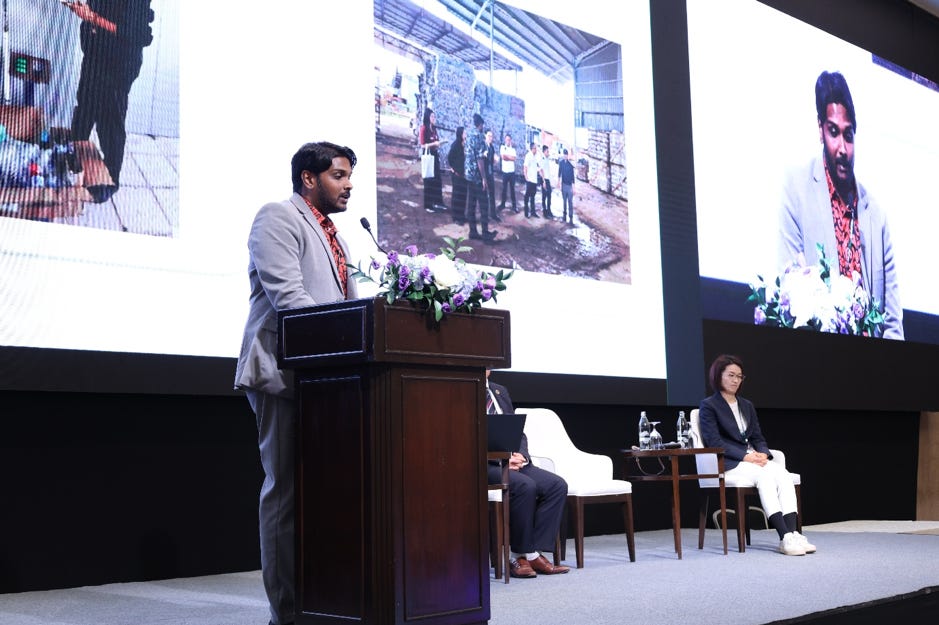
One starting point was Towards Zero Food Waste in Bintulu, a collaboration among Universiti Putra Malaysia Sarawak, Tokyo University of Agriculture, and local stakeholders, funded by the Bintulu Development Authority (BDA).
In February 2025, the programme brought together approximately 300 participants representing around 120 organisations, including businesses, hotels, schools, government agencies, community organisations and other groups.
The attendance figure itself is not the interesting part. What mattered was that people who normally encounter different parts of the same problem were in the same conversation.
A hotel sees kitchen waste.
A recycler sees materials with different market values.
A school sees an educational opportunity.
A local authority sees collection, cleanliness and disposal.
Researchers see data, behaviour and potential interventions.
Community organisations see what people will realistically do.
Bringing those perspectives together does not solve the problem, but it helps reveal where the system breaks down.
This is vital because environmental programmes can easily become trapped at the awareness stage. A seminar can be successful by conventional measures: The room is full, photographs are taken, participants fill in evaluation forms, and everyone agrees that waste should be reduced.
Then Monday morning arrives, and old routines have a habit of returning.
The real question, then, is what happens to the waste.
The Ramadan bazaar initiative became one attempt to move beyond that point by linking awareness directly with a practical pathway for food recovery.
Giving waste somewhere else to go
The distinction between edible and unavoidable food waste sounds obvious, but it changes the question being asked.
The first question is no longer, ‘How do we dispose of this food waste?’ but, ‘Does this need to become waste at all?
Where food remained suitable for consumption, redistribution came first. Only the unavoidable fraction moved towards composting or other forms of recovery.
It also became clear that individual behaviour was only part of the problem.
Institutions often have greater scope to change material flows because they control kitchens, storage areas, staff responsibilities and relatively consistent waste streams.
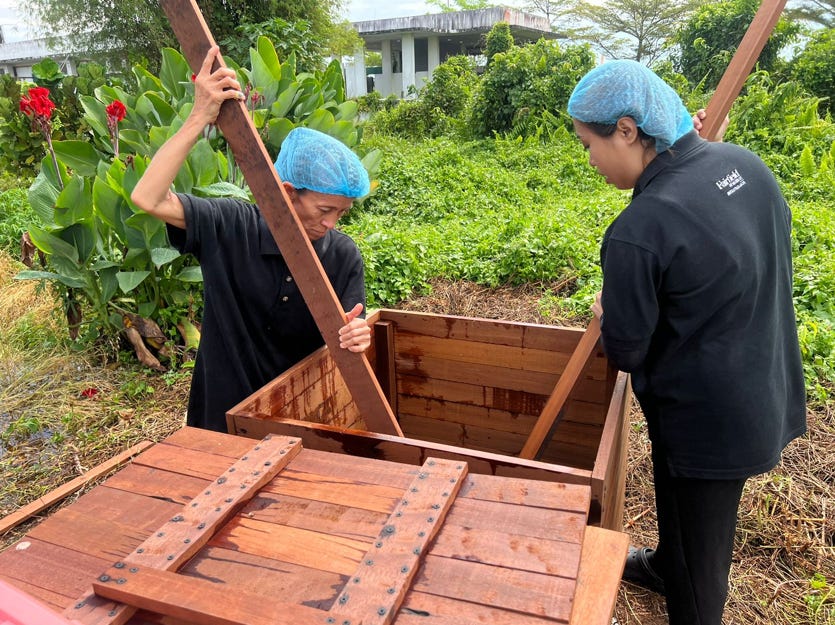
Following the broader food-waste programme, composting activities were introduced or explored with hotels and other institutions in Bintulu.
The difficult questions were not about whether composting works. They were much more ordinary.
Where will scraps be separated? Who is responsible? What happens when trained staff are off duty? How much space is needed? Which materials can enter the system? Who will use the compost?
These mundane questions often determine whether an environmental intervention survives after its launch. Circular economies are built as much through routines as through technologies.
When recycling happens, can we see it?
A different problem emerged around recyclable materials.
Many organisations already carried out some form of recycling, but the process was fragmented.
Materials accumulated until someone contacted a recycler. Different recyclers accepted different materials. Records varied considerably. Organisations could participate in recycling without having a clear picture of what had been recovered.
This was one of the problems behind the development of KitarNow.
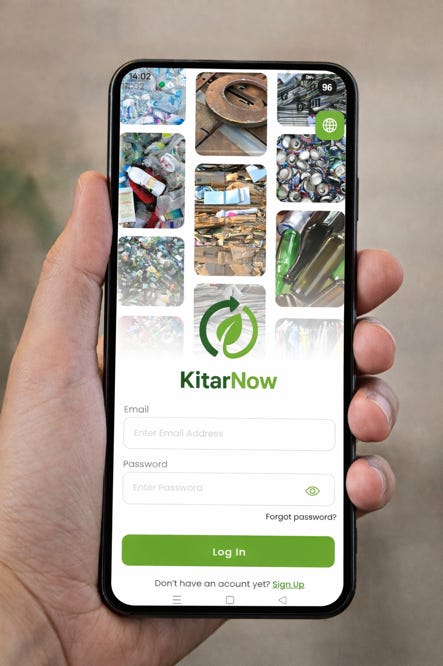
Developed by Universiti Putra Malaysia Sarawak in cooperation with Tokyo University of Agriculture, with funding through the Asia-Pacific Telecommunity and support from local partners, the platform allows organisations to list recyclable materials, while recycling companies can identify available materials.
Transactions can then be recorded by material type and weight.
However, the technology should not be romanticised. KitarNow does not recycle anything. People do.
Recyclers still need vehicles. Someone still must separate cardboard from general waste. Markets still determine whether particular materials are worth collecting.
What the application adds is a coordination and information layer.
As of May 2026, 43 organisations were registered on the platform, including five recycling companies. It had recorded 8,401.73 kilograms of recyclable material, of which 8,199.64 kilograms were recorded as recycled.
For us, the useful change was partly conceptual.
Instead of saying, “We conducted a recycling campaign”, it becomes possible to ask: What material entered the system? What was recovered? What remains uncollected? Which materials repeatedly struggle to find a destination?
That shift from activity to material flow changes how a programme can be understood.
It also exposes weaknesses.
If glass or textiles remain difficult to recover, an app cannot manufacture a market for them. If recyclers do not participate, digital listings simply become digital piles of uncollected material.
Digitalisation can reduce friction between actors. It cannot remove the physical economics of waste.
That may be one of the more useful lessons from KitarNow: technology works best when it is introduced after the coordination problem is understood, not before.
An unexpected role for schools
Schools became one of the strongest early sources of recyclable material recorded through KitarNow.
This developed alongside the Towards Zero Waste in Bintulu: Youth Environmental Empowerment 2026 programme and the Bintulu Zero Waste Schools Challenge.
The programme combined environmental education with practical recycling and sustainability communication.
Rather than judging participation solely by attendance or enthusiasm, the recycling component could also be linked to actual quantities recorded through KitarNow and supported by recycling records.
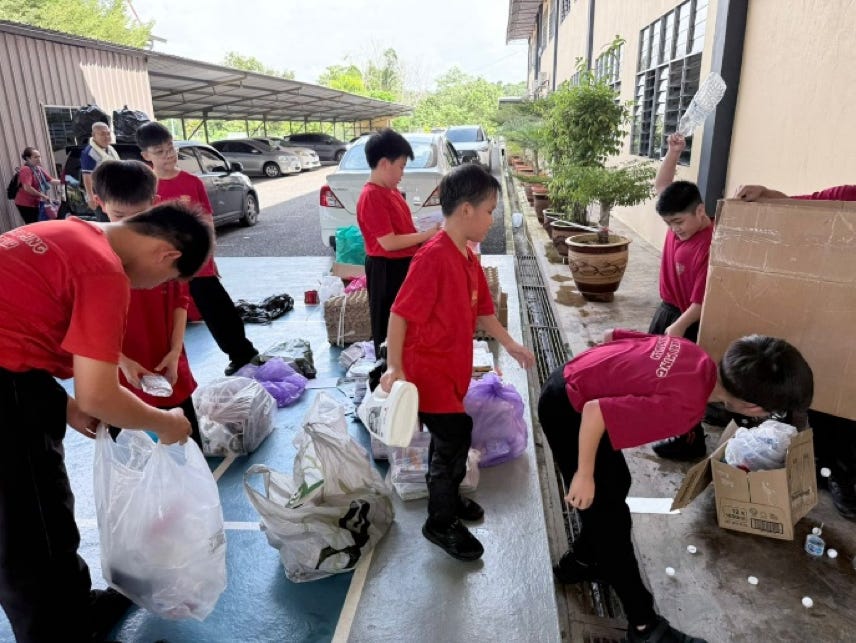
Across the wider challenge, nearly five tonnes of recyclable material were recorded in less than two months. The tonnage was useful, but schools were interesting for another reason.
Schools are institutions, but they are also networks.
Students take messages home. Teachers organise collective action. Parents become involved indirectly. A recycling activity can become visible to hundreds of people at once.
But school competitions have an obvious weakness.
Competitions end.
The harder question is what happens once the certificates are distributed and the winners announced.
Temporary mobilisation is relatively easy. Institutional memory is much harder. Which brings the problem back to continuity.
Digital systems still need physical places
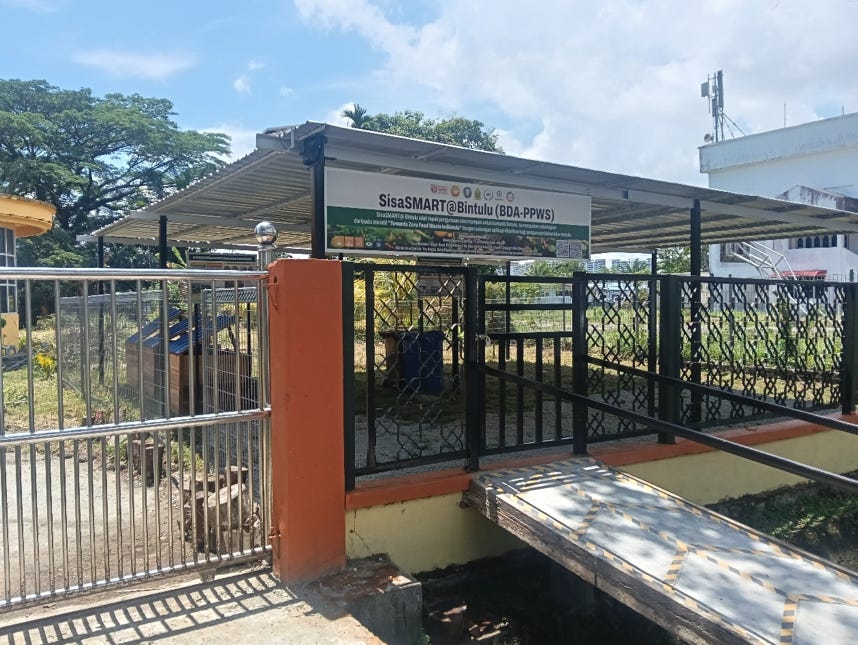
In June 2026, SisaSMART@Bintulu was established as a community facility supporting waste separation, recycling, composting, training and environmental education.
Its purpose is straightforward: to provide a physical place where sustainable waste practices can be carried out rather than only discussed.
The arrangement also illustrates the institutional side of the circular economy.
Bintulu Development Authority provides support and coordination. Sarawak Federation of Women’s Institute (PPWS) Bintulu-Tatau contributes to day-to-day operation and community mobilisation. Universiti Putra Malaysia Sarawak provides technical guidance and training support.
No single organisation is expected to do everything.
That sounds obvious, but environmental projects are often designed as though a single institution could conduct research, mobilise communities, develop technology, collect waste, train participants, operate facilities, and monitor outcomes indefinitely.
In practice, few institutions can do all of these things well.
A more realistic approach is to identify which organisation is best placed to perform which function.
SisaSMART@Bintulu is still new, and it would be premature to claim that it has changed community behaviour or significantly altered Bintulu’s waste flows.
Its importance at this stage is more modest: It provides continuity.
Campaigns, competitions and workshops have an expiry date, but a physical facility can still be there the following week.
Infrastructure does not always mean sophisticated machinery or an expensive processing plant. Sometimes it is simply a reliable place, a responsible operator and a recognised process through which people can participate.
The connections matter more than the projects
Viewed separately, none of these initiatives is particularly unusual.
There is an awareness programme, food redistribution, composting, a recycling application, a school programme and a community facility.
The more interesting development is what happens when they begin to connect.
The stakeholder programme brings organisations into the conversation. The Ramadan initiative provides a practical pathway for food recovery. Organisational composting creates another destination for unavoidable organic waste.
Schools broaden participation. KitarNow records part of the recyclable material flow and connects organisations with recyclers. SisaSMART provides a physical community node where some of these activities can continue.
None is sufficient on its own.
An awareness campaign without an action pathway produces informed frustration.
A composting system without source separation receives contaminated waste.
A recycling application without recyclers becomes a database of unresolved listings.
A community facility without an operator becomes an empty building.
A local authority working alone cannot reasonably manage every part of the circular economy.
The emerging lesson from Bintulu is therefore less about the projects themselves than about the spaces between them.
Those spaces are where local circular economies either begin to function or fall apart.
What Bintulu has not solved
Bintulu is not a zero-waste town, and these initiatives should not be presented as evidence that it is becoming one.
The quantities recorded through KitarNow represent participating organisations, not the total recyclable waste generated in Bintulu.
Food diverted through individual programmes should not be confused with citywide reductions. Short-term participation does not demonstrate long-term behavioural change.
There are also practical constraints.
Some recyclable materials remain economically unattractive to collect. Recyclers have limited capacity. Community facilities require people and resources to operate them.
Organisations may participate enthusiastically during campaigns and gradually return to older routines. Digital platforms depend on users continuing to provide reliable information.
And almost every environmental programme eventually encounters the same uncomfortable question: who pays when project funding ends?
These are not reasons to dismiss local initiatives.
They are reasons to evaluate them realistically.
Circular-economy diagrams often make material loops appear almost effortless. Draw an arrow from “waste” to “resource”, and the loop appears complete.
In practice, every arrow requires an organisation, an incentive, a person, a vehicle, a facility, a buyer or some combination of them.
What may travel beyond Bintulu?
Bintulu’s experience is still developing, and it would be unwise to package it as a model for Southeast Asia.
Local conditions differ too much. Waste markets vary. Local authorities have different capacities. Formal and informal recycling systems differ across the region. What works in Sarawak cannot simply be copied elsewhere.
But some principles may travel better than individual projects.
One is to begin with the material pathway rather than the technology.
Where does the waste originate? Who currently handles it? Where could it realistically go? What prevents that from happening?
Only then does it make sense to decide whether the missing piece is awareness, collection, infrastructure, financing, data or technology.
A second is that awareness should be linked with an action pathway.
If people are asked to separate something, there needs to be an answer when they ask where it should go tomorrow morning.
A third is to measure participation increasingly through what happens to materials rather than through attendance alone.
A hall containing 300 people may be an excellent beginning. It is not, by itself, an environmental outcome.
Different institutions also need different jobs.
Universities can contribute research and technical guidance. Local authorities can coordinate and provide institutional support. Community organisations can sustain local participation. Businesses can change their operational practices. Recyclers understand material markets. Schools can mobilise students and families.
The system becomes stronger when those roles complement one another rather than trying to make every organisation responsible for everything.
And digital tools should solve actual coordination problems.
There is little value in digitising a process simply because digitalisation sounds modern. Technology becomes useful when it removes a specific friction that people already experience.
When Monday morning arrives
The food-stall operator separating leftovers at a Ramadan bazaar is a long way from the diagrams of circular economies that appear in policy documents.
But in some ways, that small act is where the circular economy actually begins.
A material that previously had one destination is given another.
For that to happen consistently, however, a chain has to exist around it.
Someone has to separate the material. Someone has to collect it. Someone has to use it. Someone has to coordinate the process. And increasingly, someone needs to know whether it happened at all.
Bintulu’s waste problem has not been solved. What has begun to change is the architecture around parts of that problem.
Food businesses have experimented with redistribution and segregation. Organisations are adopting composting. Schools have participated in measurable recycling.
Recyclers and waste-generating organisations can connect through a digital platform. A community organisation now helps operate a physical place where recycling and composting can continue beyond a one-day campaign.
These remain small interventions compared with the total waste generated by a town.
But perhaps that is precisely why they are worth examining.
The circular economy is often discussed in terms of national strategies, advanced technologies, and major infrastructure investments. Those things matter.
At the local level, however, it also has to work when the campaign is over, the banners have come down, and Monday morning arrives.
That requires something less glamorous but just as important: Connecting people, information, infrastructure and institutions well enough that yesterday’s waste has somewhere else to go.
Dr. Keeren Sundara Rajoo is the Head of the Borneo Biodiversity Laboratory, Institute of Ecosystem Science Borneo, Universiti Putra Malaysia Sarawak (UPMS) and a Senior Lecturer in the Department of Forestry Science, UPMS. His research and community work include waste management and the circular economy, soil ecology, biodiversity and nature-based approaches to human well-being, with an emphasis on translating applied research into practical environmental initiatives in Sarawak.
Disclosure: This article has not been previously published. The author leads the Bintulu initiatives discussed in this article, including Towards Zero Food Waste in Bintulu and KitarNow.
Sources and further reading
Bintulu Development Authority. 2025. “Bintulu’s ‘Towards Zero Food Waste’ Initiative Diverts Over 500kg from Landfills.” 7 April 2025.
Unit Komunikasi Awam Sarawak (UKAS). 2026. “Agenda Sifar Sisa Bintulu Diperkasa Melalui Kolaborasi BDA-UPMS.”
Universiti Putra Malaysia Sarawak. 2025. “KitarNow: Digitising Recycling for an Inclusive Circular Economy in Bintulu.”
Universiti Putra Malaysia Sarawak. 2026. “SisaSMART@Bintulu Dilancarkan Sebagai Pusat Komuniti untuk Pengurusan Sisa, Kompos dan Kitar Semula.” 18 June 2026.
United Nations Environment Programme (UNEP). 2024. Food Waste Index Report 2024. Nairobi: United Nations Environment Programme.
United Nations Environment Programme (UNEP). 2024. Circular Economy: From Indicators and Data to Policy-Making. Nairobi: United Nations Environment Programme.
(QOB)