




🎧 Opening
Artificial intelligence has quietly become our default advisor.
For many of us, it’s now a go-to tool.
But what if AI could do more than solve daily problems?
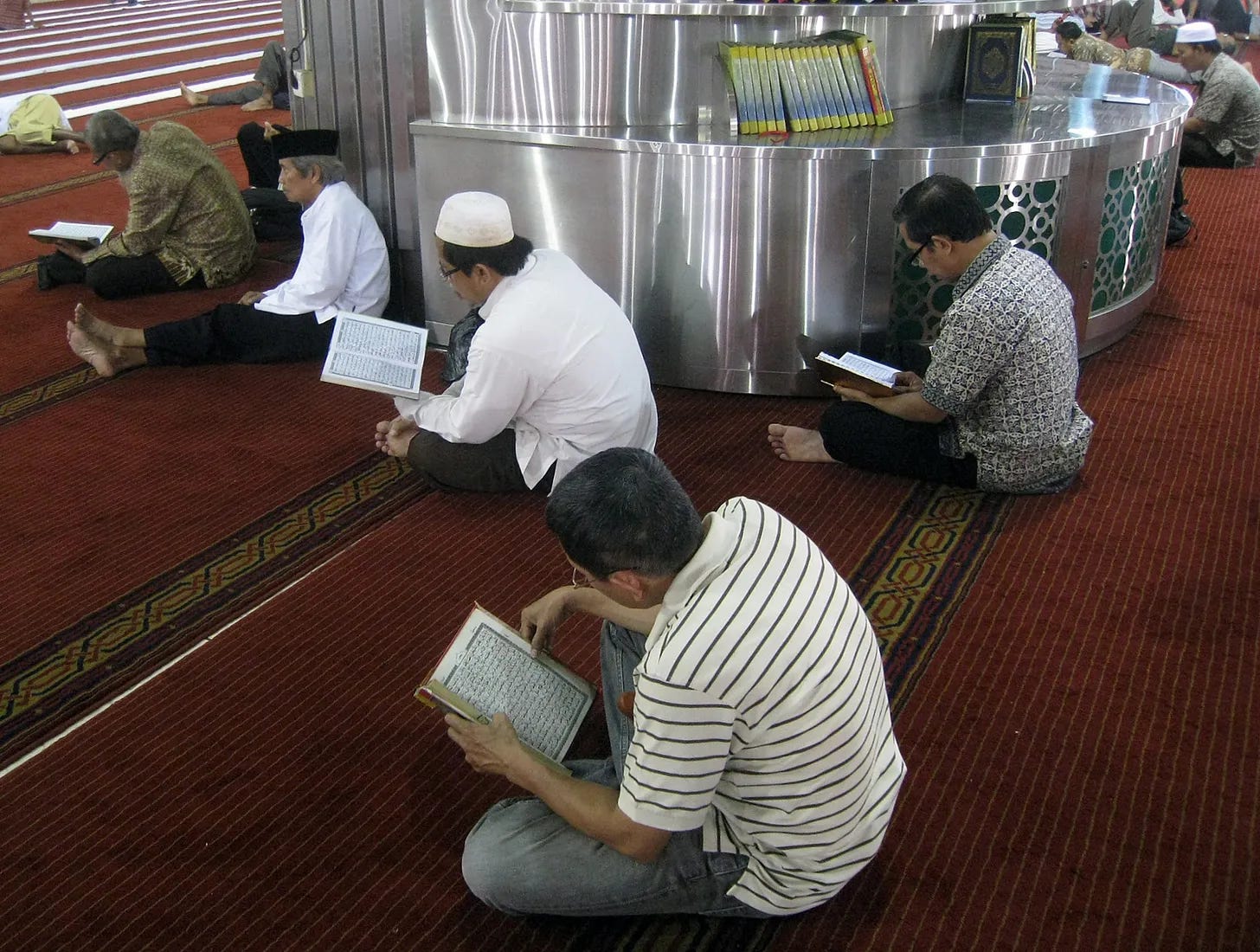
What if it could help Muslims maintain their spiritual routines, especially during Ramadan?
Yes, you heard that right.
There’s an AI-powered learning app called Ngaji.ai.
And yes, it does exactly what its name suggests.
Let’s take a closer look.
Hello and welcome to The Southeast Asia Desk Weekly Dispatch Podcast.
I’m Akasha Viandri, this is where we slow down the headlines and make sense of the stories shaping Southeast Asia region.
🧭 Background Story
Before we talk about the app, let’s begin with a simple fact.
Around 85 percent of Indonesia’s population, more than 245 million people, identify as Muslim. That makes Indonesia not only the largest Muslim-majority country in ASEAN, but in the world.
But numbers alone don’t guarantee Quran literacy.
According to the Ministry of Religious Affairs, 72 percent of Indonesian Muslims are still unable to read the Quran properly and correctly.
The reasons vary.
Busy lives.
A fear of starting too late.
Limited access to teachers or mentors.
And sometimes, simply not knowing where to begin.
At the same time, Indonesia’s Muslim population represents an enormous market for Muslim-related products and technology investment.
So here lies a tension.
A challenge and an opportunity.
Why not bring the two together?
That is where Vokal.ai, an Indonesian education technology company, enters the picture with its app, Ngaji.ai.
📲 How The App Works
Muslim-focused apps are not new.
Many people are already familiar with Muslim Pro, a 🇸🇬 Singapore-based app that provides prayer notifications, adhan reminders, and qibla direction tools.
Or Athan Pro, based in 🇬🇧 London, which offers much the same.
🇮🇩 Indonesia has its own players as well, including the NU Online Super App, developed by Nahdlatul Ulama.
These apps function as digital companions, supporting worship routines through reminders, audio features, and increasingly, artificial intelligence.
Ngaji.ai follows that path, but with a much narrower focus: Quran learning.
Inside the app, users can start from the basics, like learning Arabic letters, through interactive modules and short quizzes.
They can set goals to complete all 30 juz.
They can read surahs, study their meanings, listen to correct pronunciation, and record their own recitation.
And this is where AI comes in.
The app evaluates users’ recitation and provides feedback.
To make that possible, developers are collecting 30,000 audio datasets from Quran readers across Indonesia, ensuring the AI is credible, helpful, and adaptable, including to regional accents.
In other words, it aims to function as a mobile mentor.
🌏 The Regional Stake
But this story extends beyond personal devotion.
It sits within Indonesia’s broader position in the global Islamic economy.
According to the State of the Global Islamic Economy Report 2024/2025, published by DinarStandard, 🇮🇩 Indonesia has ranked third globally for the past three years in the overall Global Islamic Economy Indicator (GIEI).
🇲🇾 Malaysia remains in first place, holding the top spot for eleven years in a row now.
🇸🇦 Saudi Arabia comes second.
🇦🇪 The United Arab Emirates ranks fourth, followed by 🇧🇭 Bahrain, 🇯🇴 Jordan, 🇰🇼 Kuwait, 🇵🇰 Pakistan, 🇹🇷 Turkey, and 🇶🇦 Qatar, which rounds out the top ten.
The report evaluates seven main sectors:
Halal food,
Islamic Finance,
Modest fashion,
Muslim-friendly travel,
Halal pharmaceuticals,
Halal cosmetics, and
Islamic media and recreation.
Muslim-related technology doesn’t quite fit into a single category.
But with global Muslim consumer spending projected to reach 3.36 trillion US dollars by 2028, the opportunity for Muslim tech platforms is difficult to ignore.
Ngaji.ai plans to expand across Southeast Asia, starting with 🇲🇾 Malaysia, 🇧🇳 Brunei Darussalam, and 🇸🇬 Singapore.
Together with other Indonesian apps, this could mark Indonesia’s deeper entry into Southeast Asia’s evolving Muslim-tech ecosystem and a gradual rise as a benchmark for Muslim digital lifestyle trends in the region.
🎧Closing
For years, technology was often framed as a distraction from spirituality.
Now, in some corners, it is being positioned as a bridge back to it.
Whether AI can truly replicate the guidance of a human teacher remains an open question.
But its presence in religious practice, especially in Southeast Asia’s largest Muslim-majority nation, signals a shift.
Not just in how people learn.
But in how faith, technology, and regional markets increasingly intersect.
I’m Akasha Viandri, and this has been The Southeast Asia Desk Weekly Dispatch Podcast, where we slow down the noise and follow the region’s compass.
If you enjoyed this episode, subscribe
to our newsletter at thesoutheastasiadesk.com, and join us again next weekend for stories to linger over, one weekend at a time.


