



📌 The Main Takeaway
Russia is positioning its latest naval visit to Jakarta as part of a broader strategic recalibration in Southeast Asia, moving from symbolic engagement to a more active, multi-dimensional presence, while still navigating structural limits to its regional influence.
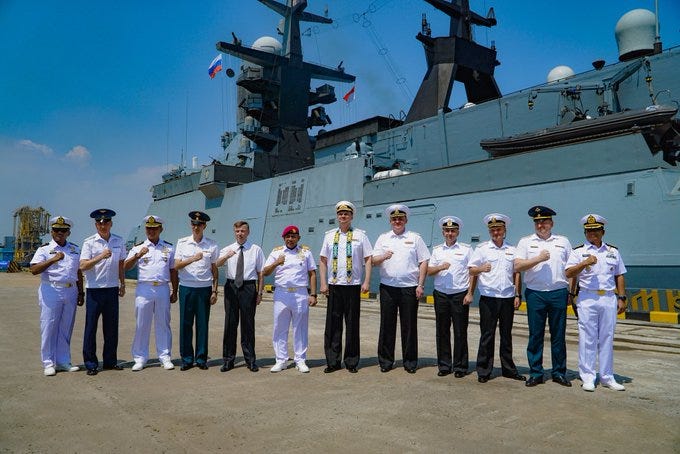
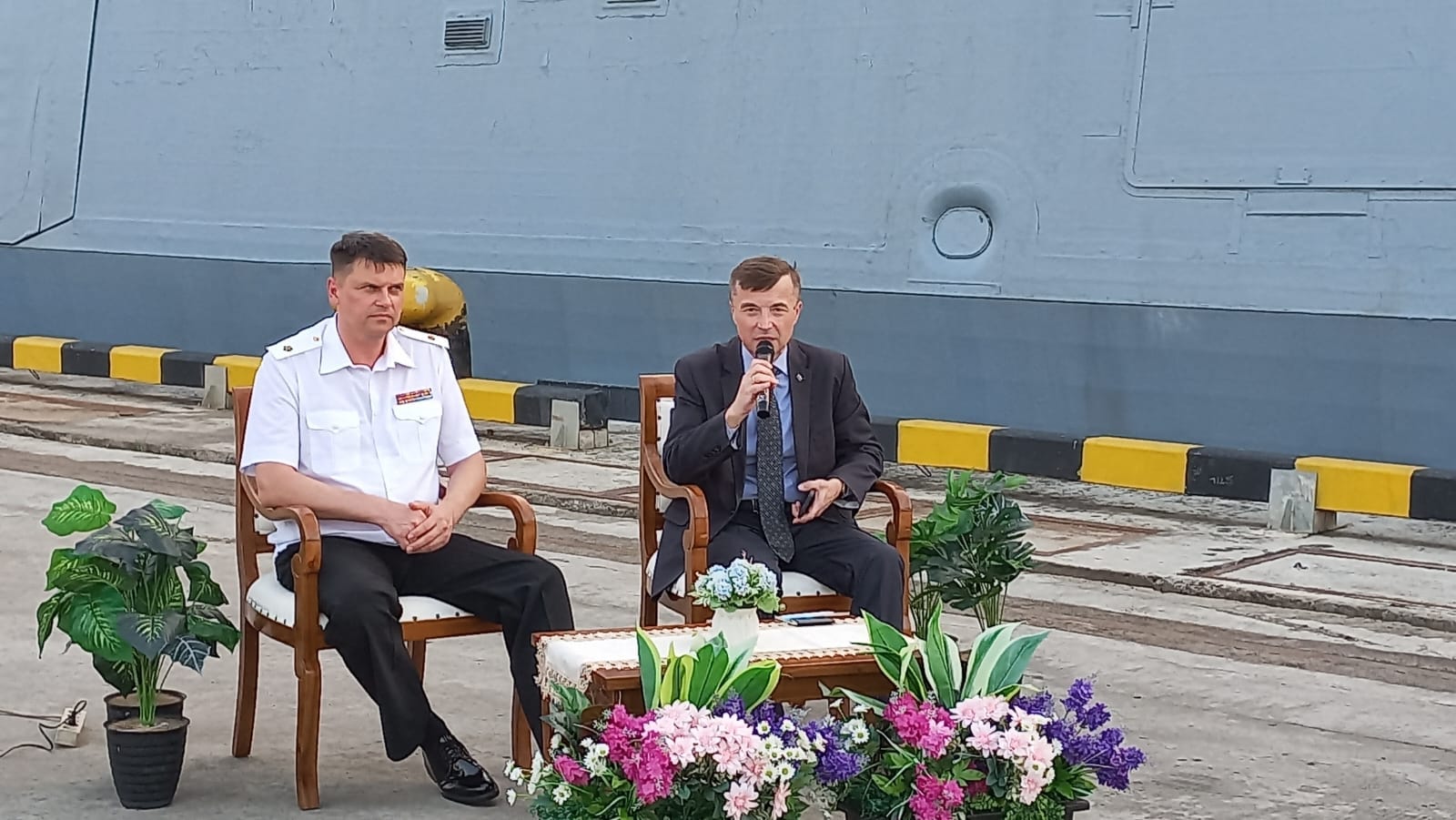
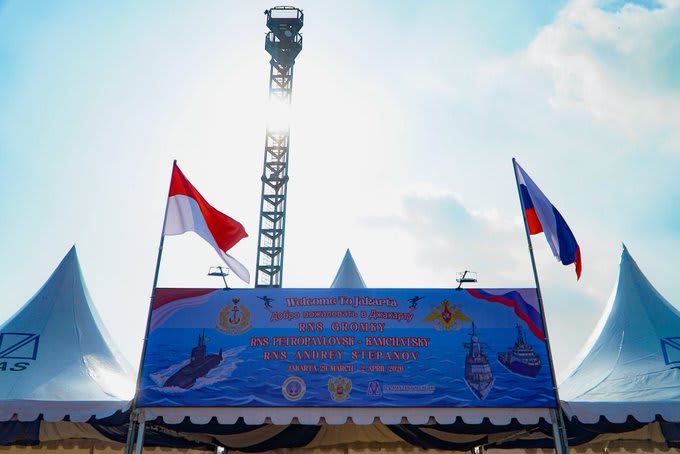
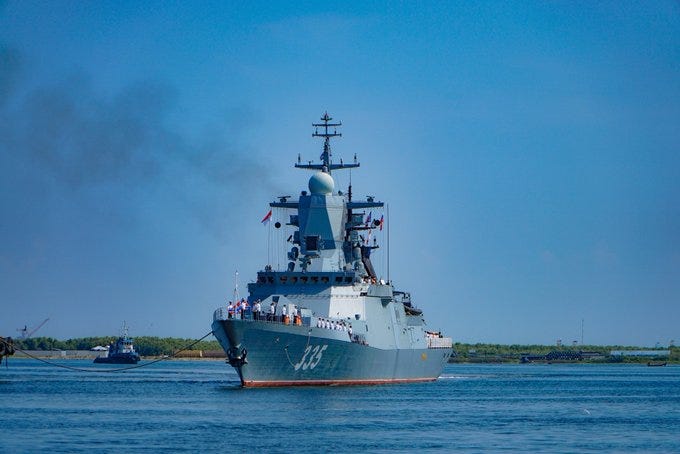
At a press briefing on March 31 at Port of Tanjung Priok, Ambassador Sergei Tolchenov and Military Attaché Maxim Lukyanov emphasized that the Pacific Fleet’s port call, featuring Gromky, Petropavlovsk-Kamchatskiy, and Andrey Stepanov, is part of Russia’s regular naval diplomacy across ASEAN, rather than a standalone engagement with Indonesia.
According to the Ambassador, Jakarta is only one stop in a broader rotation that includes Thailand, Cambodia, Malaysia, Myanmar, and Vietnam, a regular and institutionalized pattern of engagement aimed at sustaining Russia’s presence in the region.
📡 Why It’s on Our Radar
This is not just about ships docking in Jakarta; it’s about how Russia is redefining its role in Southeast Asia.
For years, Moscow’s presence in ASEAN was largely diplomatic and multilateral. Now, the shift is visible through:
⚓ More frequent naval deployments and port calls
🔄 Increased bilateral engagement with key ASEAN states
🌐 Expansion into energy, trade, and infrastructure sectors
The Jakarta visit serves as a visible signal of this transition, combining military presence with strategic messaging.
⚓ Defense Signals and Procurement Possibilities
Beyond symbolism, the visit also carried clear defense signaling. During the press engagement at Tanjung Priok Port, Sergei Tolchenov indicated that Moscow is open to supporting Indonesia’s naval modernization through potential military cooperation and acquisitions.
Referring to the visiting corvette Gromky, he suggested that Indonesia could, in the future, operate similar Russian-built platforms to strengthen its maritime defense capabilities. While declining to confirm whether formal procurement talks are underway, he emphasized that military-technical cooperation remains “a natural and integral part” of bilateral ties.
His remarks reflect a calibrated message—signaling openness without formal commitment—while aligning with Indonesia’s broader defense modernization efforts under Prabowo Subianto. As Jakarta continues to diversify its military procurement, Russia positions itself as a potential partner within that evolving landscape.
📜 A Long Maritime History: Indonesia–Russia Naval Ties
The current engagement is rooted in a decades-long maritime relationship between Indonesia and Russia.
As highlighted by Ambassador Sergei Tolchenov, naval cooperation dates back to the Soviet era, when Moscow played a key role in supporting Indonesia’s naval development:
⚓ The Soviet Union provided the submarine KRI Pasopati in 1952 (now preserved as a museum in Surabaya)
🚢 The cruiser ship KRI Irian was delivered in 1962
These transfers became early symbols of strategic trust and military partnership during the Cold War.
Today, that legacy continues through modern cooperation:
🤝 The first Orruda Joint Exercise (November 2024 in Surabaya) between the Indonesian Navy and the Russian Navy
🌊 Participation in Multilateral Naval Exercise Komodo 2025 in Bali, where Russia was among the largest foreign contingents
Beyond military exercises, this shared history is also reflected in cultural diplomacy—such as the naval exhibition “Marine Ships Must Be” held at the Jakarta Maritime Museum.
📊 Russia–ASEAN Engagement by the Numbers
🌏 ASEAN population: 650+ million people
📈 Trade growth: +70% over the past decade
💱 Increasing use of local currencies and swap mechanisms
🛢 Key exports: LNG, fertilizers, military equipment
Despite these gains, Russia still ranks relatively low among ASEAN dialogue partners in trade and investment.
⚖️ Why It Matters
Russia’s approach reflects a distinct strategic positioning.
Unlike the United States or China, Moscow:
🚫 Avoids forcing alignment
🤝 Emphasizes non-interference and ASEAN centrality
🧭 Positions itself as a flexible alternative partner
This makes Russia particularly relevant for countries seeking strategic diversification.
Defense remains its strongest pillar:
🛡 Legacy arms ties (especially with Vietnam)
⚙️ Expanded cooperation in training and maintenance
🚢 Continued naval diplomacy and joint exercises
🔍 What’s Changing on the Ground
1. From Symbolic to Substantive
More concrete cooperation beyond forums
2. From China Reliance to Diversification
Expanding partnerships across ASEAN
3. From Dollar Dependence to Alternatives
Growing use of local currency mechanisms
🌏 The Bigger Picture
Russia’s outreach is part of a broader Eurasian and Global South strategy.
Through initiatives linked to:
🌍 Eurasian Economic Union
🤝 BRICS cooperation frameworks
🌐 ASEAN-led mechanisms (ARF, ADMM+, EAS)
Moscow aims to position itself as a balancing power in a multipolar order.
🚧 The Constraints
📉 Declining arms export competitiveness
💰 Limited economic capacity
🌍 Reputational impact of the Ukraine war
🧩 Narrow influence concentrated in select sectors
Perception remains a key challenge, as Russia ranks low in ASEAN strategic-relevance surveys.
🔮 What to Watch
⚓ Continued regular naval rotations across ASEAN
🔋 Expansion in energy and infrastructure cooperation
🤝 Growth in non-traditional security partnerships
📊 Whether economic engagement can match military visibility
🚨 The Bottom Line
Russia is not retreating from Southeast Asia—but it is not emerging as a dominant force either.
Instead, it is adapting through continuity and recalibration.
By combining historical ties with Indonesia, regular naval diplomacy, and selective economic outreach, Russia is securing a role as a persistent, balancing actor in the Indo-Pacific.
The Jakarta port call is not just a visit—it is a reflection of both legacy and strategy, showing how Russia intends to remain relevant in a rapidly evolving regional order.
🔎 Need More Angles?
Geopolitical Intelligence Services AG, Russia in Southeast Asia: Gaining ground or treading water?
Jakarta Globe, Russia Open if Indonesia Wants to Buy Its Warships
Modern Diplomacy, Russia’s Southeast Asia Policy Adjustments in 2025
Radio Republik Indonesia, Maritime History Strengthens RI-Russia Friendship: Ambassador
(JUN/QOB)
In 1945, it was the Russian Fleet that sailed into Indonesia to re-colonialize the "Dutch East Indies" and the people of Indonesia did not fall for it. Instead, they made one of the largest and strongest Democracies in the world and dominate the South Asian trade replacing the Dutch colonialists. It has not been easy but with Oil resources and being the crossroads of Southeast Asia and Jakarta being the worlds most populated city, all we need from Russia is trade, but only when they stop being aggressive and at WAR with their neighbor, Ukraine.