



🎯 The Main Takeaway
The geopolitical bridge between Moscow and Jakarta is stronger than ever.
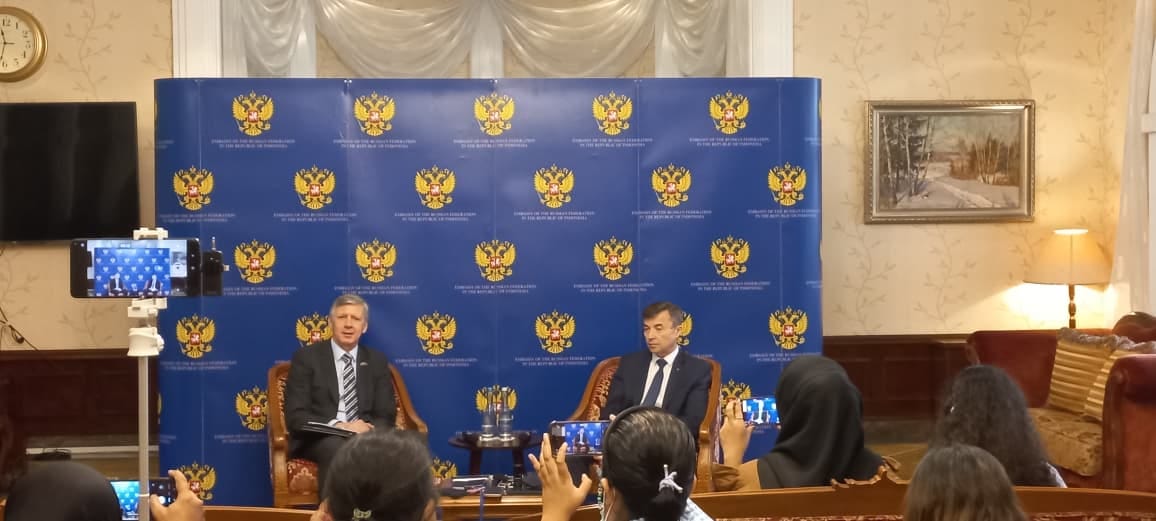
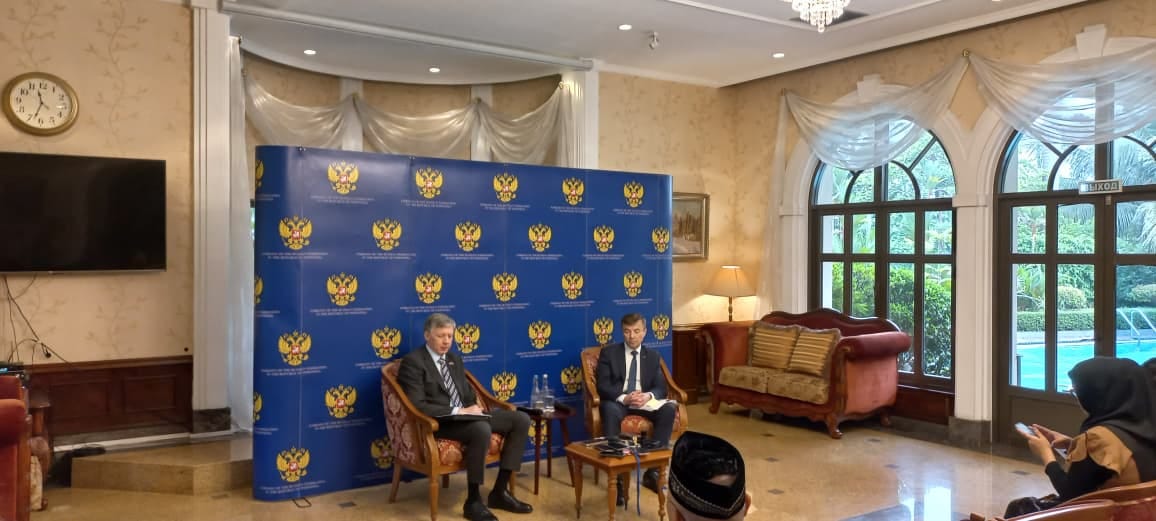
In a joint media briefing held at the Russian Ambassador’s residence in Jakarta on Wednesday (6/24), Russian Ambassador to Indonesia H.E. Sergei Tolchenov and Russian Ambassador to ASEAN H.E. Evgeny Zagaynov outlined a massive wave of recent high-level state visits, upcoming joint military exercises, and a newly signed five-year ASEAN-Russia comprehensive action plan.
The message is clear: despite Western economic pressures, Russia is successfully positioning itself as an indispensable strategic, industrial, and energy partner for both Indonesia and the wider Southeast Asian region.
🏛️ Grounded in History: Russia-Indonesia Relations
The current partnership is built on a deep historical foundation of 76 years of diplomatic ties, officially established on February 3, 1950.
A Renaissance of Strategic Partnership: Following the landmark 2025 anniversary year, the strategic partnership was formalized through a joint declaration approved during negotiations between President Vladimir Putin and President Prabowo Subianto in Saint Petersburg on June 19, 2025.
Surging Economic Cooperation: Bilateral trade volume experienced positive growth, increasing by 16.2% to reach $4.02 billion USD. This spike stems directly from the 13th Meeting of the Russia-Indonesia Joint Commission co-chaired by First Deputy PM Denis Manturov and Coordinating Minister Airlangga Hartarto in Jakarta. A monumental milestone was achieved with the official signing of the Free Trade Agreement (FTA) between the Eurasian Economic Union (EAEU) and Indonesia in Saint Petersburg.
🌏 Shaping Regional Architecture: Russia-ASEAN Evolution
Moscow’s institutional ties with Southeast Asia have transitioned through clear developmental phases to form a structured multilateral partnership.
The Early Dialogue Framework: Formal relations began in July 1991 when the Minister of Foreign Affairs of the Russian Federation attended the Opening Session of the 24th ASEAN Ministerial Meeting (AMM) in Kuala Lumpur as a guest of the host government. Russia was subsequently elevated to a full Dialogue Partner of ASEAN during the 29th AMM in Jakarta in July 1996.
Legal and Institutional Foundations: To solidify its commitment to regional stability, Russia officially acceded to the Treaty of Amity and Cooperation in Southeast Asia (TAC) on November 29, 2004, in Vientiane, Laos. This established a legally binding framework based on peaceful coexistence and mutual respect. The institutional architecture was further reinforced in December 2011 with the establishment of the Mission of the Russian Federation to ASEAN in Jakarta.
Elevation to Strategic Partnership: A major diplomatic milestone occurred during the 3rd ASEAN-Russia Summit in November 2018 in Singapore. There, regional leaders officially issued a Joint Statement elevating the dialogue framework to a Strategic Partnership, locking in deep, long-term cooperation across political, security, economic, and socio-cultural domains.
📡 Why It’s on Our Radar
Southeast Asia has become a primary arena in the shift toward a multipolar world.
Indonesia, under the leadership of President-elect Prabowo Subianto, is actively maintaining an independent, non-aligned foreign policy. Over the last 12 months alone, Prabowo has visited Russia three times for direct talks with Vladimir Putin.
Concurrently, economic reliance is surging: trade turnover between Russia and ASEAN has grown by 54% over the past decade, now exceeding $20 billion USD, making regional stabilization and supply chain resilience a high-stakes priority for both sides.
“Both ASEAN and Russia are among the most important poles of this multipolar world that already exists.” — H.E. Evgeny Zagaynov, Russian Ambassador to ASEAN
⚠️ However...
Navigating this deepening relationship comes with significant geopolitical friction and logistical hurdles:
Sanctions Pressures: Western-led secondary sanctions force regional economies, like Singapore, to walk a tightrope, balancing official restrictions against profitable, practical economic cooperation with Moscow.
Energy Delays: Despite intense high-level political talks regarding oil and gas supplies, practical business-to-business (B2B) implementation remains stalled. Indonesia recently shifted its energy mediation focal point from Pertamina to Lemigas, but concrete technical requests regarding oil grades, volumes, and payment mechanisms have yet to be finalized.
Geopolitical Spillover: The ongoing conflict in Ukraine continues to shadow diplomatic ties. Russia faces continuous pressure to defend its security policies and targeting parameters against international criticism regarding civilian casualties and regional stability.
“Russia is a reliable and sustainable provider of oil and gas... If there will be any specific request, we will be ready to discuss.” — H.E. Sergei Tolchenov, Russian Ambassador to Indonesia
💡 To Solve the Problem…
Both parties are implementing institutional, military, and digital frameworks to transform political goodwill into concrete realities:
🏭 INNOPROM 2026: Indonesia will serve as the official partner country at Russia’s premier industrial expo in Yekaterinburg next month. Minister of Industry Agus Gumiwang Kartasasmita will lead a massive delegation of 200 state and private business representatives to showcase Indonesian industrial products at a dedicated national pavilion.
⚓ Exercise ‘Oruda 2026’: To solidify defense ties, the Indonesian Navy has confirmed it will dispatch warships to Vladivostok on July 24–29 to participate in the second bilateral “Oruda” maritime military exercises alongside the Russian fleet.
📄 Kazan Declaration 2026: Endorsed at the recent ASEAN-Russia Summit in Kazan, this landmark document establishes the Comprehensive Plan of Action (CPA) 2026–2030. It expands cooperation into emerging high-tech sectors, including smart cities, artificial intelligence (AI), biological security, and digital transformation.
“The plan of action reflects the growing maturity and evolving nature of our strategic partnership by expanding cooperation into new and emerging areas.” — H.E. Evgeny Zagaynov, Russian Ambassador to ASEAN
🚩 Key Future Milestones to Watch
EAEU-Indonesia FTA Ratification: Russia and Belarus have fully ratified the Free Trade Agreement between Indonesia and the Eurasian Economic Union. The document is currently awaiting final legislative ratification from the Indonesian parliament (DPR RI) and remaining EAEU states.
Bilateral Labor Migration: Recognizing Russia’s aging demographics, talks have commenced with the Indonesian Ministry of Manpower to establish formal, transparent intergovernmental frameworks to safely bring Indonesian workers into Russian regional industries.
Diplomatic Expansion: Following a historic first-ever meeting between Vladimir Putin and Timor-Leste Prime Minister Xanana Gusmão in Kazan, initial discussions are underway for Timor-Leste to open an embassy in Moscow, with Russia eyeing a reciprocal embassy in Dili in the foreseeable future.
“In my country also, the population is aging... Russian companies are looking for such possibilities [for labor force] in Southeast Asia, including Indonesia.” — H.E. Sergei Tolchenov, Russian Ambassador to Indonesia
📌 The Bottom Line
Russia’s diplomatic offensive in Jakarta proves that isolation is a matter of perspective. By diversifying from traditional security ties into advanced digital markets, industrial exhibitions, and direct energy frameworks, Moscow and Jakarta are actively building the foundation of a multipolar Eurasian-ASEAN partnership that operates independently of Western institutional oversight.
📰 Need More Angles?
ASEAN Secretariat, Overview of ASEAN-Russia Dialogue Relations
Kompas, 76 Years of Friendship Between Russia and Indonesia
(JUN/QOB)
Remember who tried to bring the Dutch Colonialists back on Russian ships in 1945 and how badly Ukraine accords were replace with invasion and occupation just as recently in 2022 to date. Joint military drills expose all the vulnerabilities in the Indonesian Navy could alienate the British, Australian and American Asian regions defense posture against aggression by any other country. Trade is good. Tradeoffs in security is bad.