



🎯 The Main Takeaway
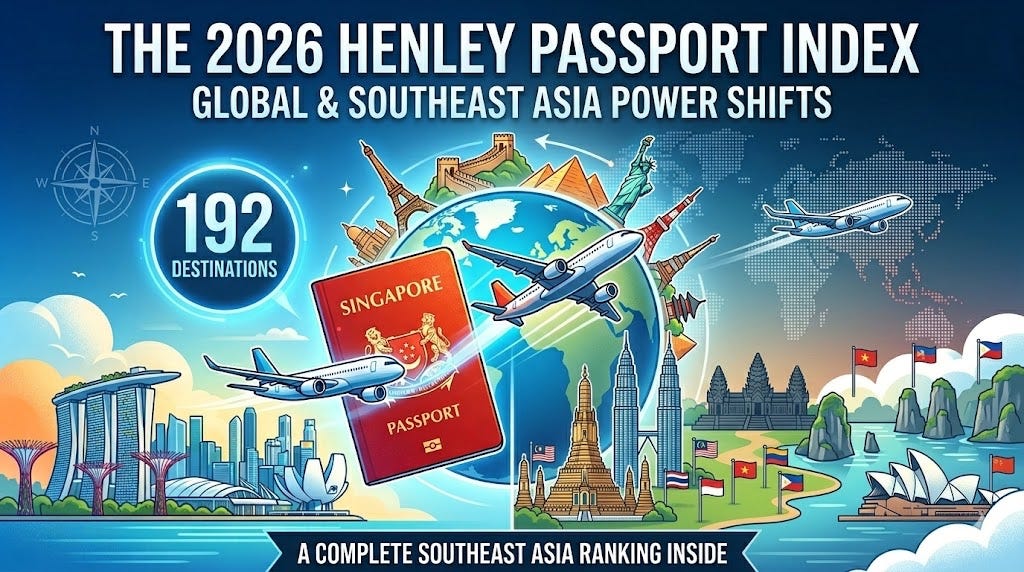
The 2026 Henley Passport Index reveals a massive “mobility chasm” within Southeast Asia. While Singapore has secured the world’s #1 spot with visa-free access to 192 countries, regional neighbours like Myanmar and Laos remain restricted to fewer than 55 destinations, highlighting a stark disparity in diplomatic influence.
🔍 Why It’s on Our Radar
Singapore isn’t just winning; it’s pulling away. It now sits four points clear of regional rivals Japan and South Korea. In Southeast Asia, the ranking creates a three-tier hierarchy: the Global Leader (Singapore), the Rising Middle (Malaysia, Brunei), and the Restricted Tier (the remaining eight nations).
⚖️ What’s at Stake
A weak passport is a tax on ambition. For citizens in the lower half of the SEA rankings, international business, tourism, and education require expensive, time-consuming visa applications. This “paperwork ceiling” arguably slows regional integration and individual economic mobility.
🌏 The Big Picture: Southeast Asia Rankings
The 2026 leaderboard for all 11 Southeast Asian nations, sorted by global standing:
1st: Singapore 🇸🇬 (192 destinations) — The undisputed global champion.
6th: Malaysia 🇲🇾 (183 destinations) — Firmly in the global elite tier.
17th: Brunei 🇧🇳 (163 destinations) — Strong, stable, and highly mobile.
49th: Timor-Leste 🇹🇱 (92 destinations) — The highest-ranked “developing” SEA nation.
59th: Thailand 🇹🇭 (76 destinations) — Middle-tier mobility with room for growth.
64th: Indonesia 🇮🇩 (73 destinations) — Lagging behind its economic G20 status.
69th: Philippines 🇵🇭 (65 destinations) — Facing significant visa barriers.
75th: Vietnam 🇻🇳 (55 destinations) — Restricted access despite rising economic clout.
76th: Cambodia 🇰🇭 (54 destinations) — Limited international reach.
79th: Laos 🇱🇦 (50 destinations) — One of the most restricted in the region.
87th: Myanmar 🇲🇲 (42 destinations) — Bottom-tier mobility due to domestic instability.
💸 The Wealth Wildcard
However, there is a caveat: the “Visa Wall” is often porous for the ultra-wealthy. While a weak passport slows down the average traveller, a heavy bank balance acts as a universal skeleton key.
Golden Visas: High-net-worth individuals from Indonesia or Vietnam can essentially “buy” mobility through investment programmes in Europe or the Caribbean.
Financial Proof: Embassies are notoriously more lenient when a bank statement shows significant liquidity; for the elite, a visa is a mere administrative formality rather than a barrier.
💡 Why This Hits Home
The “ASEAN way” promotes regional unity, but your birth certificate still dictates your freedom. A Malaysian can visit London or Paris on a whim; a Vietnamese or Filipino professional often faces a significant visa rejection rate for the same trip—unless they have the capital to bypass the queue.
📍 The Regional Stakes
The Outlier: Singapore’s dominance is historic. It is the only nation in the region with “frictionless” access to nearly 85% of the globe.
The Growth Gap: Indonesia, despite its massive regional influence, ranks 64th. Its passport strength hasn’t kept pace with its economic growth.
The Conflict Cost: Myanmar remains the lowest in the region, a direct reflection of domestic instability.
🔚 The Bottom Line
Southeast Asia is a region of two speeds. While Singapore, Malaysia, and Brunei enjoy “Western-level” mobility, the majority of the region remains locked behind visa walls—at least for those without the financial means to pay their way through them.
(ZIL/VBD/ELS)