



🎯 The Main Takeaway
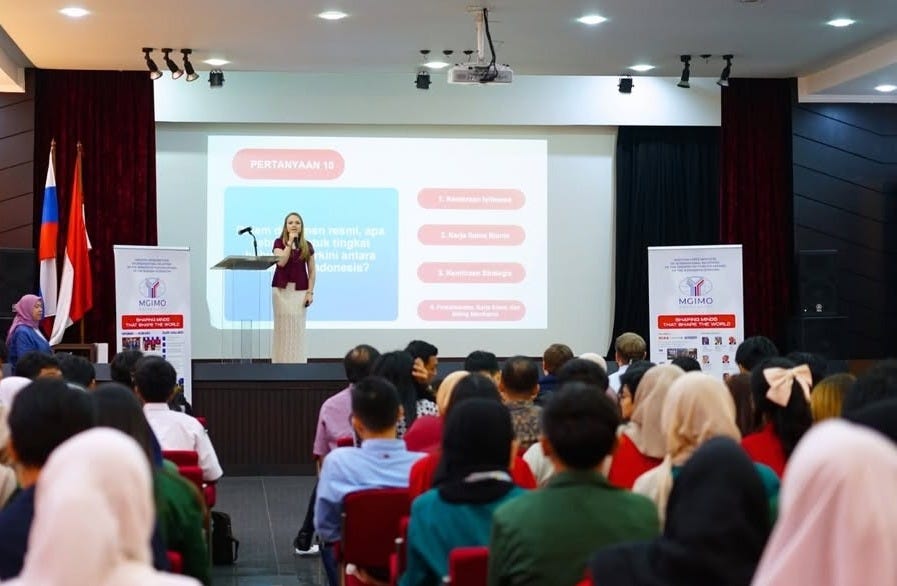
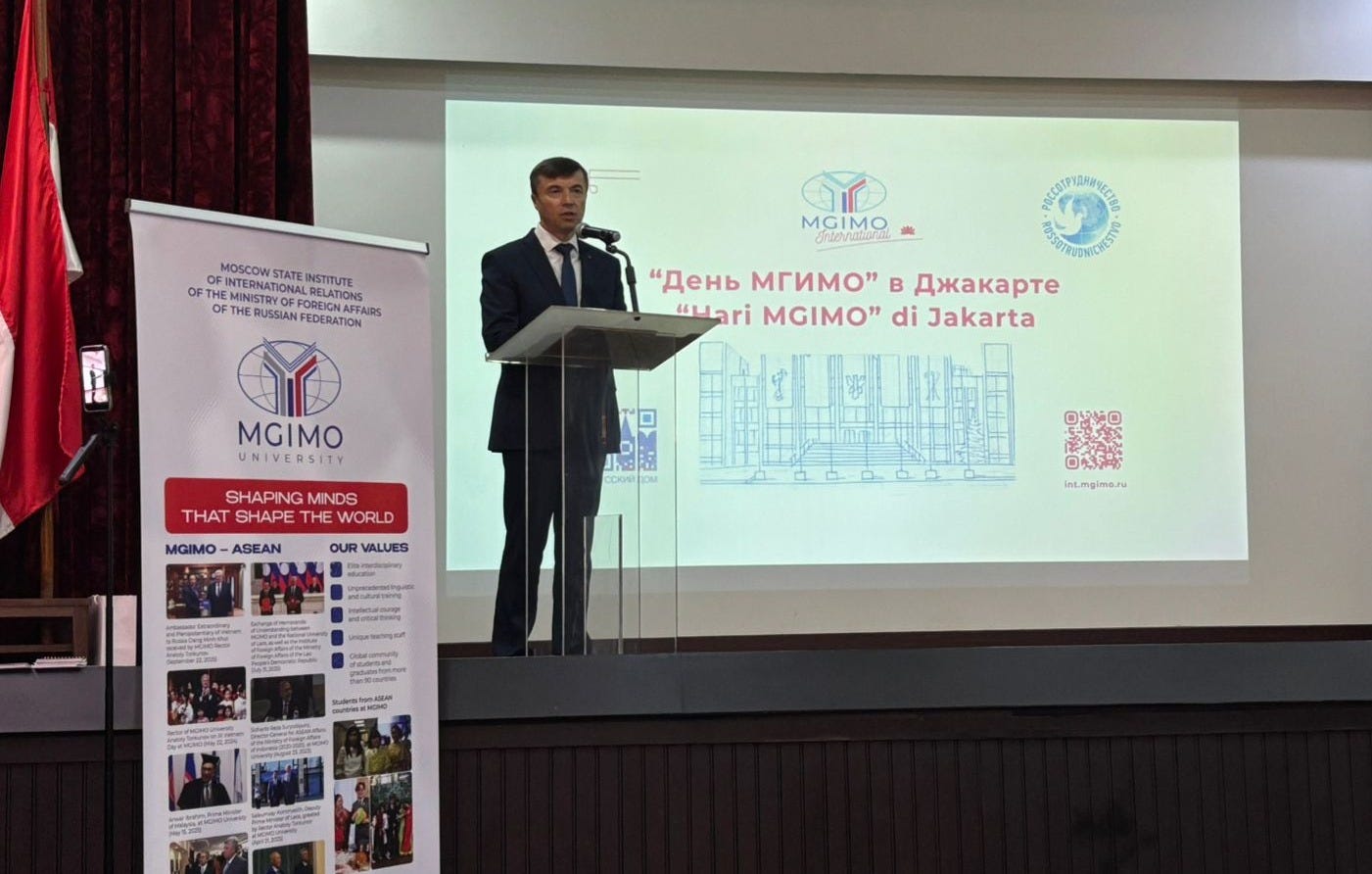
On Monday, 2 February 2026, the Day of the Moscow State Institute of International Relations (MGIMO) was held at the Russian House in Jakarta, offering a concrete snapshot of how Indonesia–Russia educational ties are evolving on the ground.
The event drew around 150 participants, many of whom are actively considering studying in Russia or pursuing careers in international relations.
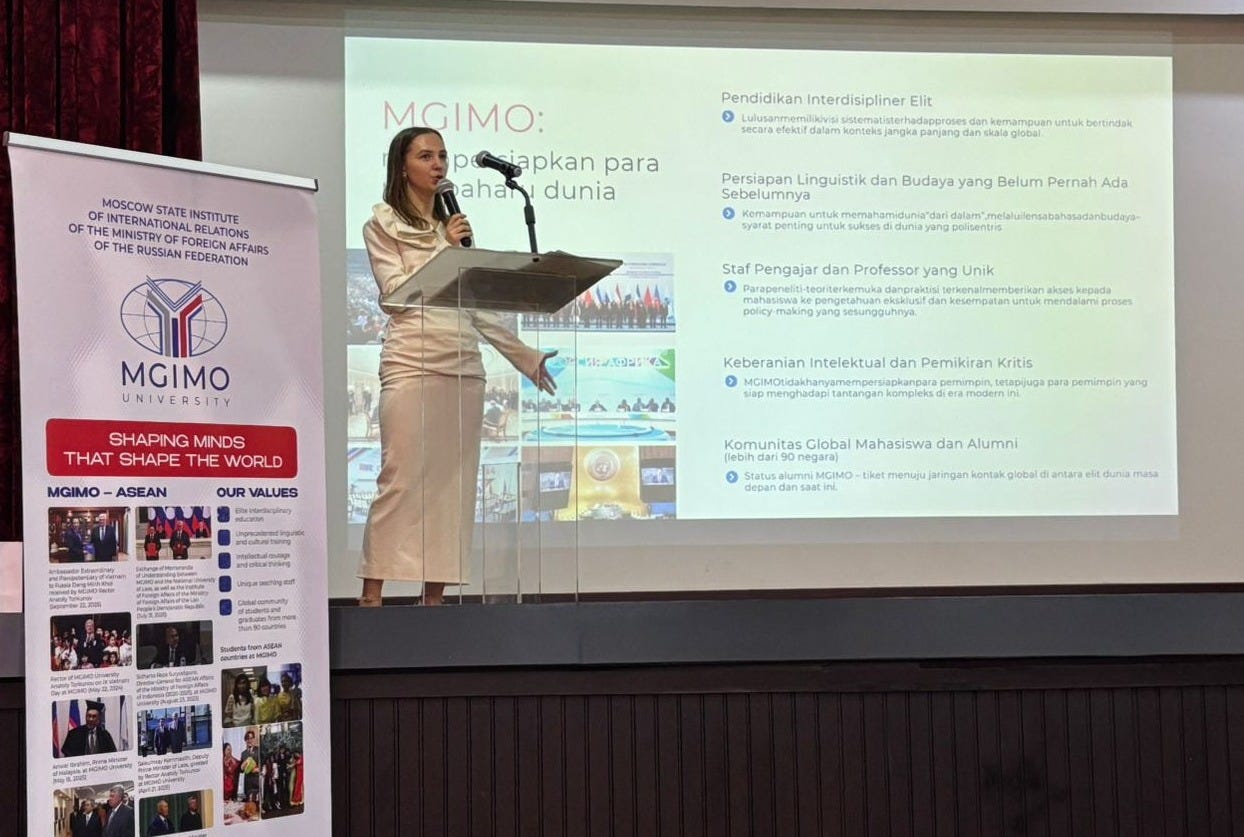
During MGIMO Day, participants were introduced to the university’s academic programs, admission pathways, and training opportunities for foreign students, as well as the professional prospects available to MGIMO graduates.
⚠️ Why It Matters
Education cooperation between states is never neutral. It directly shapes:
🎓 Human capital development and elite formation
🌍 Foreign policy orientation and diplomatic culture
🗣️ Language mastery as a diplomatic tool
🤝 People-to-people diplomacy beyond formal state channels
For Indonesia, sending students to globally connected institutions like MGIMO means cultivating future officials who understand Eurasian politics from the inside — not just through Western lenses.
For Russia, education strengthens long-term engagement in Southeast Asia by embedding familiarity, trust, and networks across generations.
🔍 Why It’s on Our Radar
👤 Sergey Gennadievich Tolchenov, Russia’s Ambassador to Indonesia since 2024, is himself an MGIMO alumnus — a living example of how education and diplomacy intersect.
🗣️ In recent remarks, Tolchenov emphasized that Russia–Indonesia relations are a strategic partnership, and education is one of its most critical sectors.
🌉 Academic opportunities, he noted, do more than produce graduates — they build diplomatic bridges between societies.
🎓 Currently, Indonesian students are studying at MGIMO, with the expectation that applicants master at least two foreign languages — reinforcing education as a pathway to professional diplomacy.
💡 Key Highlight: MGIMO as a Diplomatic Institution
MGIMO (Moscow State Institute of International Relations) is not a conventional university.
🏛️ Founded in 1944, MGIMO began as a diplomatic school and has evolved into a multidisciplinary public university, focusing on international relations, political science, law, economics, and global studies.
🏢 The university operates under the Russian Ministry of Foreign Affairs, while retaining its status as a public academic institution — blending statecraft with scholarship.
🌍 MGIMO is widely described as the “Harvard of Russia”, reflecting its elite status and influential alumni network.
🗣️ It also holds a Guinness World Record for the number of foreign languages taught — 56 languages, including Bahasa Indonesia.
📜 Indonesia’s own former president, Megawati Soekarnoputri, received an honorary doctorate from MGIMO — highlighting long-standing ties between the university and Indonesia.
🌏 Expanding Access: MGIMO and the Global South
MGIMO is actively widening its international recruitment pipeline.
🎓 Through the MGIMO International School Olympiad, high school students can compete for tuition-free admission into MGIMO’s bachelor programs, taught in either Russian or English.
📚 Over the past three years, more than 7,000 students have participated, with many successfully enrolling.
🌐 The Olympiad tests:
Language proficiency
Knowledge of world history
Geography
International relations
📅 Importantly, MGIMO has signaled plans to expand outreach to ASEAN countries in the coming academic cycles — opening a new window for Southeast Asian students.
🤝 A Structural Shift: Mutual Recognition of Degrees
Beyond campus showpieces, Indonesia and Russia have taken a decisive institutional step.
🇷🇺🤝🇮🇩 Both governments have signed an intergovernmental agreement on the mutual recognition of education, qualifications, and academic degrees.
📜 This means Indonesian graduates from Russian universities no longer face lengthy equivalency procedures at home.
🧠 For students, this removes a major structural barrier.
🏗️ For the state, it ensures foreign-educated graduates can directly contribute to national development.
Russian officials have framed this as a commitment to training specialists aligned with Indonesia’s development needs, while Indonesian policymakers view returnees as strategic national assets.
🗺️ The Bigger Picture
What we’re seeing is not isolated cooperation, but a long-term education–diplomacy ecosystem built on:
🎓 Elite academic institutions
🗣️ Linguistic and cultural immersion
📜 Legal frameworks for degree recognition
🤝 Alumni networks embedded in diplomacy
Education becomes a form of soft power with durability — slower than headlines, but far more lasting.
❤️ Why This Hits Home
🇮🇩 For Indonesia, MGIMO represents access to non-Western diplomatic traditions, Eurasian geopolitics, and multilingual global engagement.
🇷🇺 For Russia, it reinforces Indonesia’s role as a key partner in Southeast Asia — not just economically or politically, but intellectually.
🌏 For students, it reframes studying abroad as statecraft in motion, not merely personal advancement.
🔮 The Bottom Line
Indonesia–Russia educational cooperation is no longer just about sending students overseas. It is about shaping how future leaders think, negotiate, and position Indonesia in a multipolar world.
MGIMO is not simply a university in this story — it is a diplomatic infrastructure, quietly producing the human links that formal agreements alone cannot sustain. The real question now isn’t whether education matters in diplomacy — but how intentionally Indonesia chooses to use it.
(JUN/BRZ/DEV/FRD)