



🪶 The Main Takeaway
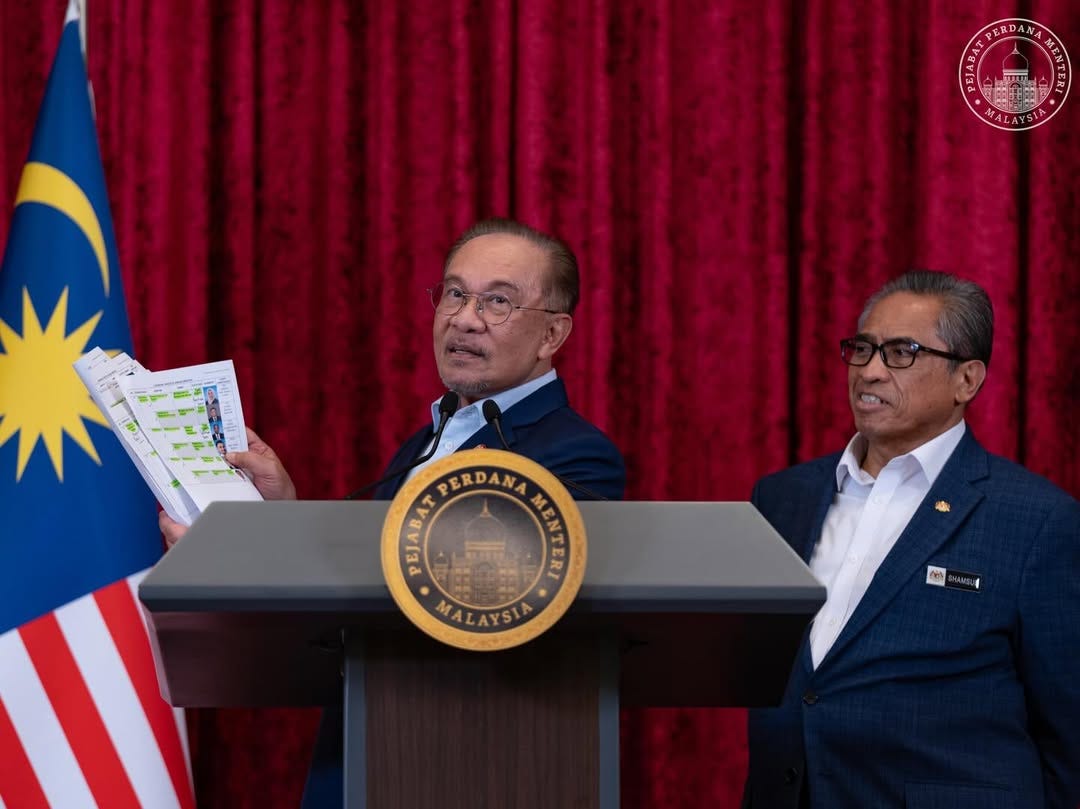
Malaysia’s Prime Minister Anwar Ibrahim reshuffled more than 25 Cabinet positions, filling key vacancies and reassigning ministers to stabilize his administration less than two years before the next general election due by February 2028.
Despite earlier assurances that no major reshuffle was planned, mounting vacancies and political pressure forced a recalibration aimed at economic delivery and coalition balance.
🌏 Why It’s on Our Radar
The reshuffle comes after weeks of speculation, triggered by multiple resignations and term limits—most notably the departure of former Investment, Trade and Industry Minister Tengku Zafrul Aziz.
Malaysia’s unity government, anchored by Pakatan Harapan (PH) and supported by UMNO, requires constant coalition management, especially as economic performance and public confidence remain under scrutiny.
Anwar framed the changes as a functional necessity, saying there was a need for a Cabinet that “works as a team” and focuses on economic growth and people’s problems.
⚠️ What’s at Stake
🏛️ Economic leadership reset: Johari Ghani appointed Investment, Trade, and Industry Minister; Akmal Nasir named Economy Minister.
🤝 Coalition balance: Key portfolios redistributed between PH, UMNO, DAP, and East Malaysian parties.
📉 Public trust pressure: Education Minister Fadhlina Sidek retained her role despite criticism over school safety and bullying cases.
🔄 Political turnover: Multiple ministers reassigned or dropped, including Zaliha Mustafa and Religious Affairs Minister Mohd Na’im Mokhtar.
🗳️ Limited runway: With elections due by 2028, the Cabinet has a narrow window to deliver results.
🌐 Federal–state tension: Sabah-related resignations highlight unresolved revenue-sharing disputes.
📸 The Big Picture
This reshuffle underscores how coalition governance is transforming the nature of political stability in Malaysia.
Rather than sweeping reform, Anwar’s adjustments reflect strategic patching—filling gaps left by resignations, Senate term limits, and inter-party negotiations.
The trade-off is clear:
stability over bold reform,
continuity over disruption,
cohesion over political experimentation.
To sustain momentum, the government will need:
policy execution,
coalition discipline, and
economic credibility.
🌐 The Regional Stakes
As Southeast Asia faces slower global growth and intensifying competition for investment, Malaysia’s economic ministries—trade, economy, human resources, and entrepreneurship—are under close regional watch.
Neighboring economies are accelerating reforms, raising the stakes for Malaysia to remain competitive in trade, manufacturing, and foreign direct investment amid political constraints.
🏠 Why This Hits Home
For Malaysia, this reshuffle is less about political drama and more about delivery under pressure.
The government now faces a clear test:
Can it convert reshuffled leadership into tangible economic gains?
Maintain coalition cohesion through 2028, and
Restore public confidence amid rising social and economic concerns?
Anwar’s Cabinet now has its team—but whether it can perform at scale will determine how much political capital the government carries into the next election cycle.
Need More Angles?
CNA Malaysia PM Anwar makes sweeping Cabinet changes, including new trade and economy ministers
Reuters Malaysian PM Anwar names new trade, economy ministers in cabinet reshuffle
The Straits Times PM Anwar reshuffles Cabinet in possible last rejig before GE16, after rout in Sabah state polls
(CCL/QOB)