



🎯 The Main Takeaway
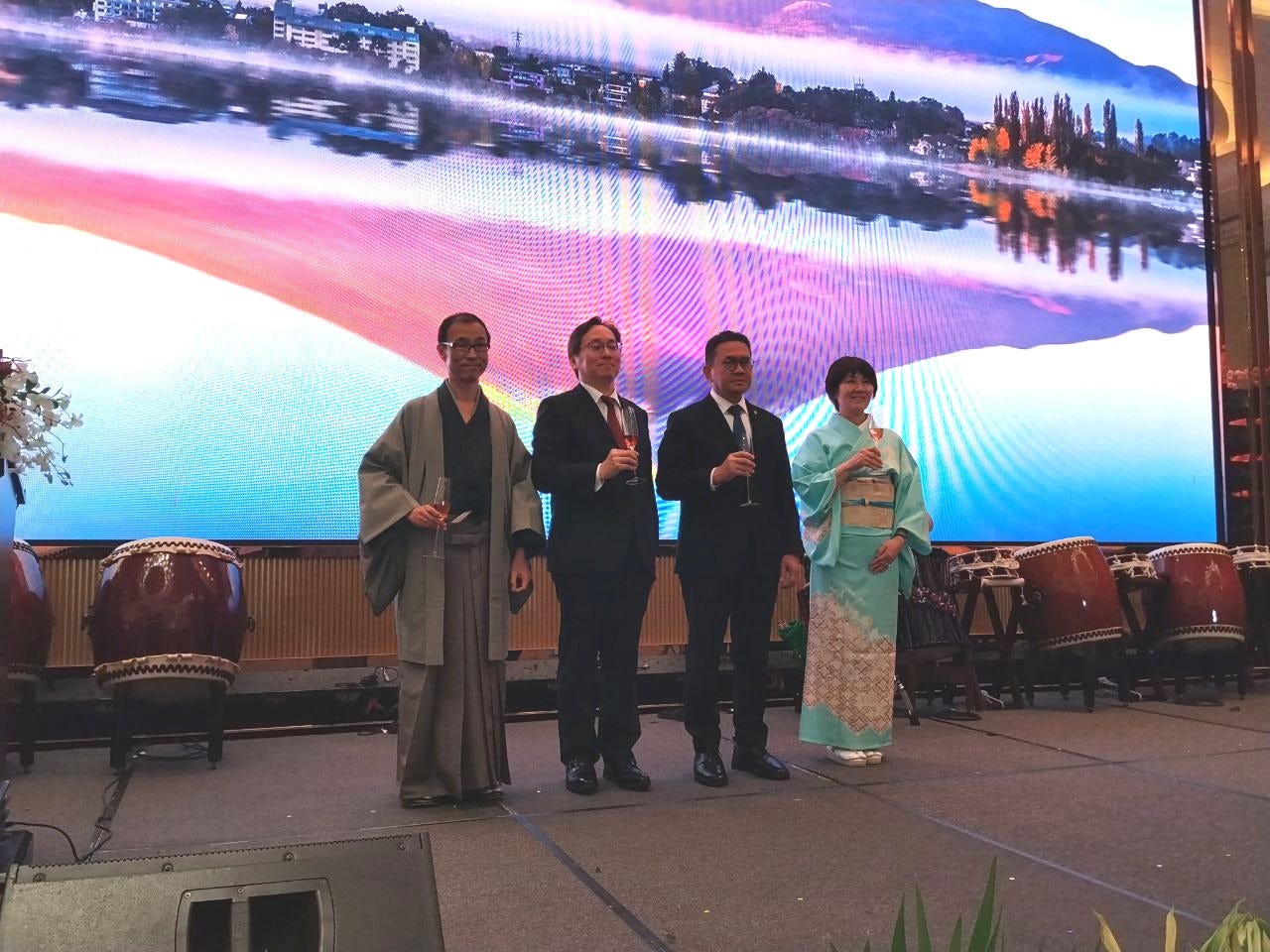
Japan’s Chargé d’Affaires ad interim to Indonesia, Myochin Mitsuru, reaffirmed Tokyo’s commitment to expanding technology cooperation during Japan’s National Day reception in Jakarta (5 February 2026).
Japan has invested more than US$32 billion in Indonesia across key sectors—including large-scale infrastructure, advanced technology, and renewable energy—with new initiatives now targeting AI, semiconductors, and next-generation gas storage systems.
🚄 Japan’s Strategic Projects in Focus
🚆 MRT Expansion (ODA-backed)
Through Official Development Assistance (ODA), Japan continues to support Jakarta’s MRT development. In October 2025, PT MRT Indonesia and Sumitomo Corporation signed a contract for Package CP206, covering the design, manufacturing, and delivery of Phase 2A facilities—including eight new trainsets.🤖 AI & Semiconductor Cooperation
Japan has expressed interest in exploring collaboration in semiconductor manufacturing and artificial intelligence. Discussions remain in early stages, but signal a shift toward higher-value industrial integration.🧪 Metal Organic Framework (MOF) Technology
A standout proposal involves collaboration between Yachiyo Engineering and Indonesia’s National Research and Innovation Agency (BRIN) to develop and mass-produce MOF-based gas-storage systems, known as Cubitan.
🔬 What Is MOF — and Why It Matters
Metal Organic Frameworks (MOFs) are ultra-porous crystalline materials composed of metal nodes linked by organic ligands.
Developed by Kitagawa Susumu, recipient of the 2025 Nobel Prize in Chemistry, MOFs offer:
🧬 Extremely high surface area for gas storage
⚙️ Customizable pore structures for industrial applications
🧊 Nanoscale cube-shaped particles containing trillions of channels
⛽ Higher gas storage efficiency than conventional LPG
The proposed Cubitan system can store 12 kg of gas at 40 bar pressure—significantly higher than traditional LPG storage capacity.
🚀 The Next Step
🇮🇩 Indonesia would become the first country outside Japan to implement Kitagawa’s MOF technology.
🏭 Yachiyo Engineering plans potential mass production in Indonesia.
🤝 BRIN and Kitagawa are exploring joint development of MOF-based gas cylinders—especially for areas without pipeline access.
🔍 Why It’s on Our Radar
Japan–Indonesia technological cooperation is not new. Anchored in ODA programs through JICA since the 1970s, the relationship has evolved from infrastructure reconstruction to deep industrial integration.
But this phase is different.
The shift toward AI, semiconductors, and advanced materials reflects Indonesia’s ambition to move up the value chain, while Japan diversifies its supply chains amid global geopolitical uncertainty.
Energy is another strategic layer:
🔥 Indonesia holds 41.62 trillion cubic feet of natural gas reserves.
🌍 It ranks as the 11th largest natural gas producer globally (2025).
🚧 Yet its 13,000 km pipeline network remains concentrated in Java and Sumatra—leaving eastern Indonesia underserved.
MOF-based storage could provide a decentralized solution that bridges infrastructure gaps without massive pipeline expansion.
🌏 The Bigger Picture
This is not simply about bilateral goodwill. It reflects a recalibration of Japan’s role in Southeast Asia, shifting from an infrastructure financier to a technology co-developer.
For Indonesia, the equation is clear: advanced technology partnerships are no longer optional—they are foundational to industrial upgrading and energy resilience.
If implemented successfully, MOF collaboration and semiconductor talks could signal the beginning of a deeper Indonesia–Japan strategic technology corridor.
🔎Need More Angles?
Japan Times Gas container using Nobel Prize winner’s technology draws attention
JICA Indonesia’s Development and Japan’s Cooperation: Building the Future Based on Trust
Sumitomo Corporation Rolling Stock Order Received for the Jakarta Mass Rapid Transit (MRT) North-South Line Phase 2A
(ERN/QOB)