



🎯 The Main Takeaway
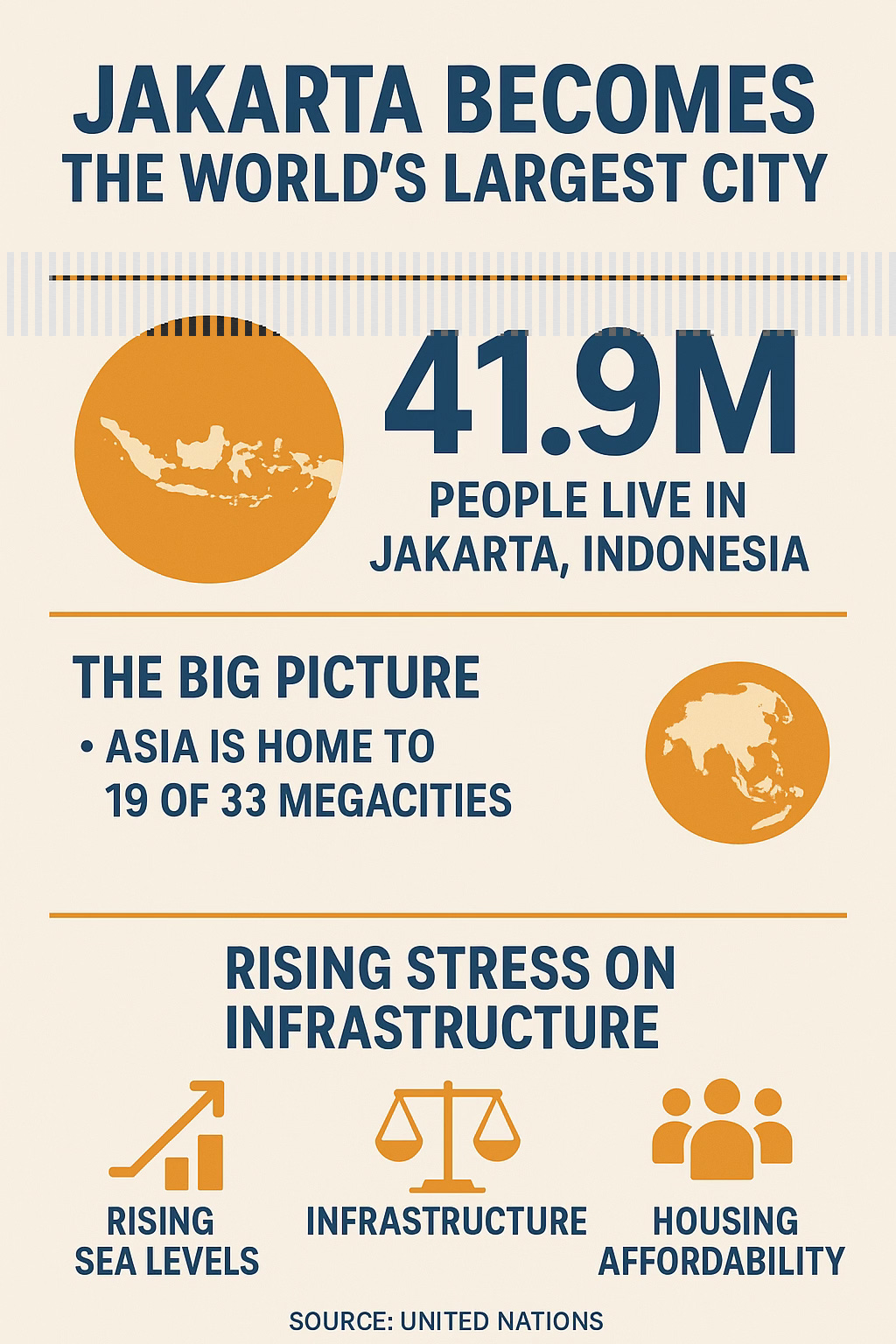
Jakarta has officially become the world’s largest city, home to 41.9 million people, overtaking Tokyo for the first time in 25 years.
The UN’s World Urbanization Prospects 2025 reveals more than just a new ranking — it signals how Asia’s megacities are reshaping global demographics, climate vulnerability, and the future of urban life.
Asia now hosts 9 of the world’s top 10 megacities, marking the region as the center of global urban expansion.
🔍 Why It’s on Our Radar
According to the UN report:
Dhaka jumps from 9th to 2nd place with 36.6 million people — and is projected to become No. 1 by 2050.
Tokyo, long the global giant, falls to 3rd place with 33.4 million.
The number of global megacities has quadrupled from 8 in 1975 to 33 in 2025.
The new ranking uses updated “contiguous agglomeration” measurements, designed to reflect real density and expansion more accurately.
This surge isn’t driven only by economic opportunity — climate displacement, rural migration, and affordability crises are pushing millions into major Asian cities.
⚖️ What’s at Stake
Jakarta and Dhaka are experiencing urban growth under intense pressure:
Rising sea levels may submerge up to 25% of Jakarta by 2050.
Land subsidence continues faster than global averages.
Inequality and affordability issues have triggered protests from low-income workers, including ojek and delivery riders.
Dhaka faces similar challenges, intensified by climate-driven migration from flood-prone rural regions.
Urban expansion in Asia is colliding with environmental instability — and millions are caught in the middle.
🌏 The Big Picture
Asia dominates the global megacity landscape:
19 of the world’s 33 megacities are in Asia.
Cities in the top 10 include:
Jakarta — 41.9M
Dhaka — 36.6M
Tokyo — 33.4M
New Delhi — 30.2M
Shanghai — 29.6M
Guangzhou — 27.6M
Manila — 24.7M
Kolkata — 22.5M
Seoul — 22.5M
Cairo (32M) is the only non-Asian city in the top 10.
This is not just population growth — it’s a transformation of how cities expand, merge, and adapt to global pressures.
🏠 Why This Hits Home
For Indonesians, this is a lived experience:
Flooding and coastal erosion worsen every year.
Infrastructure is pushed to the breaking point.
The cost of living rises while wages stagnate.
A new capital — Nusantara in East Kalimantan — is being built to relieve Jakarta’s burden.
But the UN projects that Jakarta will still gain 10 million more residents by 2050.
The city is not emptying. It’s growing — even without being the capital.
🌏 The Regional Stakes
Jakarta is not alone — major Southeast Asian capitals are navigating their own urban challenges and growth patterns:
Manila (24.7M — Top 10 Megacity)
One of the fastest-growing megacities, driven by high density and economic centralization.
Faces similar climate threats, including flooding and coastal erosion.
Bangkok (~11M)
A major ASEAN hub with severe congestion, pollution, and housing pressures.
Highly vulnerable to flooding due to its low elevation and river delta location.
Kuala Lumpur (~8M in Greater Klang Valley)
Urban region expanding rapidly but still below megacity scale.
Infrastructure strength is higher than peers, but affordability gaps and sprawl persist.
Singapore (5.9M)
Not a megacity in population size, but one of the world’s densest and most urbanized capitals.
Known for long-term urban planning, yet faces rising climate-driven risks and limited land.
What This Means for the Region
Southeast Asia sits at the heart of global urban transformation.
Cities like Jakarta and Manila become megacities by necessity — fueled by migration, economic gravity, and climate instability.
Cities like Singapore, Kuala Lumpur, and Bangkok grow differently — slower, more controlled, but not immune to climate stress.
Together, these capitals reveal how diverse — and fragile — Southeast Asia’s urban future is.
📉 The Bottom Line
Jakarta might now be the world’s largest city — but that title comes with both pride and peril.
The UN report makes one thing clear:
Urban growth is inevitable, but the future of Asia’s megacities will depend on how they confront climate change, inequality, and infrastructure collapse. What Jakarta faces today is a preview of the world’s urban future.
📐 Need More Angles?
The Guardian Jakarta overtakes Tokyo as world’s most populous city, according to UN
Travel And Leisure Asia This Asian City Is Now Officially The World’s Largest (Tokyo Is Third
(ZIL/VBD/QOB)