




President Prabowo Subianto has entered office with an ambitious vision of a stronger, more interventionist, and more socially responsive Indonesian state.
Among his most prominent policies are the Makan Bergizi Gratis (MBG) program and the development of Koperasi Desa/Kelurahan Merah Putih (Kopdes Merah Putih).
Both policies respond to genuine structural problems. MBG seeks to improve nutrition and human capital, while Kopdes Merah Putih aims to strengthen village economies, improve market access, and increase community participation in economic development.
Their political appeal is therefore understandable. Yet the ultimate test of these policies will not be the attractiveness of their objectives, the size of their budgets, or the number of facilities established. It will be their implementation.
A government can announce an ambitious program, allocate substantial resources, and establish impressive targets, but public policy succeeds only when citizens experience tangible improvements in their everyday lives.
For the Prabowo administration, the central question is consequently not whether its flagship programs are popular, but whether the state possesses the administrative, technological, and institutional capacity to deliver them effectively.
Makan Bergizi Gratis (Free Nutritious Meals, MBG)
MBG represents the clearest test of this implementation challenge. The program is unprecedented in scale and seeks to reach millions of Indonesian children and other priority beneficiaries.
Its objectives are highly consequential: improving nutrition, reducing food insecurity, strengthening human capital, and potentially stimulating local agricultural production. However, the number of meals distributed should not become the primary measure of success.
A program can achieve extensive coverage while still producing poor outcomes if meals fail to meet nutritional standards, food-safety controls are inadequate, procurement is inefficient, or the most vulnerable communities remain underserved.
The government therefore needs to shift from a coverage-driven model to an outcome-driven approach in which nutritional improvement, food safety, targeting accuracy, fiscal efficiency, and local economic impact become central performance indicators.
Implementation must be judged by whether children are healthier and whether public expenditure generates measurable nutritional and social value.
Proposed Reform: Digital Food Subsidy
A further improvement would be to expand MBG’s conceptual scope beyond the physical distribution of free meals.
A child may receive a nutritious meal at school while the child’s household continues to struggle to afford rice, eggs, vegetables, milk, and other essential food products.
This suggests the need for a complementary policy: a Digital Food Subsidy for People Affected by Food Crises.
Rather than requiring the state to distribute every subsidised food item physically, eligible households could receive targeted purchasing power via their National Identity Number (NIK) or a government-issued Food Card.
Eligibility could be determined by household income, vulnerability, family composition, regional food price conditions, and exposure to food insecurity.
This would shift the government’s role from simply delivering food to ensuring vulnerable citizens have the purchasing power to obtain it.
The proposed digital subsidy could operate through an integrated national food-security platform connecting citizens, government databases, banks, and the country’s diverse food-retail ecosystem.
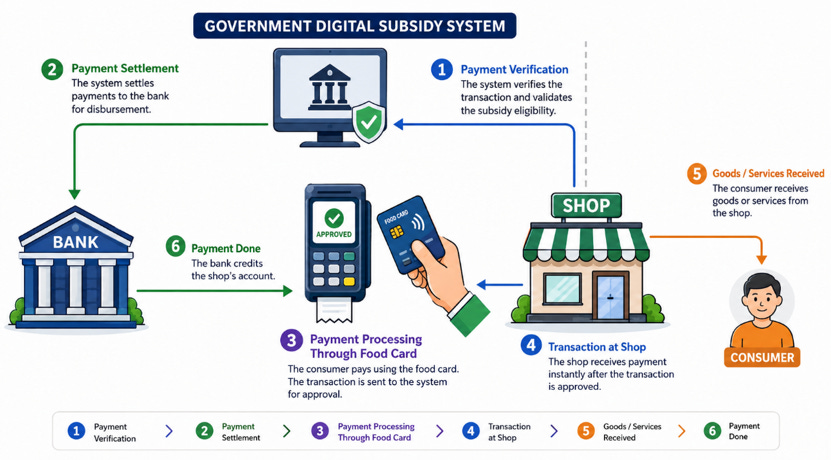
Accredited malls, supermarkets, minimarkets, utility stores, traditional markets, village shops, cooperatives, and small food stores could participate.
A citizen would present a Food Card or use an approved NIK-based identification mechanism when purchasing eligible food products.
The transaction would be checked against the government’s central eligibility system, which would determine whether the individual or household qualifies for a subsidy, the applicable subsidy rate, and the remaining balance or entitlement.
Once eligibility is confirmed, the citizen would pay the non-subsidised portion, while the government subsidy would be settled through the banking system to the participating retailer.
The retailer could also receive a modest, transparent transaction incentive for providing the public service. In this model, the subsidy follows the vulnerable citizen rather than being tied to a particular government shop.
The system's effectiveness would depend on digital interoperability. Larger retailers such as Indomaret, Alfamart, supermarkets, and malls already operate sophisticated point-of-sale and inventory management systems.
Their systems could be connected to the government’s Food Subsidy Central System through standardised interfaces and secure interoperability mechanisms.
The greater challenge concerns small food stores and informal retailers that lack digital inventory systems. Excluding these businesses would create an urban and corporate bias in food assistance.
The government should therefore provide a simple Mobile Point-of-Sale system that can operate through a smartphone or government-supported device.
A small shopkeeper could use it to register eligible products, verify a customer’s subsidy status, record purchases, update inventory, and transmit transactions to the central system.
This would enable even a neighbourhood food store to participate in national food-security policy.
The proposed architecture could connect the entire food-retail ecosystem, from large malls and modern minimarkets to Kopdes Merah Putih, utility stores, traditional markets, and small village shops.
The systems do not need to be identical; they need to be interoperable. The government should therefore act as a digital platform provider rather than attempting to replace every retailer’s technology.
The Food Subsidy Central System could serve as an interoperability layer connecting eligibility, product categories, transaction verification, inventory information, and subsidy settlement.
This would create a form of digital public infrastructure through which government financing could interact with existing market infrastructure.
The state would determine eligibility, define eligible food products, finance the subsidy, establish standards, and monitor transactions, while private and cooperative retailers would provide the actual retail service.
Such a system could also make food policy more responsive to crises. Food insecurity is not static.
A household can suddenly become vulnerable following unemployment, natural disasters, inflation, supply chain disruptions, or regional food shortages.
The government should therefore develop dynamic eligibility mechanisms rather than relying exclusively on rigid annual beneficiary lists.
When a food crisis occurs in a particular region, the government could temporarily increase subsidy levels, expand eligible food categories, or activate additional beneficiaries.
When conditions improve, the government could reduce the additional assistance.
This would make the digital subsidy a counter-cyclical instrument that can respond rapidly to changing food-security conditions.
However, digitalisation must not become digital exclusion.
Physical Food Cards, assisted transactions, offline functionality, and government-supported devices should remain available for citizens with limited digital literacy, internet access, or smartphone ownership.
Kopdes Merah Putih (Red and White Rural Cooperatives, KMP)
The second major implementation challenge concerns Kopdes Merah Putih and the role of modern minimarkets.
The government has an important objective in strengthening village economies, but protecting village cooperatives from competition does not automatically make them competitive.
Established retailers such as Indomaret and Alfamart possess sophisticated procurement systems, logistics networks, inventory management, pricing strategies, digital payment systems, and professional retail expertise.
Asking newly established village cooperatives to compete with these networks without equivalent capabilities risks creating outlets that are physically present but commercially unsustainable.
The policy debate should therefore move from the question of how to restrict minimarkets toward the more constructive question of how to make village cooperatives competitive enough that consumers voluntarily choose them.
Proposed Reform: Indomaret and Alfamart as Partners Rather Than Enemies
One promising answer is a public-private partnership model involving the government, village cooperatives, and established retail companies.
Rather than treating Indomaret, Alfamart, and similar firms exclusively as competitors, the government could treat their operational capabilities as assets that can be mobilised for public purposes.
Under a “Government Space–Cooperative Ownership–Private Management” model, the government or village administration could provide suitable premises, infrastructure, and targeted subsidies.
At the same time, Kopdes Merah Putih retains local ownership and community participation.
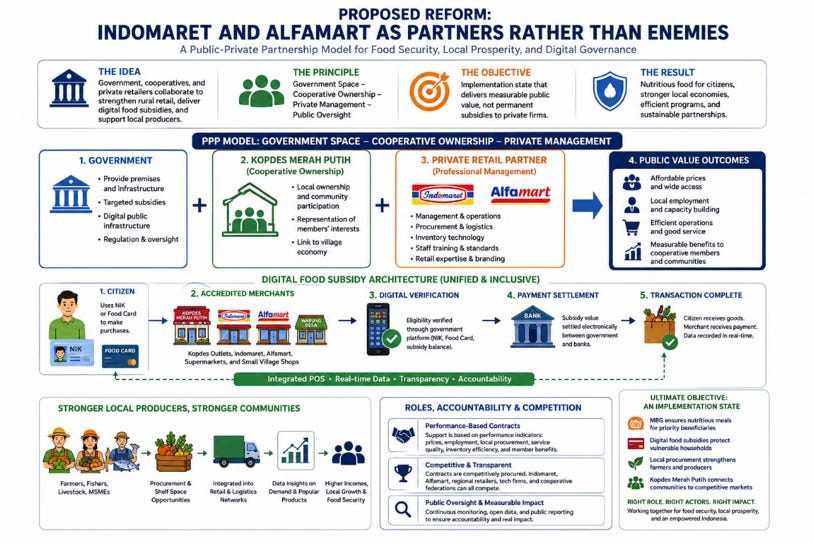
A qualified private retailer could then provide professional management, procurement, logistics, inventory technology, staff training, and operational standards. The government would not need to recreate capabilities already in the private sector; it could contract for them while maintaining public oversight.
This partnership should not become a permanent subsidy to private corporations. Government support should be performance-based, transparent, and competitively procured.
Contracts could require participating retailers to demonstrate affordable prices, local employment, local procurement, customer satisfaction, efficient inventory management, and measurable benefits to cooperative members.
Private firms should compete for contracts rather than receiving automatic access to public infrastructure. Indomaret and Alfamart could participate, but so could regional retailers, logistics companies, technology firms, and qualified cooperative federations.
The purpose should not be to create a government-supported private monopoly but to establish a competitive rural retail ecosystem in which public resources produce measurable public value.
The digital food subsidy could make this partnership even more powerful.
A Kopdes Merah Putih outlet, an Indomaret, an Alfamart, a supermarket, or a small village shop participating in the PPP ecosystem could simultaneously become an accredited food-subsidy merchant.
Large retailers could integrate their existing POS and inventory systems with the government’s central platform, while smaller businesses could receive the government’s mobile POS.
The citizen would use an NIK or Food Card, the government would verify eligibility, and the banking system would settle the subsidy electronically.
This would create a unified architecture in which public infrastructure, private operational capacity, cooperative ownership, and digital government reinforce one another.
The government would not have to build a separate physical distribution system for every welfare program.
The model could also strengthen local producers. PPP contracts and subsidy rules could require participating retailers to allocate appropriate shelf space or procurement opportunities to qualified village MSMEs, farmers, fishers, and livestock producers.
Rice, vegetables, eggs, processed foods, and other locally produced goods could therefore enter professional retail networks. The digital system could further reveal where food demand is concentrated and which products are most frequently purchased.
This would create a feedback loop linking government purchasing power, consumer demand, retailers, and local producers.
MBG could generate predictable institutional demand for nutritious food, while digital subsidies could generate household-level purchasing power.
Together, these mechanisms could form a more comprehensive food-security architecture.
The ultimate objective should therefore be an implementation state rather than simply a program-expanding state.
MBG should guarantee nutritious meals for priority beneficiaries; digital food subsidies should protect vulnerable households from food crises; local procurement should strengthen farmers and producers; and Kopdes Merah Putih should connect communities to competitive markets.
The government should provide infrastructure, regulation, targeted subsidies, digital public infrastructure, and oversight.
Private companies should contribute logistics, technology, procurement, and professional management.
Cooperatives should provide local ownership, community participation, and integration with village economies. Each actor performs the function for which it is best positioned.
Overall Evaluation Summary
President Prabowo’s flagship policies address real Indonesian problems and deserve evaluation based on their potential social value. But political popularity cannot substitute for administrative performance.
The government should publish measurable indicators covering nutritional outcomes, food safety, subsidy utilization, beneficiary targeting, food prices, retailer participation, local procurement, cooperative profitability, and the value generated by public-private partnerships.
Citizens should be able to see not simply how much money the government spends, but what that expenditure achieves.
The next stage of the Prabowo presidency should therefore focus less on announcing ambitious programs and more on perfecting their implementation.
A child who receives a safe and nutritious meal is evidence that MBG works.
A vulnerable household that can use its NIK or Food Card to purchase essential food at an accredited shop and receive a timely subsidy is evidence that digital food-security policy works.
A farmer who gains reliable market access, a cooperative that becomes commercially sustainable, and a village retail outlet that combines public infrastructure with professional private management are evidence that economic reform works.
These are the outcomes that should determine policy success.
Indonesia does not need fewer ambitions. It needs better execution.
The central lesson is therefore straightforward: implementation, not intention, is what ultimately matters. Budgets, speeches, targets, buildings, digital applications, and political narratives are only the beginning.
The real measure of President Prabowo’s most popular policies will be whether they convert public resources and political promises into healthier children, food-secure households, competitive village economies, and measurable improvements in the everyday lives of Indonesian citizens.
Muhammad Younus is a researcher in Government Affairs and Administration at Universitas Muhammadiyah Yogyakarta, Indonesia. His research interests include digital government, e-government, smart cities, public administration, digital transformation, and public policy.
Halimah Abdul Manaf is a researcher at the School of Government, College of Law, Government and International Studies, Universiti Utara Malaysia, Malaysia. Her research interests include government, public administration, governance, public policy, and institutional studies.
Estefanie R. Cortez is a researcher at the College of Political Science and Public Administration, Polytechnic University of the Philippines, Manila, Philippines. Her academic interests include political science, public administration, governance, public policy, and government institutions.
Joanne Valesca Mangindaan is a researcher in the Department of Business Administration, Faculty of Social and Political Sciences, Sam Ratulangi University, Indonesia. Her research interests include business administration, public administration, organizational studies, governance, and management.
Dian Suluh Kusuma Dewi is a researcher in the Department of Government Science at Universitas Muhammadiyah Ponorogo, Indonesia. Her research interests include government science, public administration, governance, public policy, and local government.
(QOB/ELS)