



🎯 The Main Takeaway
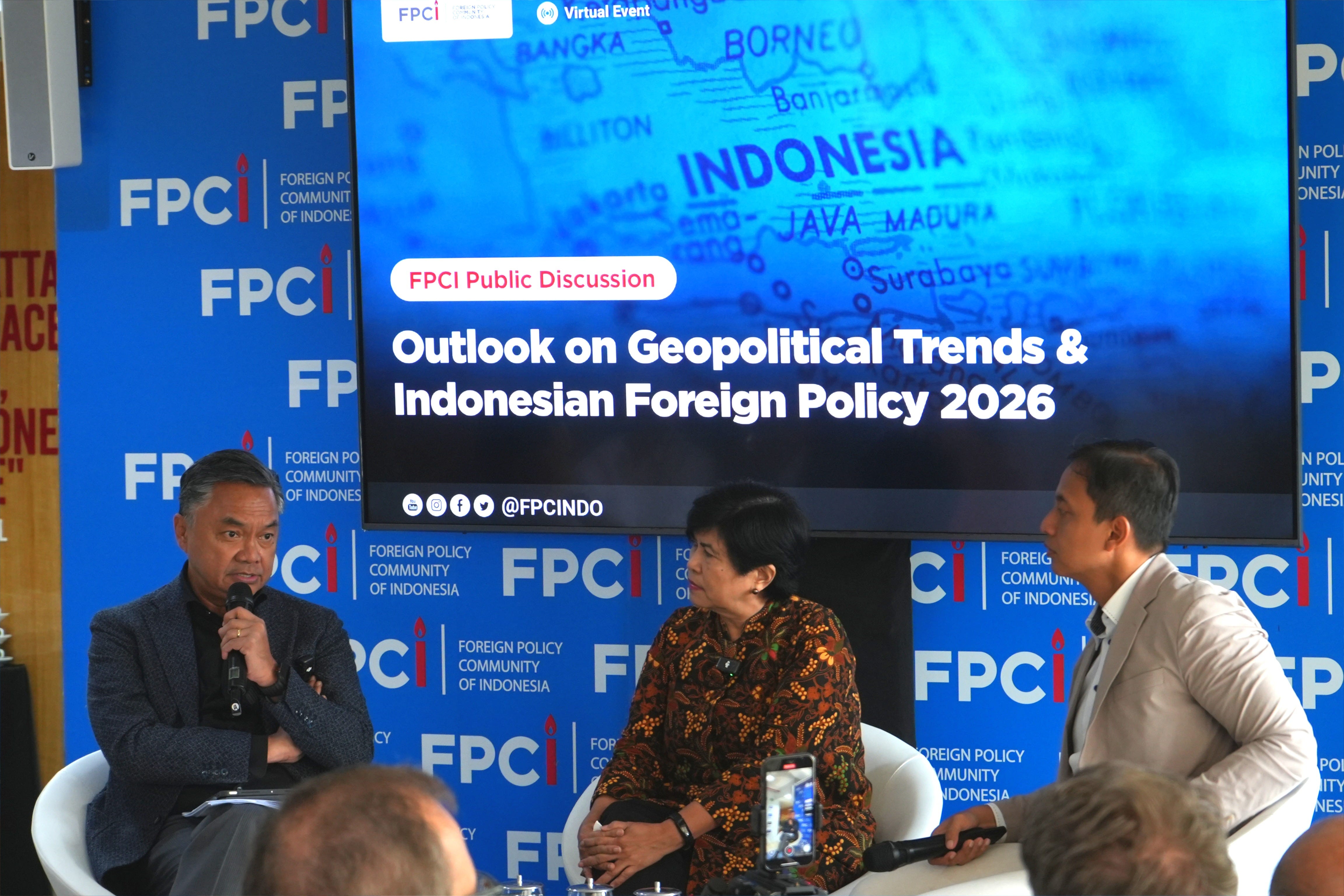
The Foreign Policy Community of Indonesia (FPCI) held a public discussion titled “Outlook on Geopolitical Trends & Indonesian Foreign Policy 2026” on Monday, 19 January 2026, bringing together experts to assess Indonesia’s strategic choices amid an increasingly fragmented and unpredictable global order.
At this FPCI’s public discussion, a clear message emerged: Indonesia is entering a harsher, ego-driven, and less predictable international order—one that demands strategic sobriety rather than diplomatic nostalgia.
The world is no longer organized primarily around rules, norms, or shared values. Instead, it is increasingly shaped by power asymmetries, leader ego, and selective respect for international law.
For Indonesia, this means foreign policy can no longer rely on comfort zones—whether excessive dependence on a single power, rhetorical multilateralism, or ASEAN-by-default.
What is required is strategic adaptation: reducing vulnerabilities, diversifying partnerships, and redefining ambition in an era where even the West is fragmented.
“Three years of U.S. foreign policy can mean decades. Its power is enormous. So we must seriously think about reducing our dependence on the United States.”
— Dr. Dino Patti Djalal, Founder & Chairman of FPCI
🇮🇩 Why This Hits Home
For Indonesia, global turbulence is no longer abstract. It directly affects economic resilience, diplomatic space, regional stability, and domestic expectations.
The discussion made clear that Indonesia cannot afford overexposure—whether to the United States, China, or any single major power. Dependency is no longer just a risk; it is a strategic liability.
“No country should be overly exposed to one major power. Overdependence—on anyone—is not good.”
— Prof. Dewi Fortuna Anwar
This resonates domestically as Indonesians increasingly expect foreign policy to deliver protection, stability, and opportunity, not just a symbolic presence on global stages.
👀 Why It’s on Our Radar
What makes this discussion notable is its rejection of two flawed assumptions:
That multilateralism will automatically protect middle powers
That raw power politics is inevitable and must be accepted without resistance
Instead, Indonesian thinkers are articulating a third position: remain inside the system, but stop being naïve about it.
“Indonesia will not entrust its national interests to a multilateralism that does not work. But neither will it surrender to a world without rules.”
This is pragmatic realism, not retreat—placing Indonesia firmly among middle powers seeking to shape outcomes without illusions of moral leverage alone.

🌏 Why This Matters
The implications extend beyond Indonesia.
The West—long the anchor of the international order—is visibly fractured. Internal divisions, policy incoherence, and leadership volatility are weakening its ability to set agendas or enforce norms.
“The most significant geopolitical event today is the fragmentation within the West.”
— Dr. Dino Patti Djalal
This creates strategic openings for middle powers and regional actors—but only for those with clarity, capacity, and coherence.
“This is the moment for middle powers and regional organizations.”
— Prof. Dewi Fortuna Anwar
Indonesia’s challenge is to convert opportunity into influence rather than merely occupying space.
🌐 The Regional Stakes
Nowhere are the consequences of global fragmentation more immediate than in Southeast Asia.
As great-power rivalry intensifies, the region risks being pulled into competing security, economic, and technological blocs—often without the ability to shape the terms of engagement.
For ASEAN, the danger is not collapse, but gradual marginalization: a loss of centrality as decisions affecting the region are increasingly made elsewhere.
“It is impossible to build regional resilience without close cooperation with neighboring countries. ASEAN is Indonesia’s home—our immediate environment.”
— Prof. Dewi Fortuna Anwar
Indonesia’s posture matters disproportionately. As ASEAN’s largest member and de facto agenda-setter, Jakarta’s diplomatic signals—attendance, initiative, and follow-through—shape how the region perceives its own cohesion.
Concerns raised during the discussion point to a credibility gap:
Missed regional summits weaken perceptions of commitment
Ambiguous leadership creates hesitation among the smaller ASEAN states
Silence on norm violations erodes ASEAN’s moral authority
“All ASEAN countries are waiting for Indonesia to provide a clear frame of reference. If you propose an idea, you bear the responsibility to initiate it.”
— Prof. Dewi Fortuna Anwar
Without consistent Indonesian leadership, ASEAN risks shifting from a rule-making hub to a passive arena—a space where external powers compete rather than cooperate.
This is not just a diplomatic issue. The erosion of ASEAN centrality would have tangible consequences:
Reduced bargaining power in trade and supply chains
Heightened security vulnerability in contested waters
Weaker collective responses to regional crises
“Convincing the region that Indonesia truly takes ASEAN seriously is one of the Prabowo administration’s biggest tasks.”
— Dr. Dino Patti Djalal
The regional stakes, therefore, are existential rather than procedural. If Indonesia retreats—intentionally or through neglect—ASEAN’s ability to buffer its members from geopolitical shock will diminish.
In a world where rules are contested and power is increasingly blunt, regional cohesion may be Southeast Asia’s last line of strategic defense.

⚠️ What’s at Stake
Nowhere are the stakes higher than in ASEAN.
ASEAN is under pressure from:
Intensifying great-power rivalry
Erosion of regional norms
Waning confidence in collective leadership
Without Indonesia’s active diplomatic leadership, ASEAN risks sliding from centrality to irrelevance.
“ASEAN is Indonesia’s home—our immediate environment.”
Missed summits, ambiguous signaling, and an outward-facing global posture have already raised concerns that Indonesia may be drifting away from its regional anchor.
“A major homework for the Prabowo administration is convincing the region that Indonesia truly takes ASEAN seriously.”
🔍 Beyond the Headlines
One of the most underappreciated insights from the discussion was the identification of ego as a new structural force in international relations.
Beyond interests and values, the leader's ego—particularly in major powers—is now shaping global outcomes in destabilizing ways.
This matters because ego-driven politics:
Undermines predictability
Weakens international law
Increases the risk of miscalculation
For countries like Indonesia, this means risk management must replace assumption-based diplomacy.
🧭 The Big Picture
Indonesia is facing a moment similar to past historical inflection points.
In previous global transitions, Indonesia responded with institution-building:
Bandung Conference (1950s)
Non-Aligned Movement (1960s)
ASEAN (late 1960s)
The open question today is whether Indonesia can once again define a new diplomatic ambition, rather than merely adjusting to global disorder.
“At every major moment, Indonesia has created something. So what is our response this time?”
The answer will determine whether Indonesia remains a rule-shaper—or slowly becomes a rule-taker in a harsher world.
🧾 The Bottom Line
The FPCI discussion revealed a sobering but necessary truth:
The international system is no longer reliable, the West is no longer unified, and leadership ego is now a strategic variable.
Indonesia’s foreign policy challenge is not about choosing sides—but about reducing vulnerability, restoring regional leadership, and defining a new level of ambition suited to an era of permanent uncertainty.
Success would position Indonesia as a credible middle power capable of navigating—and shaping—a fragmented order.
Failure would mean shrinking strategic space, a weakened ASEAN, and diplomacy reduced to symbolism in a world that increasingly rewards resilience over rhetoric.
(JUN/QOB)