



Balinese traditional gamelan is one of the cultural masterpieces of the archipelago that lives and continues to develop with its people. For Balinese, gamelan is not just a musical instrument; it is part of the soul of life.
Gamelan is present in various important moments—ranging from religious rituals, sacred dances, cultural celebrations, odalan ceremonies, to entertainment and art performances

The melody of the gamelan is so fast, tight, dynamic, and energetic. This beautiful sound is intertwined by the close cooperation between the players and the harmonization of various instruments, each of which has a special but complementary role:
Gangsa as a melody carrier.
Kendang as a tempo regulator.
Ceng-ceng as a rhythm enhancer.
Gong as a marker of the musical cycle.
The beauty of gamelan sound is intertwined due to the close cooperation between the players, which also reflects the philosophy of ‘menyama braya’ or the sense of brotherhood of the Balinese Society. Balinese gamelan is not a static art; It continues to evolve and evolve with the times and continues to live across generations.
Conservation Challenges in the Middle of the Capital City
In the midst of the rapid flow of foreign culture, the preservation of traditional culture must be the main focus. Gamelan Tantular, a Balinese Gamelan community, is present in the midst of the hustle and bustle of Jakarta’s urban life to answer this challenge.
With the spirit of caring, preserving, and making Balinese Gamelan more accessible to various groups, across ages, and professions.
Uniquely, unlike learning western music which is closely based on sheet music and block notes so that it is easy for anyone to learn, learning traditional music such as Balinese Gamelan is not based on sheet music or block notes. It requires more musical intuition, feelings, and strong memorization.
The absence of a definite (pakem), theory, or score often makes Balinese Gamelan difficult to learn by those who do not have a musical background.
So other learning media that are more relevant and easily accessible to the younger generations are needed.
Micro Learning: A Bridge to the Digital Generation
The spirit of preserving traditional arts requires adaptation to make it easier to learn and remain relevant for the younger generation.
One of the solutions is through the use of micro learning videos.
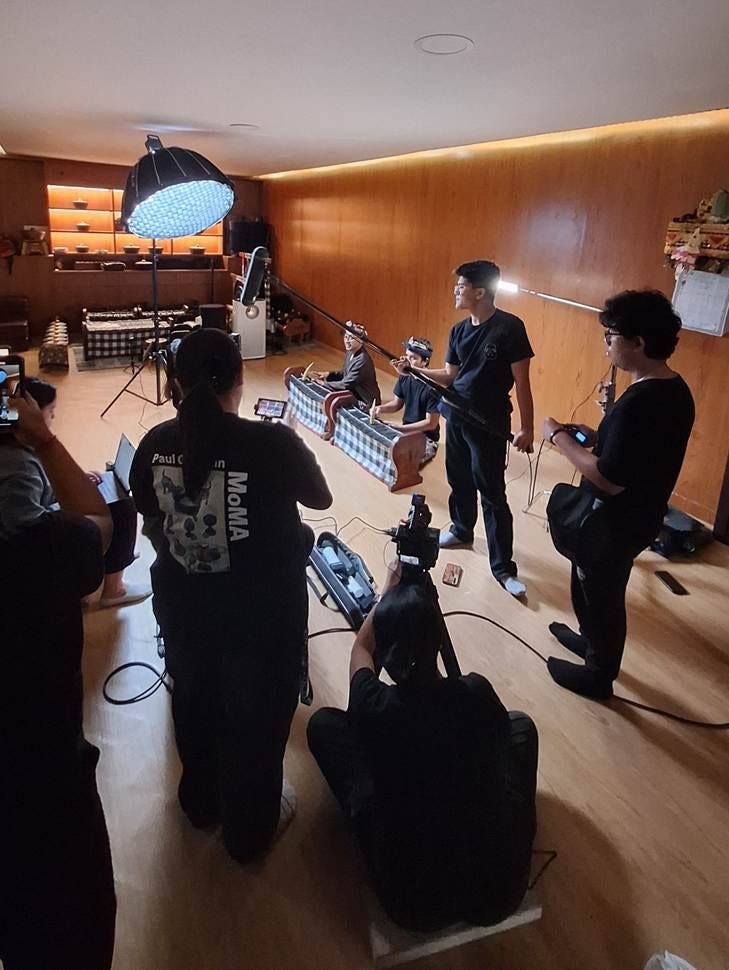
Through Program Inovasi Seni Nusantara 2025 (PISN) grant from the Directorate of Research and Community Service, Directorate General of Research and Development, Ministry of Higher Education, Science, and Technology, School of Design – BINUS University in partnership and the Gamelan Tantular community are trying to produce micro learning videos.
With the main goal of breaking down gamelan learning materials into short, focused, and easy-to-digest video pieces. With this format, learners can understand the basic techniques of playing gamelan in just a two- to three-minute video.
The advantages of this format are huge, especially since gamelan learning materials are not available in the form of written scores like pop music or Western music. With clear visuals and compact format, learners can repeat material anytime and anywhere, even just from their phones. Even though they are not present at the studio.
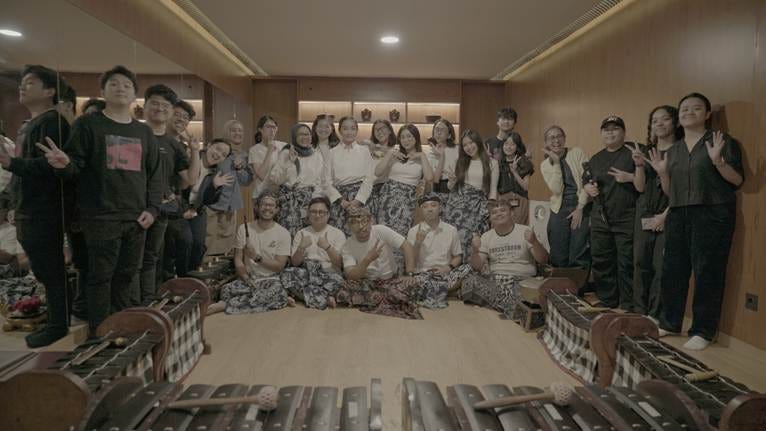
The video making process was carried out by students and lecturers at the School of Design-BINUS University with members of the Gamelan Tantular community. There are 5 micro learning videos that showed the basic techniques of playing gamelan, as well as the basic patterns of gangsa and reyong musical instruments. Another 360 videos were also created to show full set Gamelan performed by Gamelan Tantular members.
The use of micro learning not only simplifies the learning process but also proves that technology can be a bridge between ancient traditions and modern learning habits. This digital approach also helps the arts community document techniques more systematically, ensuring that traditions can be passed down in a more structured way without losing their musical essence.