




🎯 Main Takeaway
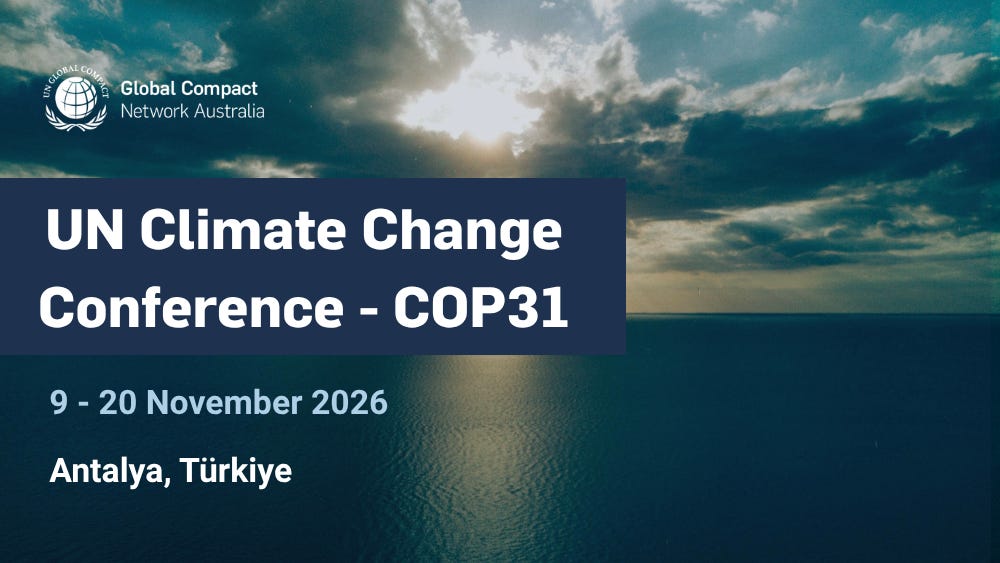
The 31st United Nations Climate Change Conference (COP31) will be held in Antalya, Turkiye, from 9 to 20 November 2026. An insight from the ASEAN Plan of Action for Energy Cooperation (APAEC) reveals how the Association of Southeast Asian Nations (ASEAN) is planning ahead of the summit.
Like many other regional associations, ASEAN under the Philippines' chairmanship is preparing a joint statement for COP31. This is signalled by ASEAN Climate Week in Taguig City from 27 April to 1 May, which was hosted by the Philippines.
The Philippines has voiced regional concern regarding ASEAN’s commitment to climate investment during UNFCCC SB64, the preparatory session of the United Nations Framework Convention on Climate Change (UNFCCC). Calling for stronger climate commitments.
📡 Why Is it on our radar?
A unified collective statement from ASEAN carries more weight at COP31 than individual Southeast Asian countries, giving the region more bargaining power at the conference.
Moreover, the joint statement would set a precedent for how Southeast Asia will face the challenge of climate change.
⚠️ Why is it important?
The joint statement will reflect the region’s shared priorities and commitments on Nationally Determined Contributions (NDCs), National Adaptation Plans, loss and damage, climate finance, and a just energy transition.
Every country that is a party to the Paris Agreement is expected to attend COP31.
Now, ASEAN must show the world it is committed to facing the many climate challenges plaguing the modern world.
🏝️ Regional Stakes
The document details how each ASEAN member is facing the issue of climate change in several different sectors, including:
⚡ Energy Climate Investment:
Cambodia: The Cambodian Sustainable Finance Initiative (CSFI), an 82.5 million USD initiative to support the energy transition, aims to integrate environmental and social safeguards into the financial sector and banking practices.
Malaysia: Efforts are underway in the public and private sectors, with the first phase of a 100 million RM (approximately 24.9 million USD) Climate Mitigation Fund launched to support small and medium-sized enterprises in decarbonising through the adoption of low-carbon practices.
Singapore: Financing Asia’s Transition Partnership (FAST-P) blended finance initiative reached two significant milestones. First, it reached a cumulative USD 800 million commitment to its green investment pillar. Second, it secured 250 million USD at its first close for its displacement energy strategy.
The Philippines: set to launch the 7th round of its Green Energy Auction (GEA-7) this year, offering renewable energy capacities across the country.
Thailand: Multiple banks nationwide are expanding sustainable lending, with Bangkok Bank launching its Bualand Green Financing programme covering renewable energy, environmental transition, energy conservation, electric mass transit, and green real estate.
🤝 Energy Climate Cooperation
Brunei Darussalam: establishing the ASEAN Centre for Climate Change, which is hosted in Brunei and funded with an initial 1.5 million USD.
Laos and Cambodia have decided to sign a joint framework agreement in Phnom Penh to launch a World Bank-funded feasibility study for a cross-border power grid between the two nations, increasing connectivity between two ASEAN members and potentially serving as an example for other members.
Indonesia: has launched the ASEAN-Korea Cooperation for Methane Mitigation project, a three-year, 20 million USD initiative targeting Indonesia’s estimated 21 million tonnes of CO2 equivalent methane emissions.
The Philippines: partnering with the European Union (EU) through the EU-Philippines Green Economy Partnership. The aim is to fund feasibility studies for a circular-economy public-private partnership of approximately 60 million USD.
Vietnam: Launching a project to mobilise investment for climate-tech startups and SMEs, targeting two different areas. In 2026, the focus will be agriculture and the circular economy, while in 2027 it will be renewable energy and transport.
🌱 Carbon and Climate Policy Advancements
Cambodia: currently striving to operationalise Article 6 of the Paris Agreement, with advancing the development of its carbon trading framework. Aiming to implement international carbon trading, develop a carbon registry, ensure transparency, and prevent double counting.
Indonesia: The government is focusing on vulnerable groups and drafting a Climate Change Law to advance inclusive, sustainable projects that protect them. Specifically, the law targets migration, vulnerable workers, women, and children.
Malaysia: The launch of the National Carbon Market Policy, part of Climate Change Policy 2.0, aims to increase Malaysia’s role in international carbon trading. It aims to regulate carbon trading and accelerate the transition to a low-carbon economy.
Thailand: The government is accelerating the development of its Climate Change Act to strengthen climate governance and support the transition to a low-carbon economy. The act would include key mechanisms for setting national net-zero emissions targets.
Timor-Leste: On June 9, Timor-Leste released its Nationally Determined Contribution 3.0 for 2026-2035, covering four sectors that affect the nation’s carbon footprint. The report includes commitments to a just transition framework.
Singapore: Ahead of its 2027 ASEAN chairmanship, Singapore has highlighted carbon markets, nature-based solutions, and climate adaptation as key priorities, with Singapore’s Ambassador for Climate Action, Ravi Menon, noting that Southeast Asia is the only major region where economic growth remains tied to rising emissions.
🏁 Bottom Line
As a region, Southeast Asia has made great strides in combating climate change and developing solutions. This includes exploring alternative energy sources, fostering cooperation between nations, and creating policies to reduce carbon emissions.
COP 31 will be an opportunity to show the world that Southeast Asia, and by extension ASEAN, is committed to discussing, negotiating, and acting on climate change.
Moreover, it’s also an opportunity for the region to show it has a consensus on this matter, as standing as a regional force would be a far greater feat than standing as individual nations.
🔎 Need More Angles?
ASEAN Climate Change and Energy Project (ACCEPT II): Strengthening the Foundation for a Just Energy Transition: ASEAN’s Development in Regional and International Climate Collaboration, Climate Investments, and Carbon Policy
(FRD/QOB)